
Cosmic Highlights
A monthly night sky guide to what’s worth capturing right now.
OCTOBER 2026
October — The Neighbours
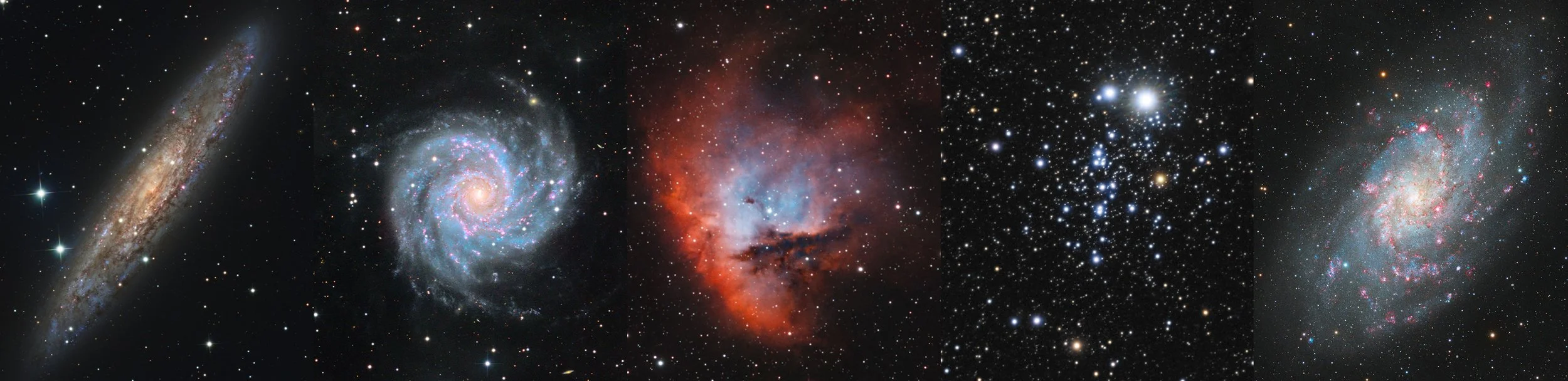
Almost everything worth photographing this month is close to home. Six of the eleven entries below are galaxies of our own neighbourhood — Andromeda with its two companions, the Triangulum Galaxy, the faint dwarf IC 1613, and the Small Magellanic Cloud, a satellite of the Milky Way itself. They are the nearest large things outside our own galaxy, and October is when they climb high enough to be worth the night.
That gives the month an unusual shape. October's list is eight galaxies out of thirteen targets, the highest proportion of any month in the catalogue, and the distances run from 200,000 light-years for the Small Magellanic Cloud out to 32 million for M74. In the north, Andromeda and Triangulum pass near the zenith around midnight, with the Pacman Nebula, the Owl Cluster and two more open clusters filling in around them. In the south, the Small Magellanic Cloud and the Sculptor Galaxy take over — and NGC 253 is the useful contrast, the nearest big galaxy that is not one of the neighbours. The New Moon falls on the 10th, and the dark run from roughly the 6th to the 14th is where the faint work belongs.
Our nearest galaxies, all up on the same nights. Not one of them needs a filter — only time.
The Night Sky at a Glance
Northern Hemisphere Sky – Midnight at New Moon (at +40° latitude)
Image from the app Stellarium
Andromeda and Triangulum ride near the zenith around midnight, which is as well placed as either gets all year, and Cassiopeia's W sits beside them carrying three of this month's clusters and the Pacman Nebula. Perseus follows them up in the east with the Little Dumbbell. Low in the south, Sculptor barely clears the horizon — the one southern showpiece the north gets a look at, and only just.
Southern Hemisphere Sky – Midnight at New Moon (at -30° latitude)
Image from the app Stellarium
The Small Magellanic Cloud stands high through the middle of the night with 47 Tucanae beside it, and Sculptor carries NGC 253 nearly overhead — the best view of it anywhere on Earth. Cetus brings IC 1613 up to a workable height, one of the few targets this month that treats both hemispheres alike. Andromeda and Triangulum stay low in the north for anyone who wants to try them.
The Best-Placed Objects This Month
These objects reach their highest point around midnight. That means better visibility, longer imaging windows, and a great chance to explore some of the best deep-sky objects.



Every night, for your sky

This page tells you what is best placed this month. TonightPlan tells you what is worth photographing tonight, from where you are actually standing, with the gear you own, under tonight's Moon and tonight's weather. It knows when your darkness starts and ends, which targets clear your horizon, and which ones the Moon has ruled out. No sign-up, nothing to install, and nothing stored about you on any server. Free, because the sky above us is for everyone.
M31, M32 & M110 — The Andromeda Group
Object type: Spiral galaxy with two elliptical companions
Constellation: Andromeda
Apparent dimensions: 190′ × 80′ (M31) · 19′ × 10′ (M110) · 9′ × 6′ (M32)
Filtering: No filter (dark skies help M110)
Recommended integration: 1–3h (M31, M32) · 3–6h (M110)
Peak month: October
Altitude at peak: Northern: High | Southern: Very low
The closest large galaxy to our own, 2.5 million light-years away — the light hitting your sensor tonight left before our species existed. The dust lane bisecting the core is real, and it comes through even from a suburban sky. M32 sits pressed against the outer disc as a tight, bright knot: a compact elliptical, one of the densest concentrations of stars known, with no gas, no dust and no star formation left in it. M110 lies on the opposite side, a softer elongated glow, and unusually for an elliptical it holds faint dust clouds of its own. Andromeda holds around a trillion stars, more than the Milky Way, and it is slowly approaching us. The Persian astronomer al-Sufi recorded it as a small cloud in 964 AD.
At 190 arcminutes on its long axis — over six Moon-widths — M31 will not fit a single frame on most setups, and a mosaic is the only way to have it whole. The core rewards modest integration; the outer arms and the blue star-forming regions along the disc reward a great deal more. M32 on its own is a featureless glow and M110 asks for real time before its dust shows, but that is not how to shoot either of them. Framed together the three make one picture, which is why they share an entry here. If you have never imaged a galaxy, start with this one.
M31, captured with a Sky-Watcher Esprit 100 at f/4.12 and an ASI2600MM Pro camera using LRGBH filters
M31, captured using a Vaonis Vespera II smart telescope by Cosmic Captures

Three galaxies in a single pointing, which is the reason to shoot the group rather than the galaxy. Spanning about six full Moons, Andromeda's long axis runs off the edge of even a wide smart-scope frame — so decide at the start whether you want the whole disc as a mosaic.
M33 — Triangulum Galaxy
Object type: Spiral galaxy
Constellation: Triangulum
Apparent dimensions: 70′ × 40′
Filtering: No filter / dark skies
Recommended integration: 3–6h
Peak month: October
Altitude at peak: Northern: High | Southern: Low
The third largest galaxy in the Local Group, about 2.8 million light-years away, though estimates run from 2.4 to 3 million. Face-on and generously proportioned, which sounds ideal until you discover that its surface brightness is notoriously low — all that size with the light spread thin across it. Give it the time and the spiral structure emerges, and the bright knots scattered across the disc turn out to be genuine HII regions, stellar nurseries on a galactic scale. NGC 604, one of the largest star-forming regions in the entire Local Group, shows as a bright patch in the northern arm. Hodierna probably saw it before 1654; Messier found it independently a century later.
A demanding target that rewards the effort, and the demand is time rather than skill. At seventy arcminutes by forty it frames comfortably in a wide field, so the difficulty is never in fitting it — it is in building enough signal that the arms lift away from the background. Three to six hours is the working range and more is better. No filter: the light here is broadband, and a narrowband filter would throw away most of what you came for.
M33, captured with a Sky-Watcher Esprit 100 at f/4.12 and an ASI2600MM Pro camera using LRGBHSO filters
M33, captured using a Vaonis Vespera II smart telescope by Cosmic Captures
The one that punishes a short session. It spans about two full Moons so it frames easily, but its light is spread thin — eight and a half hours is what lifted the pink star-forming knots clear of the haze here. Plan it across several nights rather than one.
M74 — Phantom Galaxy
Object type: Spiral galaxy
Constellation: Pisces
Apparent dimensions: 11′ × 10′
Filtering: No filter / dark skies
Recommended integration: 3–6h
Peak month: October
Altitude at peak: Northern: High | Southern: Medium
Two symmetrical arms wind outward from a warm compact core, and the blue patches scattered along them are not noise — they are active star-forming regions, lit up because that is what young stars do. M74 is often called the textbook example of a grand-design spiral. It earned the name Phantom from visual observers who struggled to see it at all, which says more about the eye than about the galaxy: photographically it gives up its structure willingly once there is enough integration behind it. Méchain found it in 1780. At 32 million light-years, every photon from those blue knots left before our earliest ancestors.
One of the most photogenic face-on spirals in the sky, and one of the smaller subjects this month at eleven arcminutes by ten. It is not bright, so this is a three-to-six-hour target rather than a quick pass, and it wants a dark sky more than it wants a filter — the light is broadband and there is nothing for narrowband to isolate. It sits high from northern latitudes and stays workable well into the south, which few of this month's targets manage.
M74, processed by Cosmic Captures from Telescope.Live image data
M74, captured using a ZWO Seestar S50 smart telescope by Cosmic Captures
A face-on spiral that gives its arms up far more easily to a sensor than to an eye. Two and a half hours under a dark sky traced both arms and the blue knots strung along them. About a third the width of the full Moon, so expect a small subject in a big field.
IC1613
Object type: Irregular dwarf galaxy
Constellation: Cetus
Apparent dimensions: 16′ × 15′
Filtering: No filter / dark skies
Recommended integration: 6–15h
Peak month: October
Altitude at peak: Northern: Medium | Southern: Medium
One of the faintest galaxies you can point a camera at — so diffuse that its glow barely rises above the background sky, which is exactly why it is a test of patience and of dark skies. IC 1613 is a dwarf irregular in our own Local Group, a couple of million light-years away, with no spiral arms and no bright core to anchor the eye. What it has instead is stars: in a deep enough exposure it dissolves into thousands of individual points, each one a sun in another galaxy. It is also a cornerstone of how we measure the universe, because its many Cepheid and other pulsating variables helped calibrate the cosmic distance ladder. Max Wolf, an early pioneer of astrophotography, found it photographically in 1906.
A few pink knots mark pockets of star formation, and they are the only structure on offer. Broadband and long integration are the only way in — six to fifteen hours, and there is no shortcut with this one. It is unusually free of interstellar dust, which is what made it so useful for distance measurement, and it is one of the very few targets this month that sits at a workable height from both hemispheres.
IC 1613, processed by Cosmic Captures from Telescope.Live image data
I have not put a smart telescope on this one. Its data suggests patience rather than a rewarding night: about half a Moon wide with no core to anchor on, and six to fifteen hours before the individual stars begin to separate. Dark skies, broadband, and no shortcuts.
NGC 253 — Sculptor Galaxy
Object type: Spiral galaxy
Constellation: Sculptor
Apparent dimensions: 27.5′ × 6.8′
Filtering: No filter
Recommended integration: 1–3h
Peak month: October
Altitude at peak: Northern: Low | Southern: High
A near-edge-on spiral seen at a beautiful tilt — about as inclined as a galaxy can be while still showing you something of its disc. The dust lanes cut clean dark stripes across the bright stretched core, and the disc shows real texture: knots of brighter regions where new stars are forming, threaded through a mottled stellar haze. This is a starburst galaxy, making new stars at a furious rate in that dusty core, and at about 11 million light-years it is one of the closest big galaxies outside our own Local Group — the nearest thing to a neighbour that is not actually one. Caroline Herschel discovered it in 1783. Its mottled disc earns it the nicknames Silver Coin and Silver Dollar.
Bright enough that you do not need to fight for it, which is unusual for a galaxy of this size. Wide enough framing keeps the full elongated form in shot, and that matters more here than it does for a round target — at twenty-eight arcminutes by seven it is a long thin shape that will waste most of a frame if you centre it square on. No filter. From southern latitudes it rides high and easy; from the north it stays low and wants a clean southern horizon.
NGC 253, processed by Cosmic Captures from Telescope.Live image data
NGC 253, captured using a ZWO Seestar S50 smart telescope by Cosmic Captures
About as wide as the full Moon but far narrower, so let it lie diagonally across the frame. The dust lanes cutting the core are the picture and they come up quickly — one of the rare bright galaxies that does not ask you to wait. No filter needed.
NGC 292 — Small Magellanic Cloud
Object type: Irregular dwarf galaxy
Constellation: Tucana
Apparent dimensions: 160′ × 100′
Filtering: No filter
Recommended integration: <1h
Peak month: October
Altitude at peak: Northern: Not visible | Southern: Medium
Not a cloud at all, but a whole galaxy — a small, irregular satellite of the Milky Way, around 200,000 light-years away and home to several hundred million stars. It is one of the most distant things the naked eye can see, a soft glow in the far southern sky that southern peoples and early seafarers navigated by for centuries, and that European explorers recorded from the 1500s. The brilliant ball at the top of this frame is a foreground bonus: the globular cluster 47 Tucanae, a Milky Way object only some 13,000 light-years away and nowhere near the Cloud itself.
The Cloud is enormous — more than five full Moons across — which makes it awkward for a smart telescope. Even where it fits the field it is a tight squeeze, and a smart scope's fixed sensor cannot be rotated to frame the long axis the way you would want. A camera lens on a tracker is the better tool here, and it needs very little: broadband, short integrations, and a dark southern sky. Nothing about this target is difficult except getting all of it into one picture.
NGC 292, processed by Cosmic Captures from Telescope.Live image data
NGC 292, captured with a 135mm lens
Not a good smart-telescope target: at about five full Moons across it overflows every fixed frame, and you cannot turn the sensor to suit its long axis. A camera lens on a tracker is the honest answer — an hour of broadband was enough here.
M76 — Little Dumbbell Nebula
Object type: Planetary nebula
Constellation: Perseus
Apparent dimensions: 3′ × 2′
Filtering: Dual / Narrowband
Recommended integration: 1–3h
Peak month: October
Altitude at peak: Northern: High | Southern: Very low
The bipolar shape is immediately obvious — two bright lobes squeezed at the centre, teal OIII emission throughout, faint reddish hydrogen at the tips. That structure is a dying star's ejected outer shell, blown outward in opposite directions by the stellar wind of the white dwarf left at the centre. Small but unmistakably resolved. Its two-lobed shape echoes the larger Dumbbell, which is where the name comes from, and it is one of the faintest objects in the whole Messier catalogue. Méchain found it in 1780. The distance is poorly constrained, but it is somewhere around 3,400 light-years.
A dual-band or LP filter makes a real difference here — the OIII signal is strong, and the filter cuts the background significantly without losing the colour contrast between the lobes and the tips. At three arcminutes by two it is the smallest target on this page by a wide margin, so the limit is resolution rather than signal: one to three hours builds it, and everything after that is about how much detail your optics can actually separate.
M76, captured using a ZWO Seestar S50 smart telescope by Cosmic Captures
Much smaller than the full Moon — one of the smallest things worth pointing at — yet three hours on a Seestar S50 resolved the two lobes and the teal shell around them. A dual-band filter is what makes it work from a suburban garden. Expect to crop hard.
NGC 281 — Pacman Nebula
Object type: Emission nebula
Constellation: Cassiopeia
Apparent dimensions: 35′ × 30′
Filtering: Dual / Narrowband
Recommended integration: 3–6h
Peak month: October
Altitude at peak: Northern: High | Southern: Horizon
The dark notch that gives the Pacman its name is a lane of cold dust cutting into the glowing gas, and it is the first thing to appear once the nebula starts to build. What lights the cloud is the small cluster sitting in the gap, IC 1590 — only a few million years old, and hot enough to make the hydrogen around it glow. Around the edges of the notch, look for little dark blobs silhouetted against the light: these are Bok globules, cold dense clumps of dust and gas, each one slowly collapsing under its own weight and some of them on their way to becoming stars. Barnard found the nebula in 1883 while sweeping the sky for comets.
At around 9,200 light-years it sits in the Perseus Arm. A dual-band filter handles it comfortably, which is what makes it a realistic suburban target rather than one that waits for a dark week. Three to six hours is the range, and the sequence is worth knowing: the notch comes first, the outer gas fills in after, and the globules along the rim are the last thing to separate.
NGC 281, captured using a DwarfLab Dwarf Mini smart telescope by Cosmic Captures
The dark mouth is the first thing to appear and the reason to keep going. Three hours with a dual-band filter brought out the notch, the cluster lighting it, and the small dark globules along the rim. A bit bigger than the full Moon, so it frames without a fight.
M103
Object type: Open cluster
Constellation: Cassiopeia
Apparent dimensions: ~6′
Filtering: No filter
Recommended integration: <1h
Peak month: October
Altitude at peak: Northern: High | Southern: Horizon
Compact and characterful. The blue-white stars are young and hot, with warm orange members scattered through, and the colour contrast is genuine — it shows well even from suburban skies. A prominent double star marks the cluster's heart, and a striking red giant sits among the members. Around 8,500 light-years away and only about 25 million years old, young enough that those orange giants are only just beginning to appear. It has a distinctive fan or arrowhead shape, and it was the last object Méchain added to the original Messier catalogue, in 1781.
Short integrations work well here — the cluster is bright enough not to need much convincing. At about six arcminutes it is small in frame and sits in a very rich Cassiopeia star field, which is doing as much work as the cluster itself, so give it room rather than filling the frame. No filter: the whole point is the star colour, and there is nothing to gain by cutting any of it out.
M103, captured using a ZWO Seestar S50 smart telescope by Cosmic Captures
An hour is enough. At about a quarter the width of the full Moon it lands small in a very busy field, and the thing to hold is the colour — the orange giant at its heart against the blue members around it. City light barely touches it.
NGC 457 — Owl Cluster
Object type: Open cluster
Constellation: Cassiopeia
Apparent dimensions: ~15′
Filtering: No filter
Recommended integration: 1–3h
Peak month: October
Altitude at peak: Northern: High | Southern: Horizon
Two bright stars sit at one end like a pair of eyes, and once you have seen the owl — or ET, depending on your generation — the rest falls into place as a body with outstretched arms. The brighter of the two eyes, Phi Cassiopeiae, may not belong to the cluster at all; it could be a foreground star that happens to line up. Behind it the cluster proper lies around 7,900 light-years away, though published estimates run from roughly 6,400 to 9,500, and it is only about 20 million years old — young enough that its heaviest stars are still burning hard and blue.
Bright, compact and forgiving, which makes it one of the few targets on this page you can attempt on a night you would otherwise write off. One to three hours is plenty. No filter, for the same reason as any cluster: the colour is the subject. The one thing to watch is the brighter eye, which will bloat long before the fainter members arrive.
NGC 457, captured using a ZWO Seestar S50 smart telescope by Cosmic Captures
The two eyes are the problem as well as the point: Phi Cassiopeiae is bright enough to bloom well before the faint members arrive, so stop stretching earlier than feels right. About half the width of the full Moon, And use no filter.
NGC 188
Object type: Open cluster
Constellation: Cepheus
Apparent dimensions: ~15′
Filtering: No filter
Recommended integration: 1–3h
Peak month: October
Altitude at peak: Northern: Medium | Southern: Not visible
One of the oldest open clusters known, some 6 to 7 billion years old — older than the Sun. Most open clusters are pulled apart within a few hundred million years by the clouds and tides of the galactic plane; this one survives because it sits far above that plane, out of the traffic. It is not bright, but it has texture: a tight swarm of faint, warm-toned stars in the middle of the frame, and the warmth is the age showing, where a young cluster runs blue. John Herschel catalogued it in 1831. It sits less than five degrees from the north celestial pole, which means it never sets from northern latitudes.
The faint members are the point, so give it time and a darker sky than a bright cluster would need. One to three hours separates the swarm from the field behind it. No filter. Its position near the pole is worth planning around rather than against — it is available every clear night of the year from the north, which makes it a good target to fall back on when something better is clouded out.
NGC 188, captured using a DwarfLab Dwarf Mini smart telescope by Cosmic Captures
A cluster older than the Sun, and it looks it — a tight swarm of warm yellow stars where most clusters run blue. Two hours on a Dwarf Mini was enough to lift them clear of the surrounding field. About half the width of the full Moon.
The main Moon Phases in October 2026
Planning your imaging sessions? The Moon plays a massive role in what we can capture.
Here’s what’s happening this month:

Last Quarter
October 3
Deep-sky imaging is best in the first half of the night, before the Moon rises.

New Moon
October 10
The darkest skies of the month. The nights around it, roughly the 6th to the 14th, are October's prime deep-sky window — and the faint half of this month's list needs all of it.

First Quarter
October 18
Deep-sky imaging is best after midnight. Strong terminator shadows make it a good evening for lunar surface detail.

Full Moon
October 26
October's full Moon is the Hunter's Moon — the one that follows the Harvest Moon, named for the weeks when the fields were clear and the game easy to spot. A night for the Moon itself, or for the bright open clusters that barely notice it.
Saturn at Opposition — October 4
Earth passes directly between Saturn and the Sun, which puts the planet at its closest and brightest for the year and keeps it above the horizon all night. It is the one night Saturn is available from dusk to dawn, and for the weeks either side of it the planet is as good as it will get until next autumn.
The rings are the reason to point at it, and how much of them you see is not a matter of equipment so much as timing: Saturn's tilt toward us changes over its 29-year orbit, and we are on the opening side of the cycle after the rings appeared edge-on in 2025. They are widening again, a little more each year.
Unlike everything else on this page, this is a target that wants short exposures and many of them rather than hours of patient integration — planetary work is a different discipline, and a bright planet under a steady sky rewards a fast frame rate far more than it rewards aperture.
Image by Cosmic Captures
The Draconids and the Orionids — October 9 and 21
Two showers this month, and neither is a spectacle — worth saying plainly, because October's reputation suggests otherwise.
The Draconids peak on the night of 9 October, and this year they get almost the best sky they can: the Moon is 3% lit, effectively absent. They are also an evening shower rather than a pre-dawn one, with the radiant highest as darkness falls, which is a rarer gift than it sounds. The catch is the rate. Under a genuinely dark sky from mid-northern latitudes, expect around five an hour — and from the southern hemisphere, nothing at all, because the radiant barely clears the horizon. The Draconids are capable of sudden outbursts and have produced spectacular ones in the past, but an ordinary year is a quiet one.
The Orionids peak on 21 October and are the more reliable of the two, from the debris of Halley's Comet. This year they run into a 78% Moon, which takes a real bite out of them — but even so, around seven an hour from a dark northern sky and five from the south, which is better than the Draconids manage on their best night. They are best after midnight, and better still once the Moon has set.
Under suburban skies, neither shower reaches more than a meteor or two an hour. Both are worth having the camera running for if you are out anyway; neither is worth a special trip.
Nightscape Opportunities
In the north, the Milky Way has swung round so the bright core is gone from the evening sky, and what is left arching overhead is the fainter outer arm through Cassiopeia and Perseus — less dramatic, but it sits high, and it holds a landscape well. October is also when aurora season is properly under way: the equinox boost to geomagnetic activity runs through October as it does through September, and the nights are long enough now to wait one out. [needs you — a personal line here if you want one]
In the south, the Small and Large Magellanic Clouds ride high through the middle of the night, and they are a nightscape subject in their own right — two satellite galaxies visible to the naked eye, needing nothing more than a fast wide lens on a tripod and a dark horizon. The southern Milky Way runs down toward the horizon through the evening, and the nights are still long enough to work properly before summer shortens them.
Image by Cosmic Captures