
Cosmic Highlights
A monthly night sky guide to what’s worth capturing right now.
APRIL 2026
April — The Heart of Galaxy Season
March opened the door. April walks you all the way in.
The winter constellations are gone. What's left is an enormous, dark window into intergalactic space — and it is full of galaxies. Canes Venatici alone holds five targets worth your time. The Virgo Cluster is still well placed. And for southern observers, the sky tips its hand completely: M83, Centaurus A, and Omega Centauri are all at their best.
There's nothing else to do this month. The sky has made the decision for you.
The Night Sky at a Glance
Northern Hemisphere Sky – Midnight at New Moon (at +40° latitude)
Image from the app Stellarium
Southern Hemisphere Sky – Midnight at New Moon (at -30° latitude)
Image from the app Stellarium
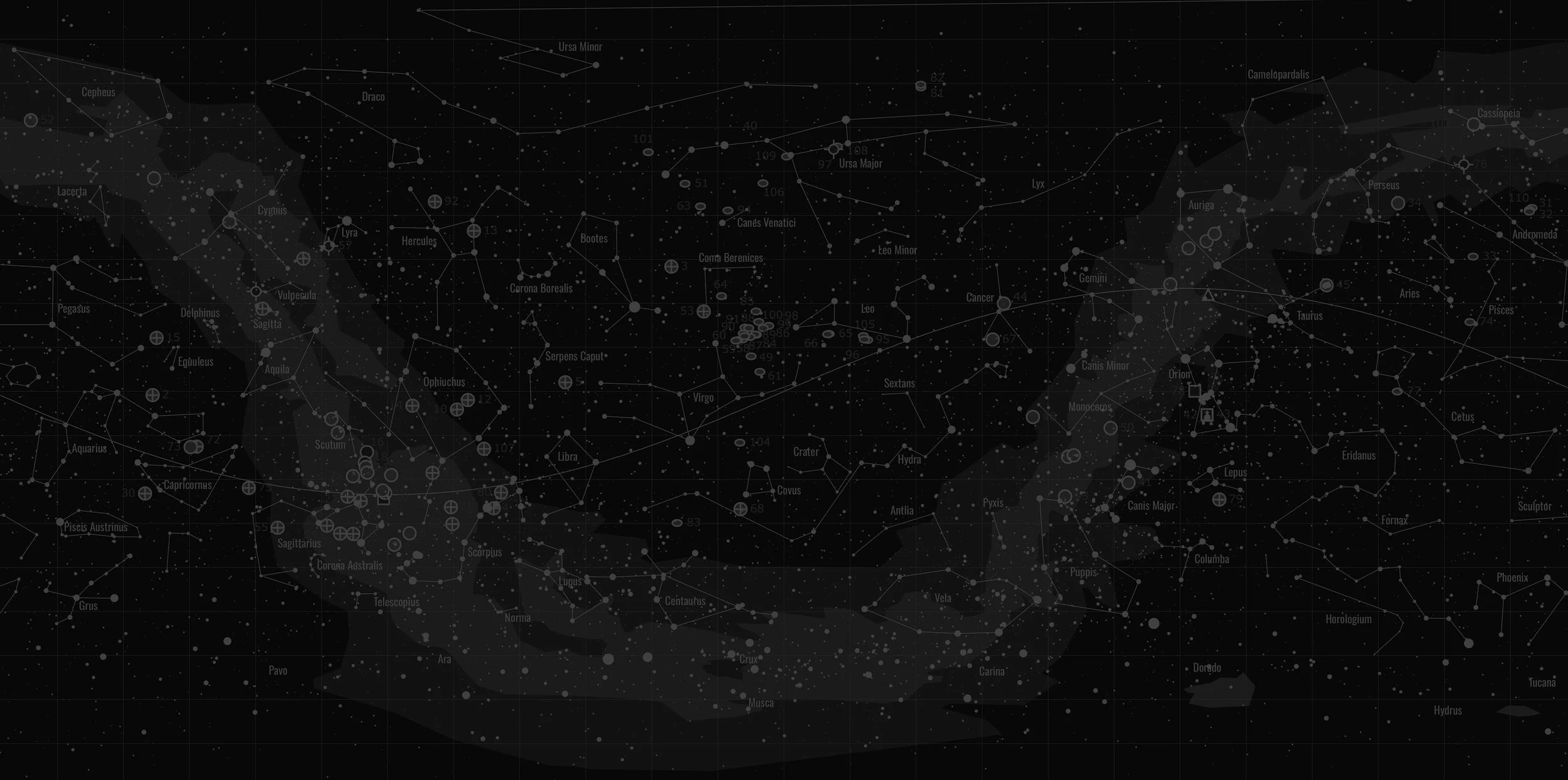
In the northern hemisphere, Leo and Virgo carry the last of the Virgo Cluster galaxies across the southern sky. Overhead, Canes Venatici and Coma Berenices are ideally placed — the heart of galaxy season. Ursa Major sits high, putting M101 near the zenith. Boötes is rising in the east.
In the southern hemisphere, Centaurus and Hydra ride high, placing Omega Centauri, Centaurus A, and M83 at their best positions of the year. The galactic centre is still a few months away, but the foundations are being laid. April is when the southern sky saves its best.
The Best-Placed Objects This Month
These objects are at their highest point in the sky around midnight. That means better visibility, longer imaging windows, and a great chance to explore some of the best deep-sky objects in the night sky.


The Cosmic Astrophotography Planner (CAP)
The Cosmic Astrophotography Planner (CAP) is a curated monthly guide to help you make the most of the night sky — with a focused selection of targets, practical framing guidance, and clear expectations for what’s realistic to capture this month.
Each CAP is built from my long-term planning system and reflects how I’m prioritising targets based on season and real-world conditions.
The free monthly overview gives you a simple snapshot of what’s available and worth focusing on right now.
M51 — Whirlpool Galaxy
Object type: Spiral galaxy
Constellation: Canes Venatici
Apparent dimensions: 11′ × 7′
Filtering: No filter
Recommended integration time: 1–3 hours +
Peak month: April
Altitude at peak: Northern hemisphere: High | Southern hemisphere: Very low
Two galaxies in the middle of a collision, frozen in a moment that will last millions of years. The smaller companion — NGC5195 — has already passed through once and is coming back around. Look at the bridge of stars connecting them. The spiral arms are being pulled out of shape by the encounter. This is not a still life. It's a slow-motion catastrophe.
M61 – Swelling Spiral Galaxy, processed by Cosmic Captures from Telescope.Live image data
M51 – Whirlpool Galaxy, captured using a ZWO SeeStar S50 smart telescope by Cosmic Captures

Smart telescope note: M51 reveals its spiral structure and the connection to NGC5195 quickly, even under a suburban sky. It's one of the most immediately rewarding galaxy targets in the spring sky — the two cores and the bridge between them are visible well before your integration is complete.
M64 — Black Eye Galaxy
Object type: Spiral galaxy
Constellation: Coma Berenices
Apparent dimensions: 11′ × 5′
Filtering: No filter
Recommended integration time: 1–3 hours +
Peak month: April
Altitude at peak: Northern hemisphere: High | Southern hemisphere: Low
That dark band isn't a processing artifact — it's a ring of dust absorbing the light from the core behind it, and it's one of the most distinctive features in the Messier catalogue. The Black Eye isn't subtle. Even on a smart telescope from a suburban sky, the asymmetry is obvious: one side sharp, one side soft. Give it a couple of hours and the outer halo starts to emerge. A target with real character.
M65, processed by Cosmic Captures from Telescope.Live image data
M64, captured using a ZWO SeeStar S50 smart telescope by Cosmic Captures
The dark band appears quickly and clearly — you'll recognise it almost immediately. One of the most satisfying galaxies to capture from a suburban sky, and one that holds up well even with modest integration time.
M94 — Croc's Eye Galaxy
Object type: Spiral galaxy
Constellation: Canes Venatici
Apparent dimensions: 11′ × 9′
Filtering: No filter
Recommended integration time: 1–3 hours +
Peak month: April
Altitude at peak: Northern hemisphere: High | Southern hemisphere: Very low
Most galaxies make you work for their structure. M94 leads with it. That bright ring surrounding the core isn't a processing halo — it's a genuine starburst ring, lit up by a wave of star formation triggered by the galaxy's own density wave. Even from a suburban sky, it shows. Compact, bright, and immediately distinctive. One of the most rewarding galaxies in the spring sky.
M94 — Croc's Eye Galaxy, captured using a ZWO SeeStar S50 smart telescope by Cosmic Captures
The starburst ring is visible surprisingly quickly — the bright core surrounded by a clearly defined halo of light is unmistakable. A compact but highly structured target that punches well above its apparent size.
M83 — Southern Pinwheel Galaxy
Object type: Spiral galaxy
Constellation: Hydra
Apparent dimensions: 13′ × 11′
Filtering: No filter
Recommended integration time: 1–3 hours +
Peak month: April
Altitude at peak: Northern hemisphere: Low | Southern hemisphere: High
One of the closest spiral galaxies in the sky — and one of the most rewarding to image. The bar structure is unmistakable, the spiral arms reach wide, and those blue star-forming knots along the arms are visible even on a smart telescope. Face-on and generous, M83 gives you everything: structure, colour, depth. From a suburban sky with a couple of hours of integration, this is as good as galaxy season gets.
M83 - Southern Pinwheel Galaxy, processed by Cosmic Captures from Telescope.Live image data
M83, captured using a ZWO SeeStar S50 smart telescope by Cosmic Captures
For southern observers, M83 is a standout — the bar and spiral arms show up quickly and clearly, with colour visible across the disk. Northern observers can still capture it low on the horizon, but altitude makes a significant difference here. If you're south of about 35°N, make this a priority.
M3
Object type: Globular cluster
Constellation: Canes Venatici
Apparent dimensions: 18′
Filtering: No filter
Recommended integration time: 1–3 hours +
Peak month: April
Altitude at peak: Northern hemisphere: High | Southern hemisphere: Low
Half a million stars packed into a sphere, resolving right to the edges. Look at the colour — blue-white younger stars at the core, older orange ones scattered through the halo. One of the best globular clusters in the northern sky, and it holds up in almost any conditions. A month dominated by galaxies, and M3 still belongs near the top of the list.
M3, captured with a Celestron EdeHD at f/7 with ASI2600MM Pro camera and LRGB filters. Image by Cosmic Captures.
M3, captured using a ZWO SeeStar S50 smart telescope by Cosmic Captures
M3 resolves quickly and cleanly, with stars visible across the cluster from the first few minutes. The colour contrast between the core and halo becomes more apparent with longer integration. An easy, high-impact target for any conditions.
NGC5128 — Centaurus A
Object type: Peculiar / Interacting galaxy
Constellation: Centaurus
Apparent dimensions: 26′ × 18′
Filtering: No filter
Recommended integration time: 3–6 hours +
Peak month: April
Altitude at peak: Northern hemisphere: Very low | Southern hemisphere: High
That dust lane isn't decoration — it's the compressed remains of a spiral galaxy that Centaurus A swallowed, still visible across the face of its captor billions of years later. One of the closest radio galaxies to Earth, with a supermassive black hole at the centre actively launching jets into space. From the southern hemisphere it's an unmissable target. From the north it hugs the horizon — but it's worth chasing.
NGC 3521, processed by Cosmic Captures from Telescope.Live image data
The dark dust lane is immediately striking — one of the most distinctive features of any deep-sky object. Southern observers will find this one of the most visually dramatic galaxies in the sky. From northern latitudes, low altitude limits the result, but the basic structure still comes through.
NGC5139 — Omega Centauri
Object type: Globular cluster
Constellation: Centaurus
Apparent dimensions: 36′
Filtering: No filter
Recommended integration time: 1–3 hours +
Peak month: April
Altitude at peak: Northern hemisphere: Horizon | Southern hemisphere: High
Ten million stars in a ball 17,000 light years away — and it shows. Omega Centauri is so large and so unusual that astronomers think it's the stripped core of a dwarf galaxy the Milky Way consumed long ago. It resolves into individual stars at the edges even on a modest setup, and the colour gradient from core to halo is visible with enough integration. The southern hemisphere's greatest globular, and one of the greatest targets in the sky. Watch the core — it's dense enough to blow out before the outer halo is properly exposed.
NGC 5139, processed by Cosmic Captures from Telescope.Live image data
For southern observers, this is one of the most immediately impressive objects in the sky — enormous, dense, and resolving to individual stars across its entire face. For northern observers it sits on the horizon or below it. A target worth travelling south for.
NGC5033
Object type: Spiral galaxy
Constellation: Canes Venatici
Apparent dimensions: 10.7′ × 5.0′
Filtering: No filter
Recommended integration time: 3–6 hours +
Peak month: April
Altitude at peak: Northern hemisphere: High | Southern hemisphere: Very low
There's a supermassive black hole actively feeding at the centre of NGC5033, which explains why the core burns so bright. The arms don't seem to care — they sprawl outward in loose, asymmetric loops, blue with star formation, slightly chaotic, completely beautiful. Not a tidy galaxy. A characterful one. Dark skies and patience, and it'll show you everything it's got.
NGC5033, processed by Cosmic Captures from Telescope.Live image data
M5033, captured using a ZWO SeeStar S50 smart telescope by Cosmic Captures
The bright core is immediately obvious, but the arm structure takes time and dark skies to emerge. With enough integration the loosely wound arms start to fill the frame — this is one of those targets where longer always pays off.
NGC4631 — Whale Galaxy
Object type: Edge-on spiral galaxy
Constellation: Canes Venatici
Apparent dimensions: 15.5′ × 2.7′
Filtering: No filter
Recommended integration time: 3–6 hours +
Peak month: April
Altitude at peak: Northern hemisphere: High | Southern hemisphere: Low
The Whale Galaxy earns its name — long, slightly curved, blue with star formation along the spine. The small companion NGC4627 sits just above it like a remora fish that forgot to let go. Edge-on galaxies are often dramatic but flat; NGC4631 has texture, colour, and structure that keeps drawing the eye back. A suburban sky target that delivers more than it promises.
NGC4631, captured using a ZWO SeeStar S50 smart telescope by Cosmic Captures
The elongated shape and companion galaxy are visible quickly. The texture along the disk — patches of brightness and colour — becomes more apparent with longer integration. A more interesting edge-on than most.
M63 — Sunflower Galaxy
Object type: Spiral galaxy
Constellation: Canes Venatici
Apparent dimensions: 13′ × 7′
Filtering: No filter
Recommended integration time: 3–6 hours +
Peak month: April
Altitude at peak: Northern hemisphere: High | Southern hemisphere: Very low
A tilted spiral that rewards the patient imager. The warm, elongated core is the easy win — structure in the arms takes time to pull out. Under a suburban sky with a few hours of integration, the texture starts to show: loosely wound arms wrapping around a bright nucleus. Not an instant gratification target, but a satisfying one when the data comes together.
M63, processed by Cosmic Captures from Telescope.Live image data
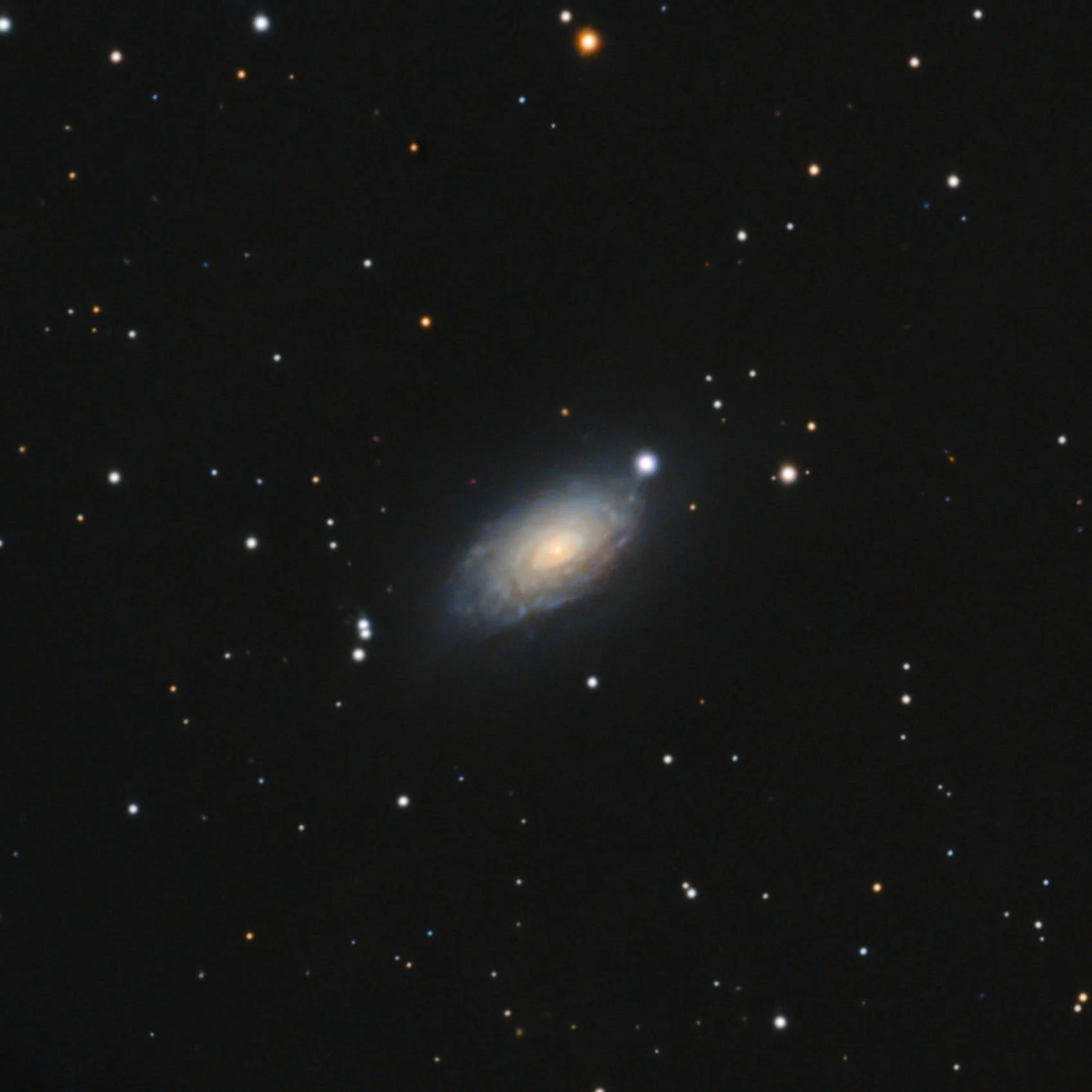
M63, captured using a ZWO SeeStar S50 smart telescope by Cosmic Captures
The core and overall shape appear quickly, but the arm texture takes integration to reveal. Give it more time than you think it needs.
M101 — Pinwheel Galaxy
Object type: Spiral galaxy
Constellation: Ursa Major
Apparent dimensions: 29′ × 27′
Filtering: No filter / Dark skies
Recommended integration time: 3–6 hours +
Peak month: April
Altitude at peak: Northern hemisphere: High | Southern hemisphere: Very low
M101 is a face-on spiral that doesn't give itself away easily. The core is modest, the surface brightness low — this is a galaxy that asks for patience. Give it enough integration and the arms start to reveal themselves: wide, asymmetric, threaded with blue star-forming regions. The asymmetry is real — M101 was likely disturbed by a gravitational encounter long ago. From a suburban sky it's workable. From dark skies, it opens up completely. One of those targets where the result feels earned.
M101, captured with a Celestron EdeHD at f/7 with ASI2600MM Pro camera and LRGB filters. Image by Cosmic Captures.
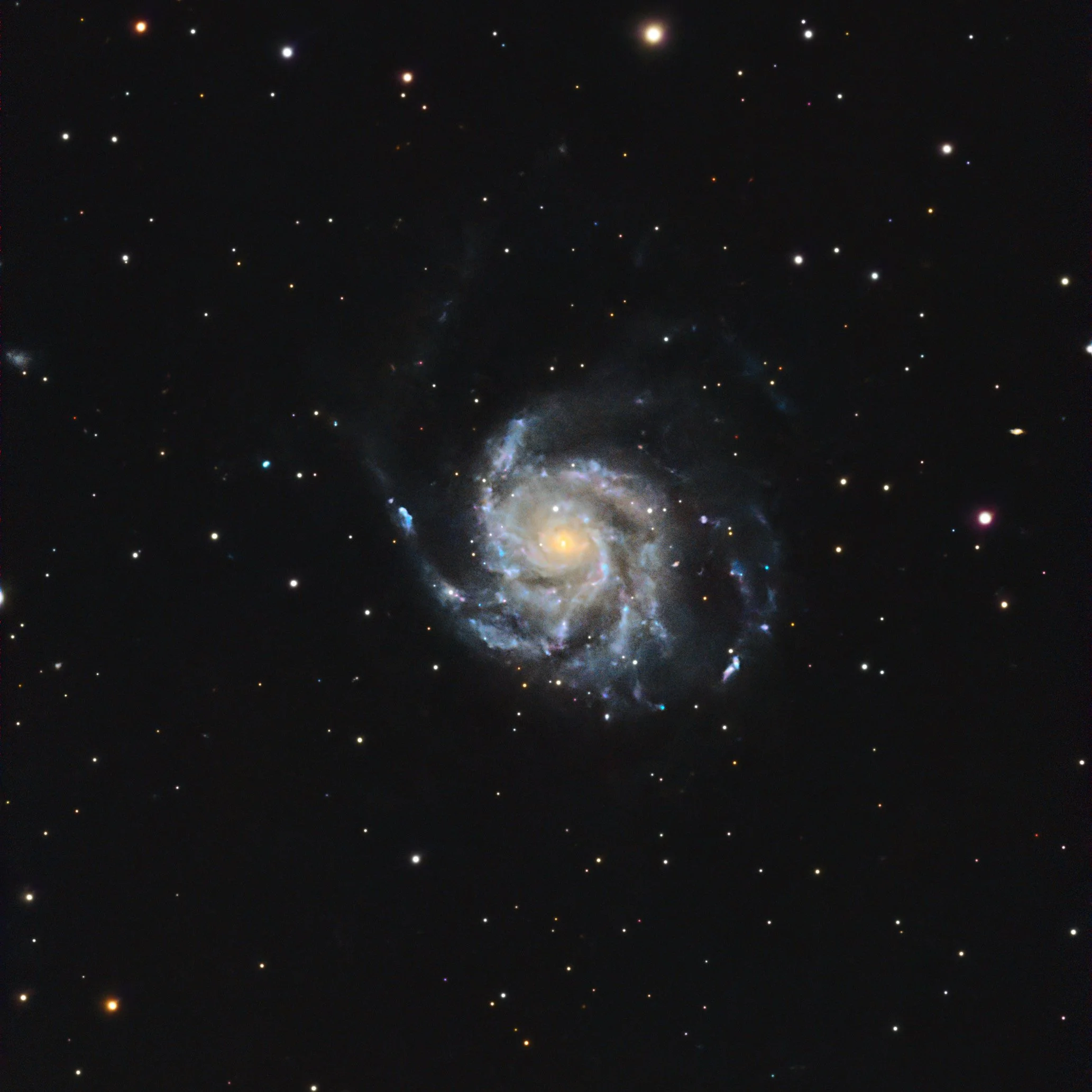
M101, captured using a ZWO SeeStar S50 smart telescope by Cosmic Captures
M101's low surface brightness means patience is essential. The core appears quickly but the arms need time and dark skies to emerge properly. High overhead in April, which helps — good altitude compensates for some sky brightness.
M58
Object type: Barred spiral galaxy
Constellation: Virgo
Apparent dimensions: 5.9′ × 4.7′
Filtering: No filter
Recommended integration time: 1–3 hours +
Peak month: April
Altitude at peak: Northern hemisphere: Low | Southern hemisphere: High
The largest and brightest spiral in the Virgo Cluster — and one of the few barred spirals Messier catalogued. That elongated core isn't just the nucleus: it's a genuine stellar bar, visible even on modest setups. The outer disc fades gently into the background, giving the galaxy a soft, oval presence. 60 million light years away, every photon in this image has been travelling since before our earliest human ancestors.
M58, processed by Cosmic Captures from Telescope.Live image data
M58, captured using a ZWO SeeStar S50 smart telescope by Cosmic Captures
The elongated bar structure is visible even with modest integration, making M58 one of the more immediately distinctive galaxies in the Virgo Cluster. A good target while the Virgo field is still well placed.
M59
Object type: Elliptical galaxy
Constellation: Virgo
Apparent dimensions: 5′ × 4′
Filtering: No filter / Dark skies
Recommended integration time: 3–6 hours +
Peak month: April
Altitude at peak: Northern hemisphere: High | Southern hemisphere: Medium
A compact elliptical in the heart of the Virgo Cluster. On its own, it's understated — a smooth, featureless glow with no spiral arms or dust lanes to grab the eye. Its real value is context: shoot wide, and it anchors the surrounding galaxy field. Worth imaging as part of the M59/M60 group rather than solo.
M60 & M59, captured using a ZWO SeeStar S50 smart telescope by Cosmic Captures
M59, captured using a ZWO SeeStar S50 smart telescope by Cosmic Captures
M59 appears as a small, smooth oval with a concentrated core. Shows limited structure even with long integration. Best captured as part of the wider M59/M60 field.
M60
Object type: Elliptical galaxy
Constellation: Virgo
Apparent dimensions: 7′ × 6′
Filtering: No filter / Dark skies
Recommended integration time: 3–6 hours +
Peak month: April
Altitude at peak: Northern hemisphere: High | Southern hemisphere: Medium
The story here isn't M60 — it's the small spiral NGC4647 pressed right up against it. Two galaxies at different distances that happen to overlap from our line of sight, and the contrast between M60's smooth elliptical glow and NGC4647's faint spiral structure is what makes this frame interesting. Dark skies help bring out the companion. A target that's more than it looks on paper.
M60, captured using a ZWO SeeStar S50 smart telescope by Cosmic Captures
M60 itself appears quickly as a bright, smooth oval. The companion NGC4647 takes more integration to reveal. Under a dark sky the contrast between the two becomes the point of the image.
NGC4567/4568 — Siamese Twins
Object type: Interacting galaxies
Constellation: Virgo
Apparent dimensions: 4.6′ × 2.4′
Filtering: No filter
Recommended integration time: 3–6 hours +
Peak month: April
Altitude at peak: Northern hemisphere: Low | Southern hemisphere: High
Two spiral galaxies in the earliest stages of collision — in about 500 million years they'll merge into a single elliptical. Shot alone they're small and subtle, but pair them with M58 in the same wide field and suddenly you're looking at the heart of the Virgo Cluster. One of those targets where context transforms the image.
M58 and NGC4567/4568, captured using a ZWO SeeStar S50 smart telescope by Cosmic Captures
M88, captured using a ZWO SeeStar S50 smart telescope by Cosmic Captures
Small but distinctive as a pair — the two overlapping cores are visible even with modest integration. Capture them alongside M58 in a wider field for the full effect.
M53 & NGC5053
Object type: Globular clusters
Constellation: Coma Berenices
Apparent dimensions: M53: 13′ | NGC5053: 9.6′
Filtering: No filter
Recommended integration time: 3–6 hours +
Peak month: April
Altitude at peak: Northern hemisphere: High | Southern hemisphere: Medium
M53 is smaller and fainter than the famous globular clusters.
What makes this field worth your time is the pairing. NGC5053 sits nearby and couldn't look more different — where M53 is dense and concentrated, NGC5053 looks like someone scattered a handful of blue-white stars loosely across the field and forgot to pack them together. One tight, one ghostly. Image them together and the contrast tells a story about how differently a globular cluster can turn out.
NGC5053 & M53, captured with a Sky-Watcher Esprit 100 at f/4.12 and an ASI2600MM Pro camera using LRGB filters
M53, captured using a ZWO SeeStar S50 smart telescope by Cosmic Captures
M53 resolves reasonably well even under a suburban sky. NGC5053 is a different challenge — its stars are sparse and faint, and it needs dark skies and long integration to show up at all. Under a full moon, it's a lost cause. Save this pair for a dark night and give it the full 3–6 hours.
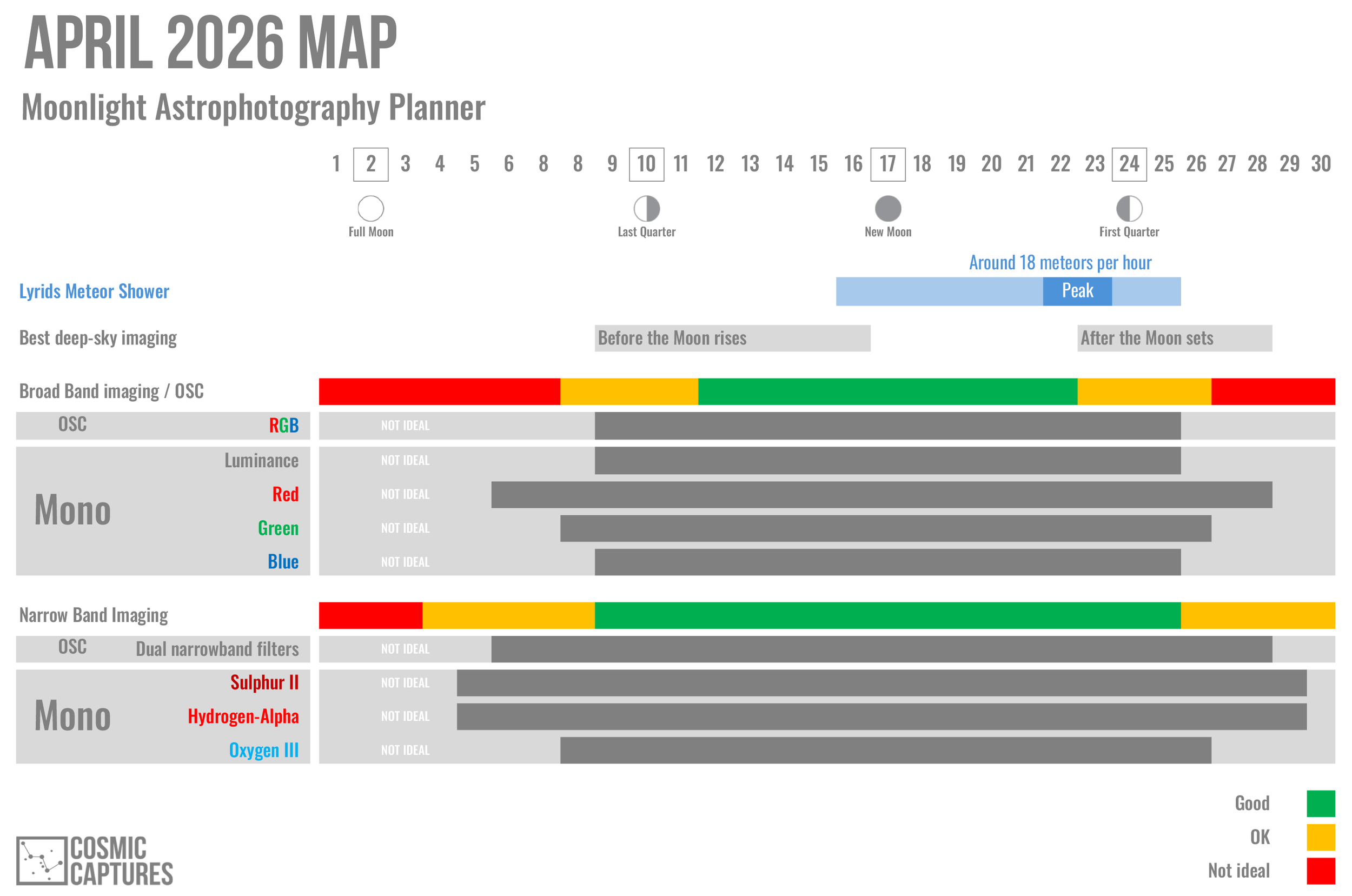
The main Moon Phases in April 2026
Planning your imaging sessions? The Moon plays a massive role in what we can capture.
Here’s what’s happening this month:

Full Moon
April 2
The Moon reaches full phase on April 2, known as the Pink Moon — named not for its colour, but for the early spring wildflowers that bloom around this time. Deep-sky imaging takes a back seat, but it's a good opportunity for lunar photography or moonlit nightscapes.

Last Quarter
April 10
Deep-sky imaging is best in the first half of the night before the Moon rises in the early morning hours. Galaxy targets high overhead — M51, M94, M64 — are well placed for evening sessions.

New Moon
April 17
The darkest skies of the month. Ideal for faint targets — M101, NGC5033, NGC5053, and the Whale Galaxy all benefit from genuinely dark skies. The Lyrid meteor shower peaks just five days later, with the Moon still a thin crescent. Good timing.

First Quarter
April 24
Deep-sky imaging is best after midnight once the Moon has set. Also a great time to capture lunar surface details, with strong shadows along the terminator bringing out crater rims in sharp relief.
The Moonlight Astrophotography Planner (MAP)
Each month, the MAP — or Moonlight Astrophotography Planner — helps you choose the best nights for capturing galaxies, nebulae, and nightscapes. Whether you’re shooting broadband or narrowband, MAP gives you clear guidance based on the Moon phase, so you can match your imaging plans to the sky conditions.
You can download this month’s MAP as a free PDF using the button below. It’s updated monthly to help you make the most of your imaging time, no matter your style or setup.
Lyrid Meteor Shower — April 22
The Lyrid meteor shower peaks on the night of April 22–23, and this year the timing works in our favour. The Moon is a thin waxing crescent, setting early and leaving dark skies for most of the night.The Lyrids are one of the oldest recorded meteor showers — observed for at least 2,700 years — and typically produce around 18 meteors per hour at peak, with occasional bright fireballs. The radiant lies near the star Vega in Lyra, which rises in the northeast after midnight and climbs higher through the pre-dawn hours. That's when rates are highest.This is one of the easiest meteor showers to photograph. A wide-angle lens, a dark spot away from streetlights, and a shutter open for 20–30 seconds, repeated through the night. The fireballs almost photograph themselves.
Check timeanddate.com for exact timings and radiant position from your location.
Image Sky Guide APP
Nightscape Opportunities
In the northern hemisphere, the nights are contracting toward summer and the window of genuine darkness is shrinking. But for many, April marks the start of Milky Way core season — the galactic centre is rising in the pre-dawn hours, low in the southeast, and those first appearances of the year have their own kind of drama. At higher latitudes like Scandinavia, this is actually the last viable month before the nights become too short and too bright to capture the arch at all. If you're north of about 55°, don't wait. The window is already closing.
In the southern hemisphere, the Milky Way core is rising before midnight and climbing higher each night. Scorpius and Centaurus are prominent, and Omega Centauri rises high enough to anchor a wide nightscape. The season is properly open. April is the month southern astrophotographers start planning their Milky Way compositions in earnest — the core is back.