
Cosmic Highlights
A monthly night sky guide to what’s worth capturing right now.
MAY 2026
May — The Last Galaxies, the First Globulars
Galaxy season is winding down. If you're tired of squeezing detail out of small, faint targets, the wait is almost over. Globulars are taking over the sky — five of them peak this month, and the brightest are big, bright, and forgiving of imperfect skies. The Milky Way is rising again, with the core climbing high enough to anchor a wide-field composition for the first time this year. And in Ophiuchus, the Rho Ophiuchi cloud complex brings together blue reflection, red emission, and dark dust into one of the most varied frames in the sky.
Last call for galaxies. First call for everything else.
The Night Sky at a Glance
Northern Hemisphere Sky – Midnight at New Moon (at +40° latitude)
Image from the app Stellarium
In the northern hemisphere, Boötes rises high, dragging the last of galaxy season behind it. Hercules climbs toward the zenith — globular cluster country. Scorpius and Ophiuchus start to make their presence felt low in the southeast, bringing M4, M5, M80, and the Rho Ophiuchi region into reach. The galactic plane is rising. Summer is here in spirit, even if the weather hasn't caught up.
Southern Hemisphere Sky – Midnight at New Moon (at -30° latitude)
Image from the app Stellarium
In the southern hemisphere, Centaurus is overhead. Scorpius and Sagittarius are climbing — the galactic core is genuinely accessible now, rising before midnight and reaching workable altitudes. Wide-field astrophotographers should already have their compositions planned. May is when the southern sky stops promising and starts delivering.
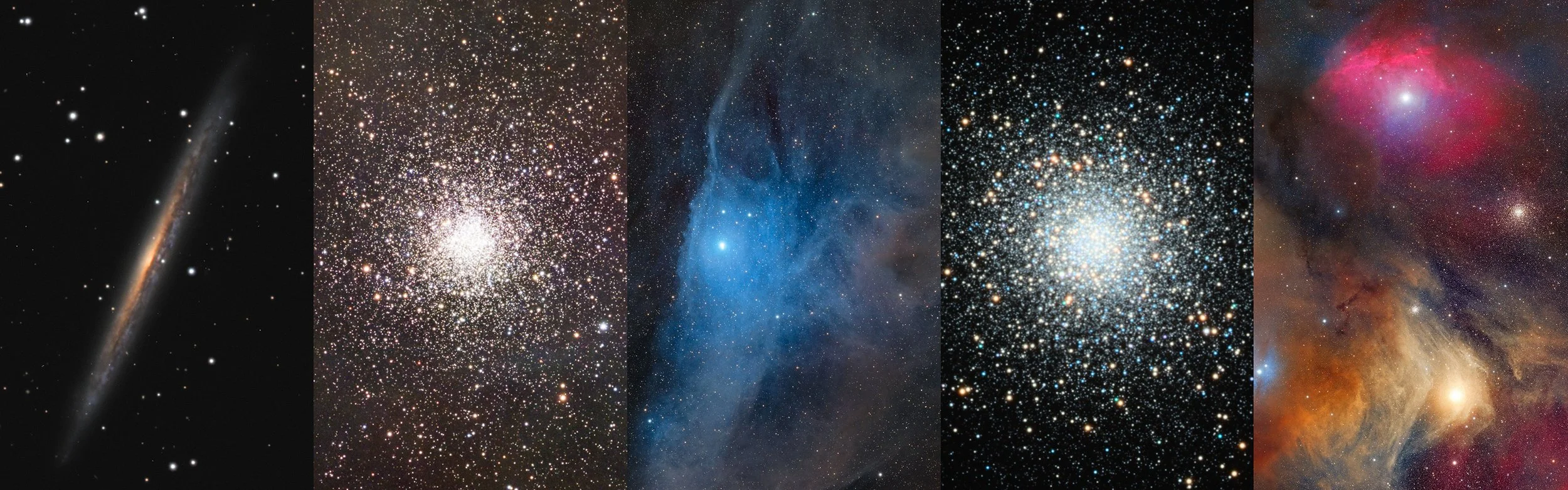
The Best-Placed Objects This Month
These objects are at their highest point in the sky around midnight. That means better visibility, longer imaging windows, and a great chance to explore some of the best deep-sky objects in the night sky.



The Cosmic Astrophotography Planner (CAP)
The Cosmic Astrophotography Planner (CAP) is a curated monthly guide to help you make the most of the night sky — with a focused selection of targets, practical framing guidance, and clear expectations for what’s realistic to capture this month.
Each CAP is built from my long-term planning system and reflects how I’m prioritising targets based on season and real-world conditions.
The free monthly overview gives you a simple snapshot of what’s available and worth focusing on right now.
NGC5907 — Splinter Galaxy
Object type: Edge-on spiral galaxy
Constellation: Draco
Apparent dimensions: 11′ × 1.4′
Filtering: No filter
Recommended integration time: 3–6 hours +
Peak month: May
Altitude at peak: Northern hemisphere: High | Southern hemisphere: Not visible
A galaxy seen perfectly edge-on — just a sliver of light tilted against the dark. NGC5907 is thinner than it has any right to be, and that's what makes it worth your time. The dust lane running along the disc is subtle but visible with enough integration. One of those targets that rewards patience without demanding perfect skies. Circumpolar from northern latitudes, which means you can image it whenever the moon is out of the way — no rush.
NGC5907 — Splinter Galaxy, processed by Cosmic Captures from Telescope.Live image data
NGC5907 — Splinter Galaxy, captured using a ZWO SeeStar S50 smart telescope by Cosmic Captures

The elongated sliver is visible from the start, but the dust lane and faint outer halo only emerge with serious integration. A patient target — give it 4 hours or more if your sky allows.
M102 — Spindle Galaxy
Object type: Lenticular galaxy
Constellation: Draco
Apparent dimensions: 6′ × 3′
Filtering: No filter / Dark skies
Recommended integration time: 1–3 hours +
Peak month: May
Altitude at peak: Northern hemisphere: High | Southern hemisphere: Very low
Two galaxies, one catalogue number. Méchain found M102, then wrote a letter suggesting it might be a duplicate of M101 — seen twice on a bad night. Modern astronomers settled on NGC 5866 as the intended target: a perfect edge-on lenticular in Draco with a dust lane that looks deliberate when conditions cooperate, and disappears completely when they don't. Dark skies and integration time are everything here.
M102 — Spindle Galaxy, processed by Cosmic Captures from Telescope.Live image data
M102 — Spindle Galaxy, captured using a ZWO SeeStar S50 smart telescope by Cosmic Captures
The dust lane is the make-or-break feature here, and it needs dark skies to come through. Under a suburban sky with a moon up, you'll see the basic spindle shape but lose the detail that gives M102 its character. Save this one for a moonless night.
M4
Object type: Globular cluster
Constellation: Scorpius
Apparent dimensions: 26′
Filtering: No filter
Recommended integration time: 1–3 hours +
Peak month: May
Altitude at peak: Northern hemisphere: Low | Southern hemisphere: High
One of the closest globular clusters to Earth, at around 5,500 light years — close enough that stars resolve right to the edges with minimal integration. What makes M4 genuinely special is where it lives: embedded in the Rho Ophiuchi cloud complex, one of the most colourful regions of the summer sky. In a wide enough field, the nebulosity surrounding Antares bleeds into the frame and the image becomes something else entirely. A showstopper on its own, and extraordinary in context.
M4, captured with a Sky-Watcher Esprit 100 at f/4.12 and an ASI2600MM Pro camera using RGB filters
M4, captured using a DWARFLAB Dwarf Mini smart telescope by Cosmic Captures
M4 resolves into individual stars almost from the first sub. The loose structure makes it forgiving — even modest integration produces a sharp, satisfying result. Try framing it wide enough to catch Antares and the surrounding nebulosity if you can.
M5
Object type: Globular cluster
Constellation: Serpens
Apparent dimensions: 23′
Filtering: No filter
Recommended integration time: ≤1 hour +
Peak month: May
Altitude at peak: Northern hemisphere: Medium | Southern hemisphere: Medium
Seriously underrated. Large, bright, and packed with colour — blue and orange stars scattered through the core like a slow-motion firework. The centre is very bright, so watch your editing carefully or you will blow it into a white blob and lose everything that makes it special. Takes about an hour to look spectacular. Less if you are good at it. M5 is around 13 billion years old — nearly as old as the universe itself. Most of those stars formed before Earth existed.
M5, processed by Cosmic Captures from Telescope.Live image data
M5, captured using a ZWO SeeStar S50 smart telescope by Cosmic Captures
M5 is the rare globular that delivers everything in under an hour. Bright, accessible from anywhere, and forgiving of city skies. The challenge is restraint — don't blow out the core in processing.
M80
Object type: Globular cluster
Constellation: Scorpius
Apparent dimensions: 10′
Filtering: No filter
Recommended integration time: 1–3 hours +
Peak month: May
Altitude at peak: Northern hemisphere: Low | Southern hemisphere: High
Compact and punchy — smaller than the famous globulars but resolves cleanly with enough integration. Individual stars start separating from the halo within a couple of hours, and the rich Scorpius star field surrounding it adds real context to the frame. Worth more attention than it usually gets.
M80, captured using a DWARFLAB Dwarf Mini smart telescope by Cosmic Captures
Resolves cleanly even from a city sky. The small apparent size means it benefits from a longer focal length than the bigger globulars — but on a smart telescope it still holds up well as a compact, structured target.
M107 — Crucifix Cluster
Object type: Globular cluster
Constellation: Ophiuchus
Apparent dimensions: 10′
Filtering: No filter
Recommended integration time: 1–3 hours +
Peak month: May
Altitude at peak: Northern hemisphere: Low | Southern hemisphere: High
One of the looser globulars in the summer sky — the stars spread outward more freely than in the densely packed classics, which means individual members resolve more easily across the full field. The core stays manageable rather than blowing out, and the surrounding star field adds real context to the frame. A bright suburban sky won't stop you — this resolves well even under significant light pollution.
M107 — Crucifix Cluster, captured using a DWARFLAB Dwarf Mini smart telescope by Cosmic Captures
The loose structure makes M107 unusually forgiving for a globular — stars are visible across the field rather than buried in a bright core. A solid target for suburban skies, where tighter clusters can be harder to extract detail from.
NGC5897 — Ghost Globular Cluster
Object type: Globular cluster
Constellation: Libra
Apparent dimensions: 12.6′
Filtering: No filter
Recommended integration time: 1–3 hours +
Peak month: May
Altitude at peak: Northern hemisphere: Low | Southern hemisphere: High
The name gives it away before you even look. The Ghost Globular is one of the loosest, most diffuse globular clusters in the sky — the low central concentration means stars resolve easily across the whole field, but the cluster itself barely announces its presence. It almost disappears into the surrounding star field rather than standing apart from it. That ghostly quality is exactly what makes it worth imaging. A quiet target that rewards a second look.
NGC5897 — Ghost Globular Cluster, captured using a DWARFLAB Dwarf Mini smart telescope by Cosmic Captures
NGC5897 is the antithesis of a high-contrast cluster — there's no bright core, no obvious silhouette. What you're capturing is presence, not form. Dark skies help significantly, but even from a suburban site the loose structure comes through.
Rho Ophiuchi Cloud Complex
Object type: Emission + Reflection + Dark Nebula
Constellation: Ophiuchus
Apparent dimensions: 600′ × 480′ (wide-field target)
Filtering: No filter / Dark skies
Recommended integration time: 3–6 hours +
Peak month: May
Altitude at peak: Northern hemisphere: Low | Southern hemisphere: High
No other region of the sky concentrates this much variety into a single frame. Blue reflection nebulae, orange and red emission, dark lanes of cold dust cutting through the glow — a bouquet of celestial objects, each lit by different physics. The warm orange haze surrounding Antares is scattered starlight; the blue to the left is a different cloud lit by different stars entirely. The dark regions aren't empty — they're where new stars are forming right now. One of the closest star-forming regions to Earth, at around 400 light years. M4, one of the closest globular clusters to Earth, sits just east of Antares and shares the frame in a wide enough field. A wide field is the only way to tell the full story — a camera lens under dark skies is all it takes.
Rho Ophiuchi Cloud Complex, 2×2 mosaic, captured with a Sky-Watcher Esprit 100 at f/4.12 and an ASI2600MM Pro camera using HRGB filters
Rho Ophiuchi Cloud Complex, captured using a 135mm lens on a Sony A7RIV camera by Cosmic Captures
This is not a smart telescope target. Smart scopes don't have the field of view to capture what makes this region remarkable, and the low altitude from northern latitudes pushes it firmly into the difficult category. A camera lens (50–135mm) on a tracker, under genuinely dark skies, is the right tool. Southern observers have a real advantage here.
IC4592 — Blue Horsehead Nebula
Object type: Reflection nebula
Constellation: Scorpius
Apparent dimensions: 180′ × 90′ (wide-field target)
Filtering:No filter / Dark skies
Recommended integration time: 6–15 hours +
Peak month: May
Altitude at peak: Northern hemisphere: Low | Southern hemisphere: High
That blue isn't emission — it's starlight scattered off a dust cloud, and the difference shows. Nu Scorpii, the bright star at the heart of it, is doing all the illuminating; the dust just catches the light and throws it back. The official name is Blue Horsehead — I've always seen a greyhound. Needs a wide field of view or a mosaic to do it justice; narrow framing misses the point entirely. Broadband only — filters suppress the very thing that makes it beautiful. Dark skies are non-negotiable.
IC4592 — Blue Horsehead Nebula, 2-panel mosaic, captured with a Sky-Watcher Esprit 100 at f/4.12 and an ASI2600MM Pro camera using LRGB filters
Smart telescopes will struggle here. The Blue Horsehead is fundamentally a wide-field target — the structure only makes sense at low magnification. A camera lens or short-focal-length refractor is the right tool. From northern latitudes, the low altitude and need for genuinely dark skies make this a target worth travelling for, not one to attempt from your backyard.
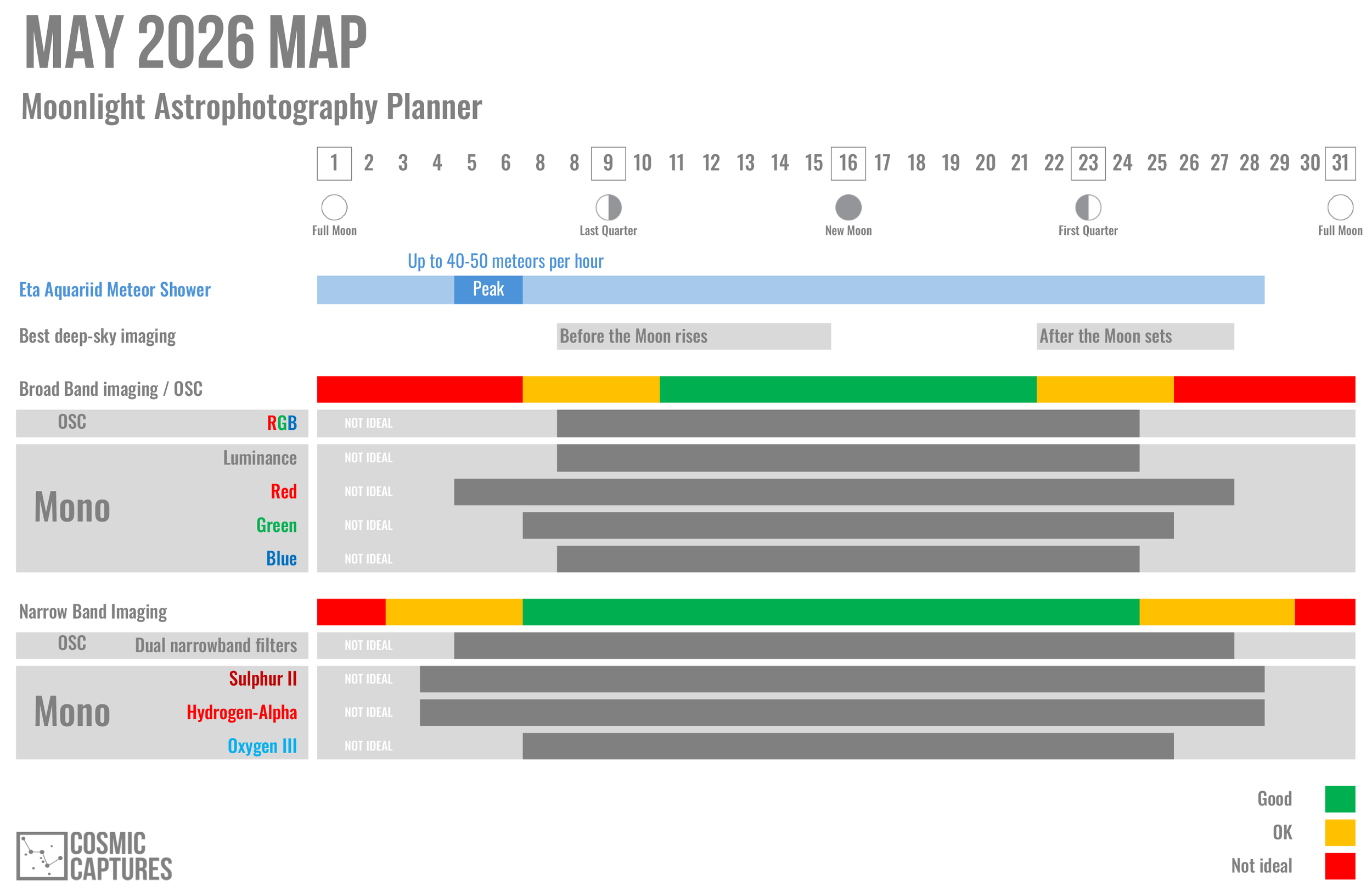
The main Moon Phases in May 2026
Planning your imaging sessions? The Moon plays a massive role in what we can capture.
Here’s what’s happening this month:

Full Moon
May 1
The month opens with a full moon. The Flower Moon rises on the evening of May 1, named for the spring blooms that mark this time of year. A poor start for deep-sky imaging — the entire first week is moon-compromised. A good week for lunar photography or moonlit nightscapes.

Last Quarter
May 9
The moon shifts to the second half of the night. Deep-sky imaging is workable in the first half of the night before moonrise.

New Moon
May 16
The darkest skies of the month. This is the window. Plus the Eta Aquariids are still active — May 16 is well past the peak but moonless skies make for clean meteor watching.

First Quarter
May 23
Deep-sky imaging is best after midnight once the moon has set. The Scorpius globulars are well placed in the post-midnight hours. Also a good time for lunar surface detail — strong shadows along the terminator bring out crater rims in sharp relief.
Full Moon
Blue Moon, May 31
The month closes the way it began — with a full moon. The May 31 full moon is a Blue Moon, the second full moon in a single calendar month. The name has nothing to do with colour; it's a calendar oddity, happening when 13 full moons fall in 12 months instead of the usual 12. Deep-sky imaging takes the night off. A good night to set up for the moon itself, or to plan June.
The Moonlight Astrophotography Planner (MAP)
Each month, the MAP — or Moonlight Astrophotography Planner — helps you choose the best nights for capturing galaxies, nebulae, and nightscapes. Whether you’re shooting broadband or narrowband, MAP gives you clear guidance based on the Moon phase, so you can match your imaging plans to the sky conditions.
You can download this month’s MAP as a free PDF using the button below. It’s updated monthly to help you make the most of your imaging time, no matter your style or setup.
Eta Aquariids — May 5–6
The Eta Aquariid meteor shower peaks on the morning of May 6, in the hours before dawn. The shower is debris from Halley's Comet — particles released over centuries of close passes through the inner solar system. Earth crosses this debris stream every May, and again in October when it produces the Orionids. Two showers, one comet.
This year the timing is hostile. The full moon was on May 1, and by peak night a bright waning gibbous moon will be in the sky for most of the night, washing out fainter meteors. Northern observers will have a tough time — the radiant near Aquarius rises only in the pre-dawn hours and stays low. Southern observers see the radiant climb much higher and get the better show, with rates potentially reaching 40–50 meteors per hour under ideal conditions, though the moon will reduce that in practice.
The shower has a broad peak rather than a sharp one — the mornings of May 5, 6, and 7 are all worth attempting. The Eta Aquariids are fast meteors, and a high percentage leave persistent trains, glowing for a moment after the meteor itself has gone.
If you're photographing them, find a way to block the moon from your frame, set a wide-angle lens to a long exposure, and let the camera run. The bright fireballs do the rest.
Check timeanddate.com for exact timings and radiant position from your location.
Image by Petr Horálek, ESO
Nightscape Opportunities
In the northern hemisphere, the nights are getting shorter — fast. At higher latitudes (Scandinavia, the UK, Canada), May is the last month to capture the Milky Way arch in genuinely dark skies. By June the nights stop ending. If you're north of about 55°, the window is closing this month. Plan your trips, set your alarms, take the data while you still can. The galactic core is rising in the southeast in the pre-dawn hours, and for a few weeks more there's still real darkness to catch it in.
In the southern hemisphere, May is when the Milky Way season properly opens. The core rises before midnight and climbs high into the sky through the second half of the night. Scorpius is overhead, the bulge is dense, and the contrast against dark southern skies is what astrophotographers from the rest of the world travel to see. If you live in this part of the world, this is the month to commit to your wide-field plans.
Image by Cosmic Captures