
Cosmic Highlights
A monthly night sky guide to what’s worth capturing right now.
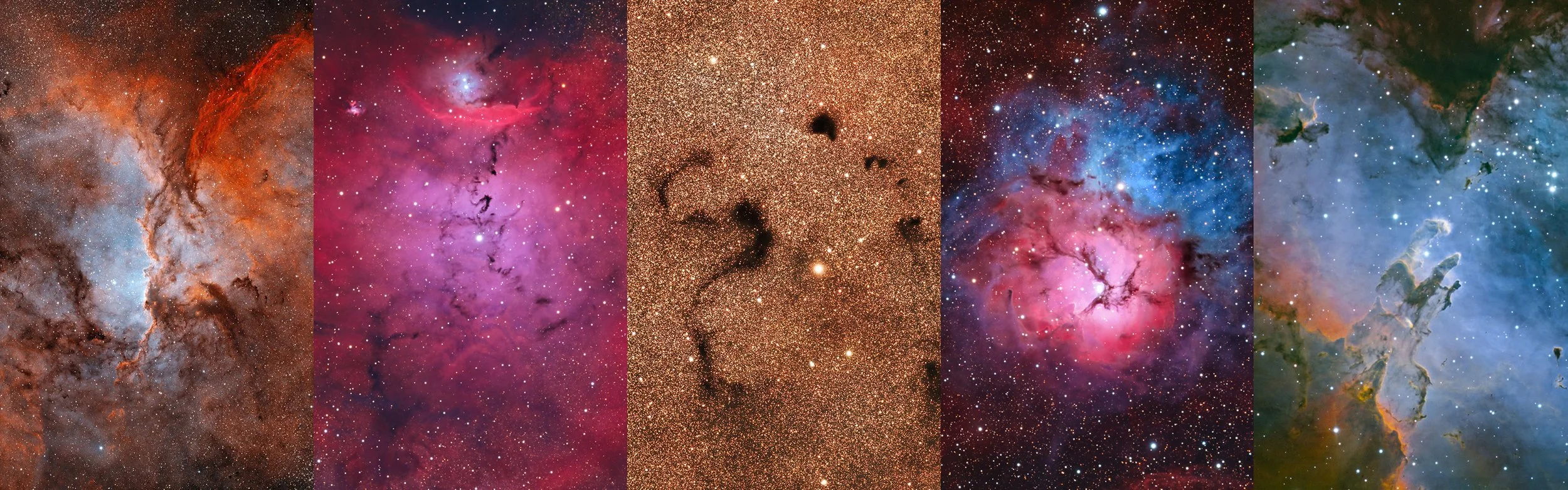
JUNE 2026
June — Into the Core
The richest month of the year for deep-sky photography is here. June is when the heart of the Milky Way climbs into the sky — and with it, the densest concentration of imaging targets you'll see all year. Globular clusters, open clusters, emission nebulae, dark lanes carved out of the galactic background: all of it sits in one broad swath of sky running from Ophiuchus through Sagittarius and Scorpius into Ara.
Nebula season has properly arrived. And unlike the scattered targets of spring, you can point your scope almost anywhere in this region tonight and find something worth capturing.
This is the month to commit to the Milky Way.
The Night Sky at a Glance
Northern Hemisphere Sky – Midnight at New Moon (at +40° latitude)
Image from the app Stellarium
In the northern hemisphere, Hercules rides high overhead — globular cluster country at its best. Lower in the south, Ophiuchus and Serpens rise to their highest workable altitudes of the year, and Sagittarius finally clears the trees with the Milky Way core visible to the south-east. Even northern observers get genuine access to the galactic centre for a few short hours each night.
Southern Hemisphere Sky – Midnight at New Moon (at -30° latitude)
Image from the app Stellarium
In the southern hemisphere, the night sky is at its absolute best. Scorpius and Sagittarius sit overhead, the galactic core passes near the zenith, and rich star fields fill the entire southern sky. The view that astrophotographers from the rest of the world travel halfway around the planet to see — this month, from these latitudes, it's just the sky above your house.
The Best-Placed Objects This Month
These objects are at their highest point in the sky around midnight. That means better visibility, longer imaging windows, and a great chance to explore some of the best deep-sky objects in the night sky.

M9 • M10 • M12 • M13 — Hercules Cluster • M14 • M19 • M22 — Great Sagittarius Cluster • M28 • M62 — Flickering Globular Cluster • M69 • M92


M8 — Lagoon Nebula • M16 — Eagle Nebula • M17 — Omega Nebula • M20 — Trifid Nebula • B72 — Snake Nebula • NGC 6164 — Dragon's Egg • NGC 6188 — Fighting Dragons of Ara • NGC 6334 — Cat's Paw Nebula • NGC 6357 — War and Peace Nebula • NGC 6559 — Chinese Dragon Nebula • IC 4628 — Prawn Nebula • vdB 123
The Cosmic Astrophotography Planner (CAP)
The Cosmic Astrophotography Planner (CAP) is a curated monthly guide to help you make the most of the night sky — with a focused selection of targets, practical framing guidance, and clear expectations for what’s realistic to capture this month.
Each CAP is built from my long-term planning system and reflects how I’m prioritising targets based on season and real-world conditions.
The free monthly overview gives you a simple snapshot of what’s available and worth focusing on right now.
A New Way to Plan: Coming very soon
The Cosmic Astrophotography Planner (CAP) has been a monthly PDF for over a year — a static snapshot you download and adapt. TonightPlan is the next step. Same target catalogue, same logic — but interactive. It knows where you are, what the moon's doing tonight, and tells you which targets are worth your time right now — matched to your sky, your gear, and your patience.
The private beta goes out to newsletter subscribers first. Sign up below to be among the first to try it.
M9
Object type: Globular cluster
Constellation: Ophiuchus
Apparent dimensions: 9′
Filtering: No filter
Recommended integration time: 1–3 hours +
Peak month: June
Altitude at peak: Northern hemisphere: Low | Southern hemisphere: High
M9 is a compact globular cluster in Ophiuchus, sitting close to the centre of our galaxy. At around 25,800 light-years away, it lies near the bulge of the Milky Way, which means it appears against one of the busiest backgrounds in the sky — a rich field of foreground and background stars that gives the image an unusual sense of depth.
The cluster has a bright, well-defined core and a loose outer halo that gradually merges with the surrounding star field. What makes M9 unusually photogenic is a foreground dust cloud that crowds in from one side of the frame, absorbing the light of the stars behind it and creating a sharp contrast between the densely starred region and the darker patch.
As a broadband target, M9 responds well to longer integration under dark skies. Additional exposure time helps resolve the outer stars and reveals the texture of the surrounding dust.
M9, captured using a ZWO SeeStar S50 smart telescope by Cosmic Captures

M9 resolves into individual stars across the halo within a couple of hours on a smart telescope. The dust cloud near the cluster is what makes this frame — keep your framing wide enough to keep that darker patch in shot.
M10
Object type: Globular cluster
Constellation: Ophiuchus
Apparent dimensions: 20′
Filtering: No filter
Recommended integration time: <1 hour +
Peak month: June
Altitude at peak: Northern hemisphere: Medium | Southern hemisphere: High
M10 is a large, bright globular cluster in Ophiuchus, often overlooked because it sits in the same constellation as the more famous M13. That comparison is unfair. M10 is one of the most rewarding globular clusters in the sky, with a strong colour contrast between the older orange-toned stars in the outer halo and the bluer members near the core.
At around 14,300 light-years away, M10 is relatively close as globular clusters go, which is why individual stars resolve so cleanly across the entire field. The core stays bright and dense without blowing out at modest integration, and the loose outer regions trail off into the surrounding star field gradually rather than dropping off sharply.
As a broadband target, M10 benefits from steady tracking under dark skies. Extended exposure time mainly improves the resolution of the outer halo and brings out more of the star colour.
M10, captured using a ZWO SeeStar S50 smart telescope by Cosmic Captures
M10 is forgiving. An hour from a moderately light-polluted sky already produces a clean, well-resolved cluster image. Watch the core in editing to preserve the warm-cool star colour contrast — that's what makes this one stand apart.
M12
Object type: Globular cluster
Constellation: Ophiuchus
Apparent dimensions: 16′
Filtering: No filter
Recommended integration time: <1 hour +
Peak month: June
Altitude at peak: Northern hemisphere: Medium | Southern hemisphere: High
M12 is one of the looser globular clusters in Ophiuchus — where most globulars pack their stars tightly toward a dense core, M12 spreads them out more evenly across the field. The low central concentration gives it a more delicate appearance than its better-known neighbours, and individual stars resolve easily right across the whole cluster.
It lies around 15,700 light-years away, with an age estimated at roughly 13 billion years — one of the oldest stellar populations in the Milky Way. The looseness isn't unusual for its type; M12 belongs to a class of globulars that have been partially eroded by repeated passes through the galactic disk over their long lifetime.
As a broadband target, M12 responds well to short integration under dark skies. Longer exposures gradually pull in more of the outer halo and improve overall colour fidelity.
M12, captured using a DWARFLab Dwarf Mini smart telescope by Cosmic Captures
M12 delivers fast on a smart telescope — the loose structure means individual stars are visible from the first sub. A quiet, scattered cluster that rewards looking at it on its own terms rather than comparing it to denser globulars.
M13 — Hercules Cluster
Object type: Globular cluster
Constellation: Hercules
Apparent dimensions: 20′
Filtering: No filter
Recommended integration time: <1 hour +
Peak month: June
Altitude at peak: Northern hemisphere: High | Southern hemisphere: Low
M13 is the finest globular cluster in the northern sky, and arguably one of the finest anywhere. It contains an estimated half a million stars packed into a sphere about 145 light-years across, sitting roughly 22,200 light-years from Earth in the constellation Hercules. The cluster is bright enough to be glimpsed with the naked eye under a dark sky, and through any imaging setup it resolves into a stunning ball of individual stars with strong colour contrast between blue main-sequence members and warmer evolved giants.
In 1974, the Arecibo radio telescope broadcast a message toward M13 — a coded image describing Earth, humanity, and our place in the solar system. The message will arrive in roughly 25,000 years.
As a broadband target, M13 is one of the most forgiving objects in the sky. The core is bright enough that care must be taken in editing to preserve the star colour rather than blowing the centre out to pure white.
M13 — Hercules Cluster, captured with a Celestron EdeHD at f/7 with ASI2600MM Pro camera and LRGB filters. Image by Cosmic Captures.
M13 — Hercules Cluster, captured using a ZWO SeeStar S50 smart telescope by Cosmic Captures
The northern hemisphere's showpiece globular, and it knows it. Even modest integration produces a stunning image. The core is bright — edit carefully or you'll lose the colour that makes this target so spectacular.
M14
Object type: Globular cluster
Constellation: Ophiuchus
Apparent dimensions: 11′
Filtering: No filter
Recommended integration time: <1 hour +
Peak month: June
Altitude at peak: Northern hemisphere: Medium | Southern hemisphere: High
M14 is a dense, compact globular cluster in Ophiuchus, sitting around 30,000 light-years from Earth. Despite its modest reputation among amateurs, it's a richly rewarding target — the core resolves cleanly, individual stars begin separating from the halo even at short integration times, and there's a noticeable colour gradient from the bright, concentrated centre to the looser, warmer-toned outer regions.
M14 made historical news in 1938 when a nova was observed within the cluster — an extremely rare event. Globular clusters contain mostly old stars, and novae require a specific configuration of close binary stars that's uncommon in such ancient populations.
As a broadband target, M14 benefits from short integration in dark conditions. Longer exposures resolve more of the outer halo and improve the colour of the resolved stars.
M14, captured using a ZWO SeaStar S50 smart telescope by Cosmic Captures
More rewarding than its reputation suggests. The core is dense and concentrated, but individual stars start resolving quickly. Preserve the warm-cool colour gradient in editing — it's there.
M19
Object type: Globular cluster
Constellation: Ophiuchus
Apparent dimensions: 10′
Filtering: No filter
Recommended integration time: <1 hour +
Peak month: June
Altitude at peak: Northern hemisphere: Low | Southern hemisphere: High
M19 is one of the most visibly squashed globular clusters in the sky. Where most globulars appear nearly spherical, M19 is noticeably oval-shaped — stretched by its plunge deep into the gravitational field of the galactic centre. At only around 6,500 light-years from the centre of the Milky Way, M19 has been gravitationally deformed by repeated close passes through the densest part of the galaxy.
The cluster sits roughly 28,700 light-years from Earth, and despite its squashed appearance, it's still a dense, bright object with a warm-toned core that resolves into individual stars at the edges. The surrounding star field is fairly even, which helps the cluster stand out clearly.
As a broadband target, M19 comes together quickly under dark skies. The oval shape becomes apparent even at modest integration, and the outer stars resolve cleanly within an hour.
M19, captured using a ZWO SeaStar S50 smart telescope by Cosmic Captures
Forty minutes of dark sky is enough to show the distinctive oval shape and start resolving the outskirts. The squashed appearance is real — that's the gravitational effect of the galactic centre on the cluster.
M22 — Great Sagittarius Cluster
Object type: Globular cluster
Constellation: Sagittarius
Apparent dimensions: 32′
Filtering: No filter
Recommended integration time: 1–3 hours +
Peak month: June
Altitude at peak: Northern hemisphere: Low | Southern hemisphere: High
M22 is one of the brightest globular clusters in the sky, and one of the closest to Earth at around 10,600 light-years. It was discovered in 1665 by Abraham Ihle, predating Charles Messier's catalogue by more than a century — globulars this bright don't tend to escape notice. From the right latitude it sits just above the galactic centre, set against the rich Milky Way background of Sagittarius.
Even at smart-telescope focal length, individual stars resolve partially through the densest part of the cluster — you can see straight into the core, where the stars are just packed more tightly. The outer halo breaks cleanly into discrete points all the way to the edges. M22 also contains two confirmed planetary nebulae embedded within the cluster itself, which is unusual: most globulars are made of stars too old to still be forming them.
As a broadband target, M22 benefits from moderate integration under dark skies. The bright core and rich Sagittarius background give the frame an unusual sense of depth.
M22, captured using a ZWO SeaStar S50 smart telescope by Cosmic Captures
One of the most rewarding globulars in the sky for southern and low-latitude northern observers. The core partially resolves even at smart-telescope focal length. The dense Milky Way background is part of the appeal — frame for context, not isolation.
M28
Object type: Globular cluster
Constellation: Sagittarius
Apparent dimensions: 11′
Filtering: No filter
Recommended integration time: 1–3 hours +
Peak month: June
Altitude at peak: Northern hemisphere: Low | Southern hemisphere: High
M28 is a compact globular cluster in Sagittarius, sitting in a Milky Way star field so dense that the cluster's outer halo nearly blends into the background swarm. The bright concentrated core gives it away — that's what tells the eye there's a cluster here rather than just a denser patch of the galactic background.
The cluster sits roughly 18,000 light-years from Earth and is around 12 billion years old. In 1986 it became the first globular cluster where a millisecond pulsar was discovered — a neutron star spinning approximately 300 times per second, buried somewhere within this glowing ball of ancient stars. Since then, more than a dozen pulsars have been found inside M28, making it one of the richest known pulsar populations in any single globular cluster.
As a broadband target, M28 needs moderate integration to lift it clearly out of the crowded background. The core stays sharp, and the outer stars resolve cleanly with patient exposure.
M28, captured using a DWARFLab Dwarf Mini smart telescope by Cosmic Captures
The dense Sagittarius backdrop means M28 needs more time than its size suggests — an hour is the minimum to lift the cluster clear of the background. The compact bright core makes it easy to find once you're framed.
M62 — Flickering Globular Cluster
Object type: Globular cluster
Constellation: Ophiuchus
Apparent dimensions: 15′
Filtering: No filter
Recommended integration time: 1–3 hours +
Peak month: June
Altitude at peak: Northern hemisphere: Low | Southern hemisphere: High
M62 is a bright, dense globular cluster on the Scorpius/Ophiuchus border, set against one of the busiest star fields in the sky. It's catalogued as the "Flickering Globular Cluster" for a peculiar reason — the bright core is asymmetric, slightly offset from where you'd expect it geometrically, likely because the cluster is being deformed by its proximity to the galactic centre. At around 22,000 light-years from Earth, it's one of the densest globulars known.
Most of M62's stars are extremely old — around 12 billion years, formed in the early history of the Milky Way. The cluster has also produced a notably high number of X-ray binary stars, suggesting unusual dynamical processes are still active in its dense core.
As a broadband target, M62 responds well to moderate integration. The bright core lifts clear of the background quickly, and the outer halo resolves into individual stars within an hour and a half.
M62, captured using a ZWO SeaStar S50 smart telescope by Cosmic Captures
The asymmetric core is the visual signature — slightly off-centre, not perfectly round. An hour and a half of dark sky resolves the outer members cleanly. The packed background is part of the story; frame to keep that context.
M69
Object type: Globular cluster
Constellation: Sagittarius
Apparent dimensions: 11′
Filtering: No filter
Recommended integration time: 1–3 hours +
Peak month: June
Altitude at peak: Northern hemisphere: Very low | Southern hemisphere: High
M69 is a small, compact globular cluster in Sagittarius, sitting close to the galactic centre at roughly 29,000 light-years from Earth. It's one of the most metal-rich globulars known — meaning its stars contain unusually high proportions of elements heavier than helium for their type. That metal-richness is a clue about M69's history: it likely formed later than typical globulars, from gas that had already been enriched by earlier generations of stars.
The cluster sits in one of the densest backdrops in the sky, the Sagittarius region near the galactic centre. The bright concentrated core stands out as the obvious feature, with the looser outer halo gradually blending into the surrounding star field.
As a broadband target, M69 needs moderate integration under dark skies to lift the cluster cleanly out of the crowded background.
M69, captured using a ZWO SeaStar S50 smart telescope by Cosmic Captures
The dense Sagittarius background means M69 needs time to lift clear — an hour minimum from dark sky. The bright concentrated core is what gives it away against the rich backdrop.
M92
Object type: Globular cluster
Constellation: Hercules
Apparent dimensions: 14′
Filtering: No filter
Recommended integration time: <1 hour +
Peak month: June
Altitude at peak: Northern hemisphere: High | Southern hemisphere: Very low
M92 is one of the finest globular clusters in the sky — dense, well-resolved core with stars streaming outward in every direction. It's consistently underrated, primarily because it shares its constellation with M13 and pays the price in every comparison anyone makes. Taken on its own terms, M92 is a stunning target.
The cluster sits around 26,700 light-years from Earth and is one of the oldest objects in the Milky Way, with an estimated age of approximately 14 billion years — close to the age of the universe itself. That extreme age makes M92 useful for cosmological studies; it serves as one of the reference points astronomers use to constrain the age of the universe.
As a broadband target, M92 responds well to short integration in dark conditions. The bright core is dense enough to demand careful processing to preserve the colour of the resolved stars.
M92, captured using a ZWO SeaStar S50 smart telescope by Cosmic Captures
Judge M92 on its own terms, not against M13. Dense well-resolved core, stars streaming outward in every direction — a serious globular cluster that just happens to live next door to a more famous one.
M6 — Butterfly Cluster
Object type: Open cluster
Constellation: Scorpius
Apparent dimensions: 25′
Filtering: No filter
Recommended integration time: <1 hour +
Peak month: June
Altitude at peak: Northern hemisphere: Very low | Southern hemisphere: High
M6 is an open cluster in Scorpius whose name comes from the loose butterfly-like pattern formed by its brightest stars — two wings of blue-white suns spreading outward from a central concentration. The shape is more poetic than precise, but the cluster is striking nonetheless.
What makes the frame visually distinctive is a single stark exception to the otherwise uniform blue-white colour palette: BM Scorpii, an orange-red variable supergiant sitting off to one side. This single warm-toned star against an otherwise cool-toned cluster creates the most arresting colour contrast in any open cluster of the summer sky. The other cluster members are hot, young, and short-lived — only around 100 million years old. BM Scorpii is the same age but much more massive, which is why it has already evolved beyond the main sequence while its siblings are still on it.
The cluster lies around 1,600 light-years away and is one of the closest open clusters to Earth.
As a broadband target, M6 comes together fast. Short integration produces a clean, satisfying result; longer exposures mainly add depth to the surrounding star field.
M6, captured using a ZWO SeaStar S50 smart telescope by Cosmic Captures
The orange supergiant against the blue cluster is the whole frame. An hour and a half is plenty. Watch your processing to preserve the colour contrast — that's what makes this one memorable.
M7 — Ptolemy Cluster
Object type: Open cluster
Constellation: Scorpius
Apparent dimensions: 80′
Filtering: No filter
Recommended integration time: 1–3 hours +
Peak month: June
Altitude at peak: Northern hemisphere: Very low | Southern hemisphere: High
M7 is one of the oldest recorded deep-sky objects in human history. Ptolemy logged it in the second century AD as a naked-eye nebulous object — it's clearly visible without optical aid from any reasonably dark site, sitting in the rich southern Milky Way of Scorpius.
The cluster itself is loose and bright — around 80 stars scattered across an area twice the diameter of the full moon, set against one of the densest star fields in the sky. The cluster stars are obvious as the brighter blue-white suns spread roughly through the centre of any frame; everything else is the Milky Way's background swarm. Look closely and dark patches of foreground dust mottle the field — interstellar clouds blocking the light of more distant stars beyond.
M7 lies around 980 light-years from Earth, making it one of the nearest open clusters known.
As a broadband target, M7 doesn't need much integration to bring out the cluster itself — most of the longer exposure goes toward developing the rich background star field and the subtle dust features.
M7, captured using a DWARFLab Dwarf Mini smart telescope by Cosmic Captures
The cluster comes out fast; the background star field rewards extra integration. Frame to keep the dark dust patches in shot — they're part of the appeal. From southern latitudes, M7 sits high. From the north, it's a horizon-hugger.
M18 — Black Swan Cluster
Object type: Open cluster
Constellation: Sagittarius
Apparent dimensions: 10′
Filtering: No filter
Recommended integration time: 1–3 hours +
Peak month: June
Altitude at peak: Northern hemisphere: Low | Southern hemisphere: High
M18 is a small, sparse open cluster in Sagittarius — a tight knot of perhaps a dozen bright blue-white stars standing out from a much richer Milky Way background. Compared to its better-known neighbours in the same region of the sky, M18 is modest in its own right, but the field around it carries the frame.
The dense Sagittarius star field fills the background completely, and a soft pink wash of emission nebulosity creeps in from one side where the Omega Nebula (M17) reaches into wider frames. The cluster sits at around 4,900 light-years away and contains stars roughly 32 million years old — young by stellar standards, hot enough to still be predominantly blue-white.
As a broadband target, M18 itself doesn't need much exposure. Longer integration is for the surrounding context — the Milky Way star field and any neighbouring nebulosity that gets pulled into the frame.
M7, captured using a DWARFLab Dwarf Mini smart telescope by Cosmic Captures
An hour from a darker sky brings the cluster out cleanly. The dense Sagittarius background is the real reward — and depending on your framing, the pink edge of M17 might creep into shot. Modest target, rich context.
M21
Object type: Open cluster
Constellation: Sagittarius
Apparent dimensions: 14′
Filtering: No filter
Recommended integration time: 1–3 hours +
Peak month: June
Altitude at peak: Northern hemisphere: Low | Southern hemisphere: High
M21 is a small, sparse open cluster in Sagittarius — a tight knot of about a dozen blue-white stars at the centre of a dense Sagittarius star field. On its own, the cluster is perfectly nice but modest, the kind of target that benefits enormously from its surroundings.
What surrounds it, in a wide enough frame, is the Trifid Nebula (M20) — pink emission, blue reflection, and dark dust lanes, just half a degree away. The two objects are physically associated, members of the same star-forming complex, and they're often framed together as a single composition. If you're imaging M21 with a wide-field setup, it's worth considering whether to centre on M21 alone or balance the frame to include the Trifid.
The cluster lies around 4,250 light-years from Earth and is roughly 4.6 million years old — making it one of the youngest clusters in the Messier catalogue.
As a broadband target, M21 comes together quickly. The longer your integration, the more nebulosity you'll pull in from the surrounding region.
M21, captured using a DWARFLab Dwarf Mini smart telescope by Cosmic Captures
Decide your framing early. M21 alone is a small cluster against rich background. With the Trifid in shot, it's part of one of the more striking pairings in the summer sky. Both are valid choices.
M23
Object type: Open cluster
Constellation: Sagittarius
Apparent dimensions: 35′
Filtering: No filter
Recommended integration time: 1–3 hours +
Peak month: June
Altitude at peak: Northern hemisphere: Low | Southern hemisphere: High
M23 is a loose, scattered open cluster of around 150 stars sorted out of the dense Milky Way background of Sagittarius. The cluster members are all roughly the same age — about 220 million years — and they were born together from a single molecular cloud before slowly drifting apart over the intervening time.
A blue cast across the brighter members indicates these stars are still young enough to be hot. What sets this frame apart from many open clusters is the background: M23 lies in one of the densest stretches of the Milky Way, and rather than the empty black backdrop typical of clusters above or below the galactic plane, M23 sits embedded in a carpet of unresolved stars that goes all the way back to the far side of the galaxy.
The cluster lies around 2,150 light-years from Earth.
As a broadband target, M23 itself comes out quickly, but the background carpet of stars takes meaningful integration to develop. Shorter exposures hurt this target more than you'd expect.
M23, captured using a ZWO SeaStar S50 smart telescope by Cosmic Captures
The background carries this image as much as the cluster does. Don't skimp on integration even though M23 itself comes out fast — the unresolved galactic backdrop is what gives the frame its sense of depth.
M24 — Sagittarius Star Cloud
Object type: Star cloud
Constellation: Sagittarius
Apparent dimensions: 120′ × 60′
Filtering: No filter
Recommended integration time: <1 hour +
Peak month: June
Altitude at peak: Northern hemisphere: Low | Southern hemisphere: High
M24 is unlike anything else in the Messier catalogue. It isn't a cluster, isn't a nebula, isn't a galaxy — it's a window. A gap in the galactic dust where the eye falls straight through to a slab of the Milky Way's far side, revealing thousands of stars stacked into a glowing bar of light. Under a dark sky it's visible to the naked eye as a brighter detached patch in the Milky Way band.
It's the only star cloud Charles Messier ever catalogued. Every other Messier entry is a discrete object; this one is a clear line of sight into the galaxy's depths, framed by the dark dust that normally blocks our view of stars this distant. A dark ink-blot punched into the top of the cloud and a smaller comma below it are nearby foreground dust silhouetted against all that distant light — and they're what give the field its remarkable three-dimensional quality.
Some of the stars visible in M24 are on the far side of the galactic centre, at distances of 15,000 light-years or more.
As a broadband target, M24 needs very little integration to look spectacular. Short exposures already pull in the dense star field; longer exposures mostly add depth to the dust contrast.
M24, captured with a Sky-Watcher Esprit 100 at f/4.12 and an ASI2600MM Pro camera using HRGB filters
M24, captured using a ZWO SeaStar S30 Pro smart telescope by Cosmic Captures
Forty minutes is plenty. M24 is huge — about four times the width of the full moon — so framing it requires a wide field. The dark dust silhouettes against the star cloud are what make the depth read. Better than its plain name suggests.
M25
Object type: Open cluster
Constellation: Sagittarius
Apparent dimensions: 32′
Filtering: No filter
Recommended integration time: <1 hour +
Peak month: June
Altitude at peak: Northern hemisphere: Low | Southern hemisphere: High
M25 is a study in contrast — a small group of about 30 known stars, mostly blue-white, with a pair of distinctly warmer-toned stars holding the centre. The cluster is loose and easy to take in at a single glance, the kind of open cluster you appreciate immediately rather than slowly.
What gives M25 historical importance is the discovery that it contains a Cepheid variable star — U Sagittarii. Cepheids are how astronomers calibrated cosmic distances throughout the early 20th century, because their pulsation period is directly related to their absolute brightness. Finding one inside a cluster of known distance gives astronomers a direct reference point for refining the cosmic distance scale.
The cluster lies around 2,000 light-years from Earth and is approximately 90 million years old. Like its neighbours in this part of the sky, it sits embedded in the dense galactic plane, so the background fills with countless fainter stars all the way through any frame.
As a broadband target, M25 comes together quickly. Most additional integration time develops the background star field rather than the cluster itself.
M25, captured using a ZWO SeaStar S50 smart telescope by Cosmic Captures
The blue-white members with the warm-toned pair at the centre is the whole story. Under an hour brings it out cleanly. The Cepheid is real, scientifically important, and looks like just another star — but it's there.
NGC 6231
Object type: Open cluster
Constellation: Scorpius
Apparent dimensions: 15′
Filtering: No filter
Recommended integration time: 1–3 hours +
Peak month: June
Altitude at peak: Northern hemisphere: Very low | Southern hemisphere: High
NGC 6231 is one of the brightest open clusters in the sky and one of the most extreme. At magnitude 2.6 it's nearly visible to the naked eye — a tight knot of hot, young blue-white stars packed into an area barely 15 arcminutes across, half the width of the full moon. Most of its members are only 3 to 5 million years old, which is extraordinarily young by stellar standards. These are stars still wrapped in the gas they formed from, blazing at temperatures most stars never reach.
The cluster is the heart of Sco OB1, a young stellar association still embedded in its parent molecular cloud. The colour contrast and tight packing make NGC 6231 the obvious cousin of the famous Jewel Box (NGC 4755) — same kind of cluster, same story, but brighter and closer.
The cluster lies around 5,500 light-years from Earth, in one of the densest regions of the southern Milky Way.
As a broadband target, NGC 6231 is brutally bright. Standard exposure times for typical open clusters can completely blow out the brightest members — care is required to preserve the star colours that are the point of the image.
NGC 6231, captured using a ZWO SeaStar S30 Pro smart telescope by Cosmic Captures
Keep your subs short. The brightest stars will blow out fast on a smart telescope — even 30-second exposures push them. Sacrifice depth to keep the star colour that makes this cluster spectacular.
NGC 6242
Object type: Open cluster
Constellation: Scorpius
Apparent dimensions: 9′
Filtering: No filter
Recommended integration time: 1–3 hours +
Peak month: June
Altitude at peak: Northern hemisphere: Very low | Southern hemisphere: High
NGC 6242 is a looser, more scattered open cluster than its more famous neighbours in Scorpius. It's the kind of cluster that's easy to overlook in such a target-rich region of the sky — but the visual hook is a single amber star sitting right among the blue-white cluster members. That orange star is almost certainly an evolved giant, briefly bright and red after burning through its main-sequence hydrogen, while the rest of the cluster is still young, hot, and blue.
The cluster sits within the broader Scorpius emission complex, so faint pink wash of background Hα often appears across wider frames — the same nebulosity that surrounds the Prawn (IC 4628) and the cluster NGC 6231 to the south.
NGC 6242 lies around 3,800 light-years from Earth.
As a broadband target, NGC 6242 doesn't need much integration to bring out the cluster, but longer exposures help develop the surrounding nebulosity if you're framing wide.
NGC 6242, captured using a ZWO SeaStar S30 Pro smart telescope by Cosmic Captures
The amber star against the blue-white members is the colour story. Not a target you'd image on its own — but worth capturing when you're already in this corner of Scorpius.
M8 — Lagoon Nebula
Object type: Emission nebula
Constellation: Sagittarius
Apparent dimensions: 90′ × 40′
Filtering: Dual narrowband recommended
Recommended integration time: 1–3 hours +
Peak month: June
Altitude at peak: Northern hemisphere: Low | Southern hemisphere: High
The Lagoon Nebula is one of the brightest emission nebulae in the sky and the closest large star-forming region in the southern Milky Way, at around 4,100 light-years from Earth. The open cluster NGC 6530 sits embedded in the gas, lighting much of what you see, while a dark dust lane cuts across the bright core and gives the nebula its name.
At 90 arcminutes across, the Lagoon spans wider than three full moons placed side by side. Some setups need a mosaic to capture the whole thing in a single composition. The bright central region — sometimes called the Hourglass Nebula — is where the most active star formation is happening right now, with new stars carving cavities in the surrounding gas.
M8 is bright enough to be visible to the naked eye under a dark sky, appearing as a small fuzzy patch in the steam rising from Sagittarius' teapot asterism.
As a broadband target, M8 produces good results — the emission is bright enough to come through. Dual narrowband filters bring out significantly more structure, especially in the fainter outer regions and the dark dust lanes that give the nebula its character.
M8, captured with a Sky-Watcher Esprit 100 at f/4.12 and an ASI2600MM Pro camera using LRGBHSO filters
M8, captured using a ZWO SeaStar S30 Pro smart telescope by Cosmic Captures
Bright enough to forgive imperfect skies. Dual-band brings out structure that broadband alone misses, especially in the outer regions. Frame for the full width — at 90 arcminutes this isn't a single-shot target on every smart scope.
M16 — Eagle Nebula
Object type: Emission nebula
Constellation: Serpens
Apparent dimensions: 70′ × 50′
Filtering: Dual narrowband recommended
Recommended integration time: 1–3 hours +
Peak month: June
Altitude at peak: Northern hemisphere: Low | Southern hemisphere: High
The Eagle Nebula is famous for containing the Pillars of Creation — three dark dust columns silhouetted against a bright, pale-blue cavity at the centre of the nebula, made world-famous by the Hubble Space Telescope's 1995 image. The pillars are real, they're enormous (the largest is about 4 light-years tall — bigger than our entire solar system), and they're sites of active star formation, with new stars currently being born inside them.
The wider nebula sprawls outward in deep red hydrogen filaments threaded with dark dust lanes that carve cavities and channels through the glowing gas. The whole complex lies around 5,700 light-years away in Serpens, and the central cluster of young hot stars (NGC 6611) provides the radiation that lights up the surrounding hydrogen.
What's striking today is how accessible the Pillars of Creation have become. Capturing them was once the exclusive domain of professional observatories; now, with modest equipment under reasonable skies, the columns are clearly resolvable in amateur images. Three hours through a small smart telescope is enough to bring out the same structure that defined a generation of space imagery.
As a broadband target, M16 works but loses contrast. Dual narrowband filters, and even better HSO filters on a mono camera, bring out the structure of the gas and the silhouettes of the pillars far more cleanly.
M16, processed by Cosmic Captures from Telescope.Live image data
M16, captured using a ZWO SeaStar S30 Pro smart telescope by Cosmic Captures
The Pillars of Creation are within reach. Three hours through a smart scope with a dual-band filter clearly resolve the three columns. The technology has come a long way — amazing times to be doing this.
M17 — Omega Nebula
Object type: Emission nebula
Constellation: Sagittarius
Apparent dimensions: 46′ × 37′
Filtering: Dual narrowband recommended
Recommended integration time: 1–3 hours +
Peak month: June
Altitude at peak: Northern hemisphere: Low | Southern hemisphere: High
The Omega Nebula — also known as the Swan, the Horseshoe, or the Checkmark depending on the observer's imagination — is one of the brightest emission nebulae in the sky. The bright core is where the action concentrates: a dense, folded knot of glowing gas with dark dust lanes cutting straight into it, the brightest of them carving a hard notch right at the centre. That's an active star-forming heart, gas lit and shaped by hot young stars buried inside.
From there the nebula opens out. A large, fainter looping shell curves off to one side like a bubble blown into the surrounding cloud, and a separate detached patch glows nearby — both threaded through a dense star field. The dust here is doing as much work as the light: it's the dark intrusions against the bright gas that give the core its structure.
The nebula lies around 5,500 light-years away in Sagittarius and is one of the most massive star-forming regions in our region of the galaxy.
As a broadband target, M17 produces good results due to its sheer brightness. Dual narrowband filters help define the structure of the outer shell and pull out the dark dust lanes more cleanly against the bright emission.
M8, captured with a Sky-Watcher Esprit 100 at f/4.12 and an ASI2600MM Pro camera using LRGBHSO filters
M17, captured using a DWARFLab Dwarf Mini smart telescope by Cosmic Captures
A dual-band filter holds the bright core and the faint outer loop together. The dark dust intrusions are the structure — frame to preserve them.
M20 — Trifid Nebula
Object type: Emission nebula
Constellation: Sagittarius
Apparent dimensions: 28′
Filtering: No filter
Recommended integration time: 1–3 hours +
Peak month: June
Altitude at peak: Northern hemisphere: Low | Southern hemisphere: High
The Trifid Nebula is one of the very few targets that combines emission, reflection, and dark nebulosity in a single small frame. Pink hydrogen glows at the core, blue dust scatters starlight just above it, and three dark lanes — the feature that gives the nebula its name — carve the emission region into three distinct lobes.
The three components are physically different phenomena lit by different mechanisms. The pink emission is ionised hydrogen glowing in Hα. The blue reflection is dust scattering the light of nearby young stars. The dark lanes are denser, colder dust blocking the light from behind. All three coexist in a tight enough area to fit easily in a single smart-telescope frame.
The nebula lies around 5,200 light-years away in Sagittarius and is approximately 300,000 years old — extremely young by astronomical standards, with stars still actively forming in its dust lanes.
Broadband works best for this target. Narrowband filters suppress the reflection and dark-lane components that make the Trifid interesting, leaving only the emission and flattening the three-part character that earns the name.
M20, captured with a Sky-Watcher Esprit 100 at f/4.12 and an ASI2600MM Pro camera using LRGBHSO filters
M20, captured using a ZWO SeaStar S30 Pro smart telescope by Cosmic Captures
Skip the dual-band on this one — it suppresses the blue reflection and dark lanes that are the whole point. Broadband captures all three components. Frames easily in a single shot at smart-telescope focal length.
B72 — Snake Nebula
Object type: Dark nebula
Constellation: Ophiuchus
Apparent dimensions: 30′ × 15′
Filtering: No filter / dark skies
Recommended integration time: 3–6 hours +
Peak month: June
Altitude at peak: Northern hemisphere: Low | Southern hemisphere: High
Barnard 72 — the Snake Nebula — is a dark nebula in Ophiuchus, an S-shaped lane of cold dense dust silhouetted against the rich star field of the Milky Way behind it. It's part of E. E. Barnard's classic catalogue of dark nebulae compiled in the early 20th century, when photographic plates first revealed that the dark patches in the Milky Way weren't empty spaces but real interstellar clouds blocking the light of more distant stars.
The "nebula" here is the absence of light, not its presence. You're imaging cold dust absorbing the starlight of millions of background stars — a negative-space target where the rich foreground star field is what makes the dark lane stand out sharply. Counterintuitively, more background light helps: the brighter the star field behind the dust, the more clearly the snake-shape is defined.
The Snake lies around 650 light-years away and is associated with the broader Ophiuchus dark cloud complex.
As a broadband target, B72 needs longer integration to fully develop the contrast between the dust and the surrounding star field. No filters apply — you're imaging the visible-light absence in a normal frame.
B72, captured with a Sky-Watcher Esprit 100 at f/4.12 and an ASI2600MM Pro camera using RGB filters
M17, captured using a DWARFLab Dwarf Mini smart telescope by Cosmic Captures
The richer the star field, the better. No filters. No tricks. Point and let the Snake reveal itself against the Milky Way background.
NGC 6188 — Fighting Dragons of Ara
Object type: Emission nebula
Constellation: Ara
Apparent dimensions: 20′ × 12′
Filtering: Dual narrowband recommended
Recommended integration time: 1–3 hours +
Peak month: June
Altitude at peak: Northern hemisphere: Horizon | Southern hemisphere: High
The Fighting Dragons of Ara is a striking emission nebula whose name comes from the appearance of its central ridge: a wall of bright-rimmed gas with its edges curling into sculpted shapes that genuinely resemble the heads of two dragons facing off across a dark trench of dust. The shape is more literal than most named astrophotography targets — anyone seeing the image for the first time tends to find the dragons immediately.
A pale cavity to one side of the ridge has been hollowed out by the hot blue-white open cluster NGC 6193 sitting inside it; the cluster's intense radiation carves the cavity and lights the bright rims of the surrounding gas. Tucked into one corner of wider frames sits NGC 6164 (the Dragon's Egg) — a separate object, a bipolar nebula blown by a different unstable star, but visually associated and thematically perfect as the dragons' offspring.
The whole complex lies around 4,000 light-years away in the Ara OB1 association, one of the nearer regions of active massive-star formation.
As a broadband target, the Fighting Dragons can be captured but loses much of its contrast. Dual narrowband filters bring out the sculpted ridge structure and the dark dust trench that gives the dragons their definition.
NGC6188, processed by Cosmic Captures from Telescope.Live image data
NGC6188, captured using a ZWO SeaStar S30 Pro smart telescope by Cosmic Captures
The bright ridge curling into the dragon-head shapes is the whole image. Dual-band brings out the sculpted edges. Frame wide enough to keep the Dragon's Egg in shot if you can — they belong together.
NGC 6164 — Dragon's Egg
Object type: Emission nebula
Constellation: Ara
Apparent dimensions: 14′ × 10′
Filtering: Dual narrowband recommended
Recommended integration time: 3–6 hours +
Peak month: June
Altitude at peak: Northern hemisphere: Horizon | Southern hemisphere: High
The Dragon's Egg is a bipolar emission nebula in Ara, easy to miss in wider frames where it appears as a small smudge that could be written off as a processing artefact. Crop in and a proper nebula reveals itself — a bright inner shell offset just to one side of the central star, wrapped in a much larger teal halo that arcs around it like a tilted egg.
The central star, HD 148937, is a massive O-type binary system that has been sculpting this shell over hundreds of thousands of years through powerful stellar winds and ejected material. The system sits within the Ara OB1 association — the same young stellar group that lights the Fighting Dragons of Ara (NGC 6188) just to the north. HD 148937 is suspected to be a runaway from that cluster, which gives the nickname "Dragon's Egg" its poetic logic: a young star that drifted from the Dragons' nest and built a shell around itself.
The nebula lies around 4,000 light-years from Earth.
As a narrowband target, the inner shell pops with even moderate dual-band exposure. The fainter outer halo needs serious integration time — this is what rewards patience on this target.
NGC 6164, captured using a ZWO SeaStar S50 smart telescope by Cosmic Captures
Easy to overlook in wider frames. Crop in and there's a proper bipolar nebula here. Inner shell comes fast on a dual-band; the outer teal halo is what the extra integration time is for.
NGC 6334 — Cat's Paw Nebula
Object type: Emission nebula
Constellation: Scorpius
Apparent dimensions: 40′ × 30′
Filtering: Dual narrowband recommended
Recommended integration time: 1–3 hours +
Peak month: June
Altitude at peak: Northern hemisphere: Very low | Southern hemisphere: High
The Cat's Paw Nebula has one of the most immediately recognisable shapes in the sky: three bright pink knots along the top, one larger pad filling the lower half, the whole arrangement looking exactly like the paw print of a cartoon cat left on the Milky Way. The four bright knots are all part of the same star-forming complex, each one a separate site where massive new stars are eating the gas around them and lighting it up from inside.
The dark gaps between the knots aren't empty space — they're foreground dust lanes carving up what would otherwise be a single bright cloud into the distinct paw structure. The complex sits around 5,500 light-years from Earth and is one of the most active star-forming regions visible from the southern Milky Way.
Despite its small angular size, the Cat's Paw is bright and structured enough that even short integrations under dark skies bring out the paw shape cleanly. It's also located right next to NGC 6357 (the War and Peace Nebula) — wider compositions can capture both nebulae in a single frame as a related pair.
As a broadband target, NGC 6334 comes through. Dual narrowband filters strengthen the contrast significantly and bring out the detailed structure within each knot.
NGC6334, processed by Cosmic Captures from Telescope.Live image data
NGC6334, captured using a DWARFLab Dwarf Mini smart telescope by Cosmic Captures
Bright and structured — comes out cleanly even in short integrations under dark sky. Cartoon cat with three toes and a pad. Next-door neighbour to the War and Peace; consider framing them together if your FOV allows.
NGC 6357 — War and Peace Nebula
Object type: Emission nebula
Constellation: Scorpius
Apparent dimensions: 60′ × 45′
Filtering: Dual narrowband recommended
Recommended integration time: 1–3 hours +
Peak month: June
Altitude at peak: Northern hemisphere: Very low | Southern hemisphere: High
NGC 6357 is often called the Lobster Nebula — and once you see it, the name fits exactly. The central knotted body sits mid-image, two curving arcs of glowing gas sweep down and outward at the lower corners like claws, and a brighter looping mass at the top forms the head. It's also catalogued historically as the War and Peace Nebula, though that more abstract name is harder to read in any image.
The colour is unusually deep — almost pure hydrogen red — with intricate dust filaments threading through the glow and a brilliant compact core at lower-centre-left where the hottest young stars are buried. Two small detached red blobs sit at the edges, separate emission regions in the same broader complex. The nebula contains one of the most extreme open clusters known (Pismis 24), home to some of the most massive stars ever measured.
The nebula lies around 5,500 light-years from Earth — the same distance as the neighbouring Cat's Paw Nebula (NGC 6334), and the two are physically associated members of the same Sagittarius arm star-forming region.
As a broadband target, NGC 6357 needs more integration than its bright neighbour to bring out the structure. Dual narrowband or narrowband filters significantly improve contrast and pull out the dust threading the gas.
NGC6357, processed by Cosmic Captures from Telescope.Live image data
NGC6357, captured using a DWARFLab Dwarf Mini smart telescope by Cosmic Captures
Just under three hours through a dual-band under dark sky pulls the lobster shape out cleanly. Pure hydrogen red with intricate dust threading — patient integration rewards this target.
NGC 6559 — Chinese Dragon Nebula
Object type: Emission + Reflection + Dark Nebula
Constellation: Sagittarius
Apparent dimensions: 15′ × 10′
Filtering: No filter
Recommended integration time: 3–6 hours +
Peak month: June
Altitude at peak: Northern hemisphere: Low | Southern hemisphere: High
NGC 6559 is one of the most underrated targets in Sagittarius — a beautiful compact region packing emission, reflection, and dark nebulosity into a single small frame. Most targets need a much wider field of view to show this kind of variety; here it's all condensed into 15 arcminutes of sky.
The reason this nebula gets overlooked is geography. It sits roughly 1.4° east of the Lagoon Nebula (M8), in one of the most photographed pockets of Sagittarius. Imagers point at the Lagoon, frame it, and never quite look at what's just next door. The dark dragon-like dust lane that gives the nebula its modern nickname is genuinely there in the structure — sculpted by ultraviolet radiation from young massive stars embedded in the surrounding gas.
NGC 6559 is sometimes catalogued or referenced as Sh2-29, although Sh2-29 strictly refers to the broader HII complex containing this nebula. The two designations are used interchangeably by imagers.
The complex lies around 5,000 light-years from Earth.
To capture the full character of NGC 6559 with its three nebula types, use broadband imaging. Narrowband filters can be added later to lift the faintest emission, but they aren't required — and they suppress the reflection and dark components that make this target distinctive.
NGC6559, captured with a Sky-Watcher Esprit 100 at f/4.12 and an ASI2600MM Pro camera using LRGBHSO filters
NGC6559, captured using a RedCat 51 by Cosmic Captures
People photograph the Lagoon and miss this one 1.4° away. Three kinds of nebulosity in one compact frame — emission, reflection, dark. Broadband captures all of it. A genuinely underrated target. But one that will require more patience than its brighter and more famous neighbours.
IC 4628 — Prawn Nebula
Object type: Emission nebula
Constellation: Scorpius
Apparent dimensions: 90′ × 60′
Filtering: Dual narrowband recommended
Recommended integration time: 3–6 hours +
Peak month: June
Altitude at peak: Northern hemisphere: Very low | Southern hemisphere: High
The Prawn Nebula is one of the larger emission nebulae in Scorpius — 90 arcminutes long, spanning wider than three full moons placed side by side. The shape is genuinely prawn-like: the body curves across the frame, brightest at the head where hot young stars are lighting up the cloud they were born from. Look closely at the bright head and you'll see two dark spots that make the eyes of the prawn.
The dark lanes cutting through aren't gaps in the gas — they're foreground dust blocking the view of Hα emission behind. The cluster of young stars at the centre of the bright head is part of Cr 316, a young open cluster embedded in its parent molecular cloud. The whole complex sits in the wider star-forming region of Sco OB1, alongside the bright open cluster NGC 6231 and the looser NGC 6242 — all three appear in the same wide-field frame.
The nebula lies around 5,700 light-years from Earth.
This is a low surface brightness target. As a broadband target, IC 4628 needs considerable integration to bring out the colour. Dual narrowband filters significantly improve contrast and make the structure visible even from compromised skies.
IC4628, captured with a Sky-Watcher Esprit 100 at f/4.12 and an ASI2600MM Pro camera using LRGBHSO filters
IC4628, captured using a ZWO SeaStar S30 Pro smart telescope by Cosmic Capture
Low surface brightness — needs time. With a dual-band filter, the nebula still comes through, even from brighter skies. Look for the two dark spots that make the eyes of the prawn; they're a nice little detail to point out in your image.
vdB 123
Object type: Reflection + Dark Nebula
Constellation: Serpens
Apparent dimensions: 150′ × 90′
Filtering: No filter
Recommended integration time: 6–15 hours +
Peak month: June
Altitude at peak: Northern hemisphere: Medium | Southern hemisphere: Medium
The vdB 123 region is one of the most atmospheric wide-fields in the summer sky — far more than just the small reflection nebula the catalogue name technically refers to. The cooler-toned blue glow at one corner of the frame is starlight scattered off dust around an embedded young star. Below and elsewhere, dark snake-like lanes are foreground dust complexes blocking the dense Milky Way behind them. A small red emission knot at the edge of typical framings is Sh2-37, completely unrelated in colour mechanism — that's Hα from ionised hydrogen, not scattered starlight.
The whole field is a study in three kinds of nebulosity in a single frame: reflection (blue), absorption (the dark lanes), and emission (the red knot). It's the kind of target that rewards looking closely rather than punching the eye, the photographic opposite of a high-contrast emission nebula.
The complex sits in Serpens at a distance of around 700 light-years — one of the closer dark cloud regions to Earth, part of the broader Ophiuchus-Serpens dust complex.
vdB 123 requires significant integration time to develop the dust structure properly. Filters cannot help — the colour comes from physical light-scattering, not emission.
vdB123, captured with a Sky-Watcher Esprit 100 at f/4.12 and an ASI2600MM Pro camera using LRGBH filters
Smart telescopes will struggle here without serious integration — six-plus hours under genuinely dark skies to start pulling out the dust structure. The reward is one of the most varied single-frame compositions in the summer sky.
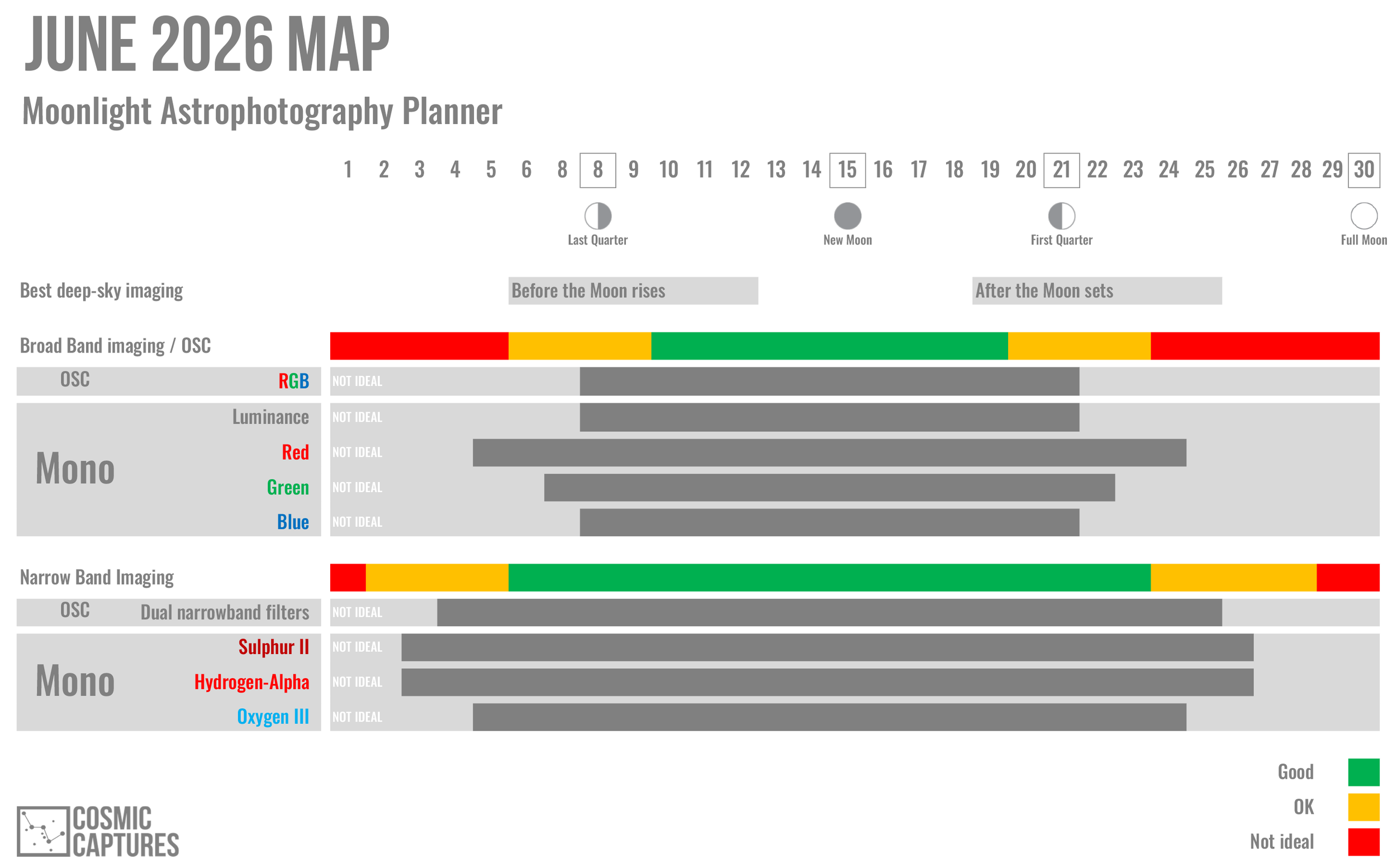
The main Moon Phases in June 2026
Planning your imaging sessions? The Moon plays a massive role in what we can capture.
Here’s what’s happening this month:

Last Quarter
June 8
The month opens with a waning moon. Deep-sky imaging is best in the first half of the night, before the moon rises in the late-evening or early-morning hours. The Sagittarius and Scorpius targets are well-placed in the post-dusk hours for those nights.

New Moon
June 15
The darkest skies of the month. Mid-June is the window for the faintest targets — the dust regions of Ophiuchus, the wider emission nebulae of Scorpius, vdB 123 and similar low surface brightness targets. The Milky Way core climbs to its highest workable altitude in the small hours.
For observers at higher northern latitudes, this is the period when astronomical darkness is shortest — and at very high latitudes, may not occur at all. Plan around your local twilight tables.

First Quarter
June 21
The moon shifts to the first half of the night. Deep-sky imaging is best after midnight once the moon has set. Also a good night for lunar surface detail — strong shadows along the terminator bring out crater rims in sharp relief. First Quarter falls on the same day as the June solstice this year.

Full Moon
June 29
The month closes with the full Strawberry Moon, named for the strawberry harvest season in the northern hemisphere. Deep-sky imaging takes the night off — a good night to set up for the moon itself, or to plan July.
The Moonlight Astrophotography Planner (MAP)
Each month, the MAP — or Moonlight Astrophotography Planner — helps you choose the best nights for capturing galaxies, nebulae, and nightscapes. Whether you’re shooting broadband or narrowband, MAP gives you clear guidance based on the Moon phase, so you can match your imaging plans to the sky conditions.
You can download this month’s MAP as a free PDF using the button below. It’s updated monthly to help you make the most of your imaging time, no matter your style or setup.
June Solstice — June 21
The June Solstice marks the longest day in the northern hemisphere and the shortest in the southern. For the northern hemisphere, it's the official start of summer; for the southern hemisphere, the beginning of winter. The Sun reaches its highest point in the sky from northern latitudes, and its lowest from southern latitudes, on this single day.
Around the solstice, the Sun rises far to the north of east and sets far to the north of west — the most extreme position of the year. The lengthening days in the south and the shortening days in the north now begin their slow reversal back toward the autumn equinox.
For astrophotographers, the solstice is a turning point in opposite directions depending on hemisphere. Northern observers face the shortest nights of the year — astronomical darkness becomes brief or non-existent at higher latitudes, and the window for deep-sky imaging shrinks accordingly. Southern observers gain their longest nights, with extended darkness and the Milky Way core now climbing high overhead.
It's a quiet astronomical milestone, but a meaningful one — the moment the year begins its turn toward the other half of the calendar.
© timeanddate.com
Nightscape Opportunities
In the northern hemisphere, the nights are at their shortest. At higher latitudes — Scandinavia, the UK, Canada, the northern United States — astronomical darkness is brief or absent entirely during the weeks around solstice. If you're north of about 55° latitude, this is the month when night photography effectively pauses until the darkness returns in July. Plan your wider trips for darker latitudes if you can. The galactic core is rising in the south-east in the late evening, and for those who can find genuine darkness, it's spectacular.
In the southern hemisphere, this is the peak Milky Way season. The galactic core passes overhead during the second half of the night, and the bulge is at its most spectacular against truly dark southern skies. Scorpius and Sagittarius are directly overhead, the contrast against dark southern fields is unmatched, and the conditions southern observers wait all year for are happening now.
If you live south of the equator, this is the month to commit to your wide-field plans. If you live in the far north, this is the month to plan a trip — or to wait for July.
Image by Cosmic Captures
Noctilucent Clouds – A Silver Lining at the Edge of Night
If you live at higher latitudes, June brings a different kind of wonder — one that shimmers just above the horizon.
Noctilucent clouds form high in the atmosphere, over 80 kilometres up, where ice crystals catch the Sun’s rays long after it has set. They glow electric blue and silver — delicate, shifting, and completely unique to this time of year.
They’re not visible from everywhere, but if you’re in the right place and looking just after sunset or before sunrise, you might spot them dancing at the edge of twilight.
I made a video entirely about these clouds — I’ll link it below if you’re curious.
Capturing Twilight's Hidden Glow: Noctilucent Clouds
Image by Cosmic Captures