
Cosmic Highlights
A monthly night sky guide to what’s worth capturing right now.
FEBRUARY 2026
February — The Turning of the Sky
February is a quiet turning point in the night sky.
The Milky Way and the great winter constellations are beginning to drift west, slowly making room for something new.
As Orion sinks lower each night, the sky’s focus shifts. Fainter, more distant islands of light — galaxies — start to rise higher and take centre stage. It’s the first true hint of spring, and the beginning of galaxy season.
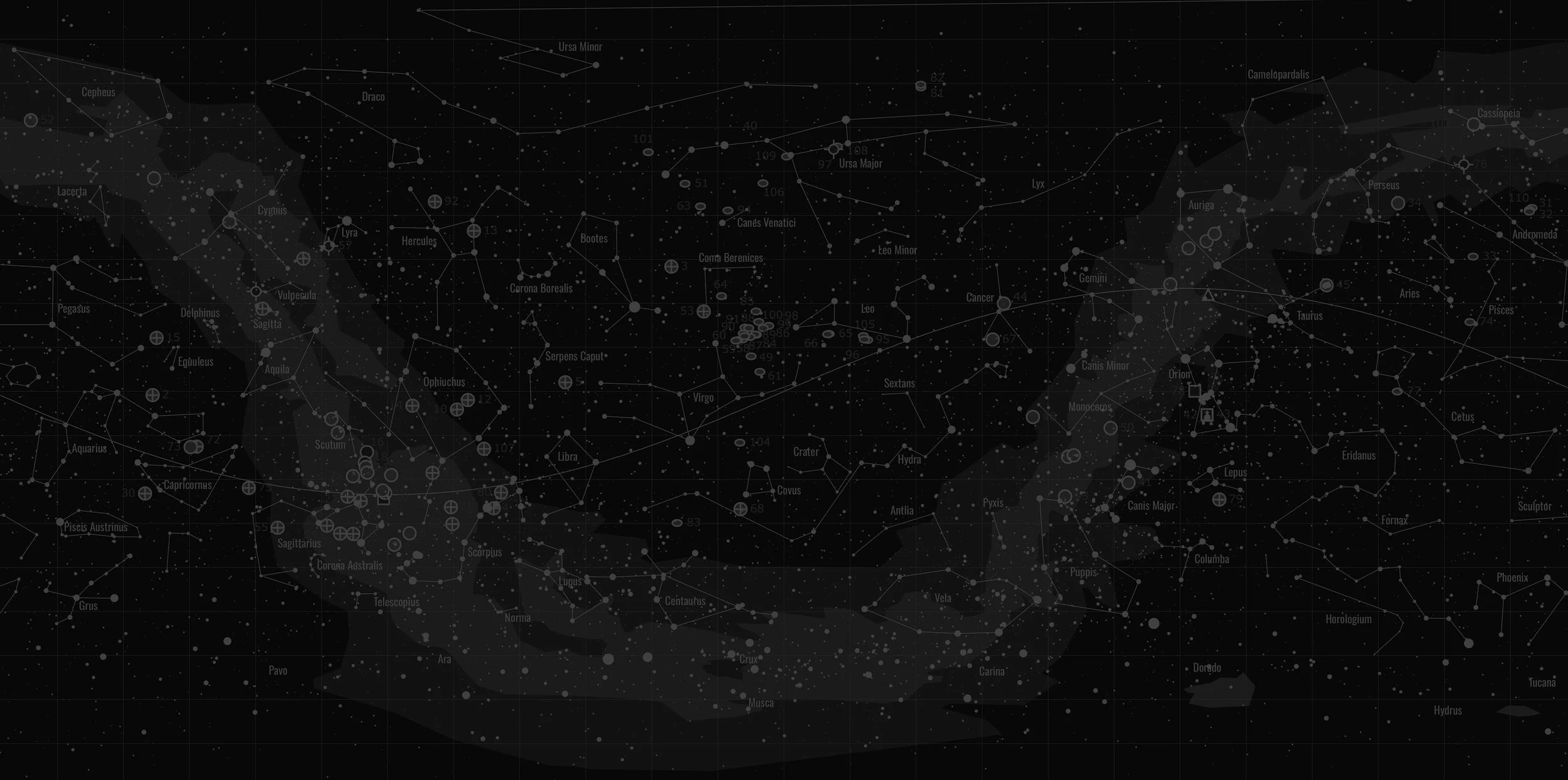
The Night Sky at a Glance
Northern Hemisphere Sky – Midnight at New Moon (at +40° latitude)
Image from the app Stellarium
Southern Hemisphere Sky – Midnight at New Moon (at -30° latitude)
Image from the app Stellarium
February is a month of quiet change in both hemispheres. The familiar winter constellations are still prominent, but they’re beginning to slide west, slowly opening the sky to what comes next.
In the northern hemisphere, Orion dominates the western sky early in the night, with Taurus and Auriga nearby. As the evening goes on, Gemini and Cancer climb high overhead, and Leo rises into a strong position later in the night — an early signal that galaxy season is beginning.
In the southern hemisphere, Orion is placed in the west, joined by Canis Major and Puppis. The Milky Way still stretches across the sky, but it, too, is shifting westward. Farther east, Hydra and Antlia begin to take over, bringing more galaxies into view as the season turns.
It’s a transition sky — familiar, but already pointing toward the deeper, more distant targets of the months ahead.
The Best-Placed Objects This Month
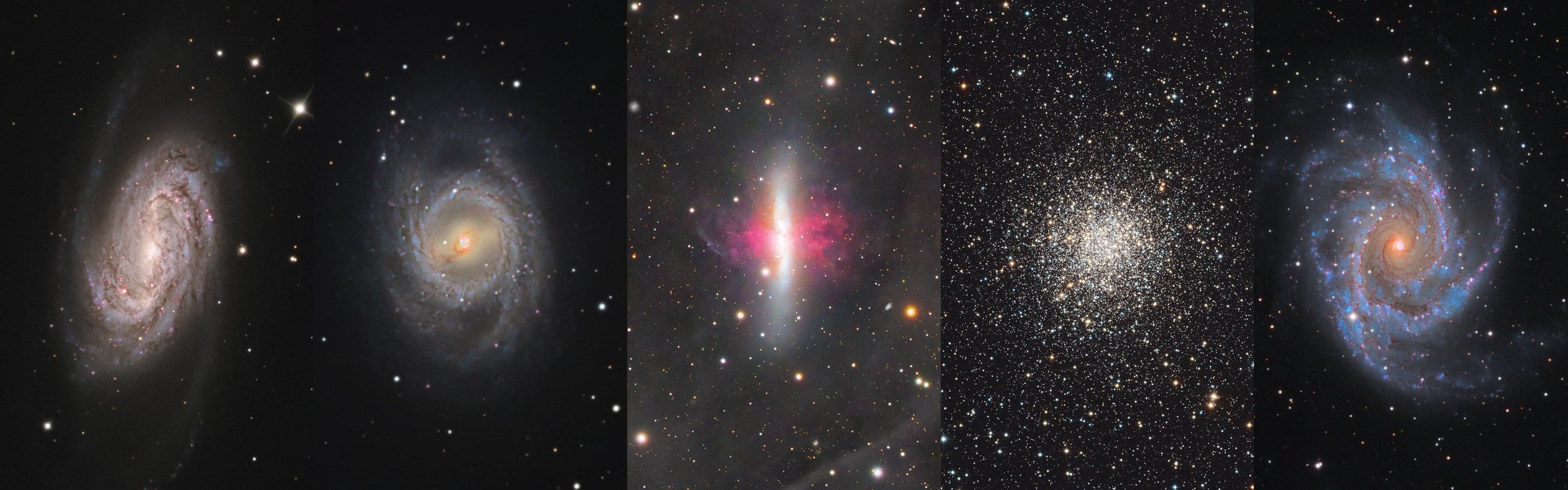
These objects are at their highest point in the sky around midnight. That means better visibility, longer imaging windows, and a great chance to explore some of the best deep-sky objects in the night sky.



The Cosmic Astrophotography Planner (CAP)
The Cosmic Astrophotography Planner (CAP) is a curated monthly guide to help you make the most of the night sky — with a focused selection of targets, practical framing guidance, and clear expectations for what’s realistic to capture this month.
Each CAP is built from my long-term planning system and reflects how I’m prioritising targets based on season and real-world conditions.
The free monthly overview gives you a simple snapshot of what’s available and worth focusing on right now.
For deeper planning and access to the full system behind CAP, supporters get access to the complete Cosmic Captures ARC — my living Astrophotography Reference Catalogue, with full data, powerful sorting and filtering, customisation, and ongoing updates.
M81 – Bode’s Galaxy
Object type: Spiral galaxy
Constellation: Ursa Major
Apparent dimensions: ~27′ × 14′
Filtering: Not recommended
Recommended integration time: 1-3 hours +
Peak month: February
Altitude at peak: Northern hemisphere: High · Southern hemisphere: Not visible
M81 is one of the brightest and most well-defined spiral galaxies in the northern sky. Its large size and strong core make it an ideal galaxy-season target for any telescope, with spiral structure becoming more apparent as integration time builds. Unlike nebulae, galaxies don’t benefit from filters — this is a broadband target where dark skies and steady stacking matter most. M81 is a great example of how extended observing reveals faint outer arms and subtle detail that aren’t obvious in short sessions.
M81 – Bode’s Galaxy, captured with a Celestron C9.25 EdgeHD at f/7 and an ASI294MC Pro camera by Cosmic Captures
M81 – Bode’s Galaxy, captured using a ZWO SeeStar S50 smart telescope by Cosmic Captures

M81 is one of the largest and brightest galaxies in the northern sky, making it a standout target for a smart telescope, with clear structure even in modest integration times.
M82 – Cigar Galaxy
Object type: Spiral galaxy
Constellation: Ursa Major
Apparent dimensions: ~11′ × 4′
Filtering: Not recommended
Recommended integration time: 1-3 hours +
Peak month: February
Altitude at peak: Northern hemisphere: High · Southern hemisphere: Not visible
M82 is a dramatic edge-on galaxy undergoing intense star formation, which gives it its bright, turbulent appearance. Even with modest integration time, its core shows strong contrast and dark dust lanes, making it one of the most visually striking galaxies and it also works great for smart telescopes. Longer stacking reveals subtle filamentary structure and outflows driven by stellar winds and supernova activity. M82 pairs naturally with M81 in the same field, offering a striking contrast between a calm spiral and a chaotic starburst system.
M82 – The Cigar Galaxy, processed by Cosmic Captures from Telescope.Live image data
M82 – The Cigar Galaxy, captured using a ZWO SeeStar S50 smart telescope by Cosmic Captures
M82 is compact, high-contrast, and very bright, making it a standout smart telescope target. Its bright core and dark dust lanes show up quickly, with longer integrations revealing the chaotic structure of its starburst activity. Adding a second session with a dual narrowband filter and combining the data can help bring out faint H-alpha structures from M82’s starburst activity.
Depending on your telescope, M81 and M82 can be beautifully captured in a single field of view, which works well with many smart telescopes. The surrounding field is also rich in Integrated Flux Nebula (IFN) — faint, wispy clouds of galactic dust softly illuminated by the combined glow of the Milky Way. This ghostly background only emerges with very long integration times under dark skies, and capturing it will be challenging for most current smart telescopes.

M82 & M81, captured with a Sky-Watcher Esprit 100 at f/4.12 with ASI2600MM Pro camera and LRGBH filters. Image by Cosmic Captures.
M95
Object type: Barred spiral galaxy
Constellation: Leo
Apparent dimensions: ~27′ × 14′
Filtering: Not recommended
Recommended integration time: 1-3 hours +
Peak month: February
Altitude at peak: Northern hemisphere: Medium · Southern hemisphere: Low
M95 is a compact barred spiral galaxy and a classic early galaxy-season target in Leo. Its bright core makes it relatively easy to detect, but its outer structure is more subtle and benefits from longer integration. For smart telescopes, M95 is a good example of how galaxy detail builds gradually with time rather than appearing immediately. It also sits in a rich galaxy region, making it a natural stepping stone into deeper galaxy season.
M95, processed by Cosmic Captures from Telescope.Live image data
M95, captured using a ZWO SeeStar S50 smart telescope by Cosmic Captures
M95 is smaller and more subtle, making it a more challenging smart telescope target. With enough integration time, its bright core and general spiral structure become clearly visible, making it a good example of how patience helps reveal galaxy detail.
NGC 2903
Object type: Barred spiral galaxy
Constellation: Leo
Apparent dimensions: ~12.6′ × 6.0′
Filtering: Not recommended
Recommended integration time: 3 hours +
Peak month: February
Altitude at peak: Northern hemisphere: Medium · Southern hemisphere: Low
NGC 2903 is one of the brightest non-Messier galaxies in the spring sky and a standout target for galaxy season. Its strong bar and bright central region give it more contrast than many similar-sized spirals, making it rewarding even with moderate integration time. With longer stacking, hints of spiral structure and uneven dust lanes begin to emerge. For smart telescopes, NGC 2903 offers a satisfying balance between brightness and detail, making it a great bridge between easy galaxy targets and more subtle deep-sky systems.
NGC 2903, processed by Cosmic Captures from Telescope.Live image data
NGC 2903, captured using a ZWO SeeStar S50 smart telescope by Cosmic Captures
NGC 2903 is bright and well-structured for its size, making it a very rewarding smart telescope target. Its strong central bar and bright core show up clearly, with longer integration revealing patchy spiral arms and uneven dust lanes. It’s a great step up from the easiest galaxies, offering more detail without becoming overly faint.
NGC 2997
Object type: Spiral galaxy
Constellation: Antlia
Apparent dimensions: ~9.1′ × 6.9′
Filtering: Not recommended
Recommended integration time: 3 hours +
Peak month: February
Altitude at peak: Northern hemisphere: Low · Southern hemisphere: High
NGC 2997 is one of the finest face-on spiral galaxies in the southern sky, with well-defined arms and a bright, structured core. Its size and surface brightness make it a strong galaxy-season target for smaller rigs and smart telescopes, where spiral structure begins to emerge with steady stacking. Under good conditions, longer integration reveals mottled arm texture and subtle dust features. For southern observers, NGC 2997 offers a rare combination of accessibility and classic spiral-galaxy appearance.
NGC 2997, processed by Cosmic Captures from Telescope.Live image data
NGC 2997 is a bright, well-defined face-on spiral and a small but rewarding smart telescope target for southern observers. Its strong core and sweeping spiral arms show up clearly with steady stacking, with longer integrations revealing mottled arm structure and subtle dust features. It’s one of those galaxies that really rewards patience, building into a classic spiral appearance over time.
NGC 3201
Object type: Globular Cluster
Constellation: Vela
Apparent dimensions: ~18′ diameter
Filtering: Not recommended
Recommended integration time: 1-3 hours
Peak month: February
Altitude at peak: Northern hemisphere: Low · Southern hemisphere: High
NGC 3201 is a bright and loosely concentrated globular cluster that stands out in the southern sky. Its large apparent size makes it an easy and rewarding target for smaller rigs and smart telescopes, where individual stars begin to resolve with even modest integration time. Compared to more tightly packed globulars, NGC 3201 has a more open, textured appearance, giving it a distinctly three-dimensional look. It’s an excellent example of how globular clusters can deliver a strong visual impact with relatively short observing sessions, even under brighter skies.
NGC 3201, processed by Cosmic Captures from Telescope.Live image data
NGC 3201 is a bright, loosely concentrated globular cluster that works extremely well with smart telescopes. Its large apparent size makes it easy to frame, and even modest integration begins to resolve individual stars. Compared to tighter globulars, its more open structure gives it a textured, three-dimensional look, making it a very satisfying target even in shorter sessions.
NGC 3324 – Carina Nebula (Gum 31 region)
Object type: Emission / Dark Nebula
Constellation: Carina
Apparent dimensions: ~120′ × 120′
Filtering: Strongly benefits from dual-band / narrowband filters
Recommended integration time: 1–3 hours
Peak month: February
Altitude at peak: Northern hemisphere: Not visible · Southern hemisphere: High
NGC 3324 lies within the vast Carina Nebula complex, one of the largest and brightest nebula regions in the entire sky. This area is dominated by bright emission clouds, dark dust lanes, and sculpted gas structures shaped by massive young stars. The sheer scale of the region makes it ideal for wide-field imaging, revealing sweeping arcs of glowing hydrogen and complex layered structure.
For smart telescopes and smaller rigs, this is a perfect example of a target where wide field of view and narrowband filtering shine. Even shorter integrations show strong emission, while longer stacking brings out intricate gas boundaries and dark dust features, giving a real sense of the Carina Nebula’s enormous scale.
The Carina Nebula, captured with a RedCat 51 WIFD with ASI2600MC Pro camera and RGB + Dual Ha/OIII filter. Image by Cosmic Captures.
The Carina Nebula is a strong smart telescope target, especially for systems with a wider native field of view. Wide-field smart telescopes can capture large, dramatic sections of the nebula in a single frame. Smart telescopes with narrower fields of view can still image the region, but will benefit from using mosaic modes and allowing extra total integration time to fully capture this vast nebula.
The main Moon Phases in February 2026
Planning your imaging sessions? The Moon plays a massive role in what we can capture.
Here’s what’s happening this month:

Full Moon
February 1
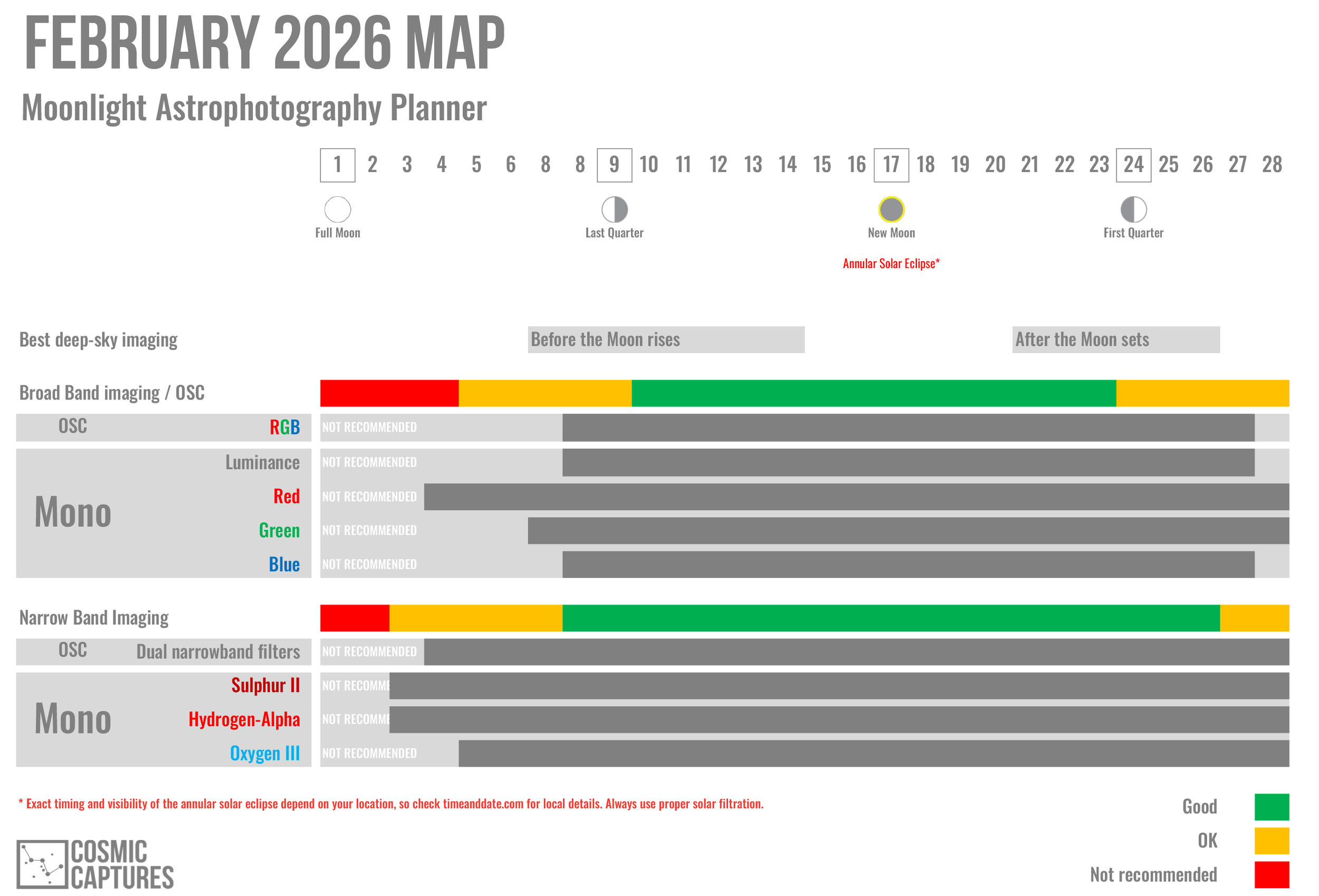
The Moon reaches full phase on February 1, known as the Snow Moon.

Last Quarter
February 9
Deep-sky imaging is best in the first half of the night before the Moon rises in the early morning hours.

New Moon and Annular Solar Eclipse
February 17
A rare “ring of fire” eclipse occurs over remote Antarctica. A partial eclipse is visible from parts of southern South America and southern Africa, but most locations will not see the event. Proper solar filters are required for safe viewing.
Check timeanddate.com for more details.

First Quarter
February 24
Deep-sky imaging is best after midnight.
Also great for capturing lunar surface details with strong shadows along the terminator.
The Moonlight Astrophotography Planner (MAP)
Each month, the MAP — or Moonlight Astrophotography Planner — helps you choose the best nights for capturing galaxies, nebulae, and nightscapes. Whether you’re shooting broadband or narrowband, MAP gives you clear guidance based on the Moon phase, so you can match your imaging plans to the sky conditions.
You can download this month’s MAP as a free PDF using the button below. It’s updated monthly to help you make the most of your imaging time, no matter your style or setup.
Nightscape Opportunities
In the Northern Hemisphere, the winter Milky Way is shifting west, opening up wide views of Orion, Taurus, and Auriga. This makes February a strong month for capturing a winter Milky Way arch, with bright nebulae and star fields stretching across the sky in a classic cold-season panorama.
In the Southern Hemisphere, the Milky Way stands nearly vertical around midnight, creating striking opportunities for tall, vertical compositions. Orion, Canis Major, and the rich southern star fields rise high, making it a great time to frame the Milky Way rising from the horizon or cutting straight through the sky.
February is all about geometry — wide arches in the north, dramatic verticals in the south.
Image by Cosmic Captures