
Cosmic Highlights
A monthly night sky guide to what’s worth capturing right now.
AUGUST 2026
August — The Moon's Triple Act
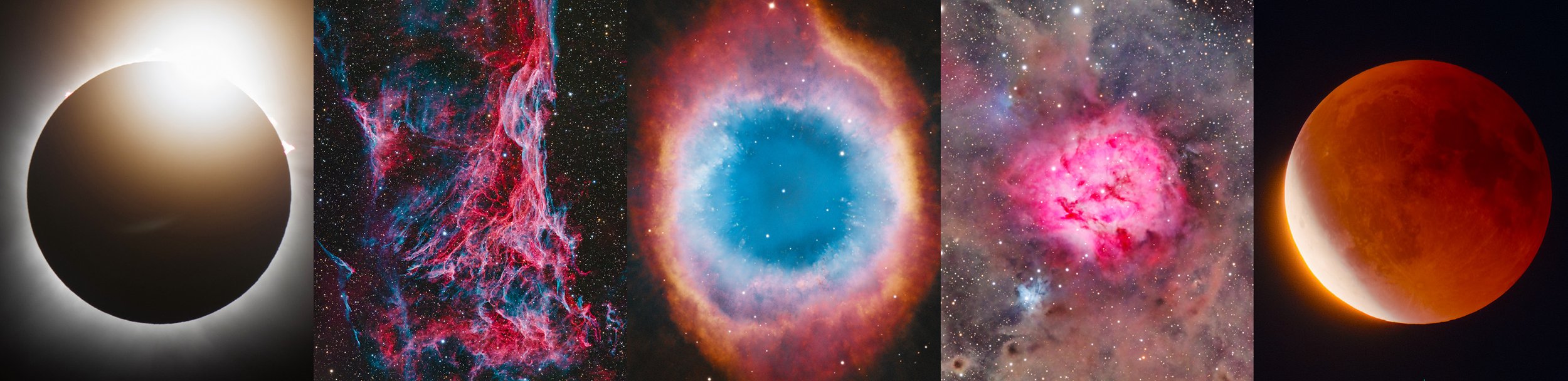
This month, the Moon performs three times. On the afternoon of August 12 it takes centre stage, crossing the face of the Sun in a total eclipse that sweeps from Greenland across Iceland into northern Spain. That night comes the second act, played entirely by absence — an eclipse can only happen at new Moon, so the sky goes properly black just as the Perseids peak. Last year, moonlight drowned them; this year, the shower gets the darkest stage of all. And on the night of the 27th–28th, the final act: the Moon slides into Earth's shadow itself, a deep partial lunar eclipse with 96% of its face in darkness. It takes the Sun's light, lends the night its darkness, and then gives up its own light to close the month.
And the generosity doesn't stop at one date. The nights around the 12th form the darkest stretch of the month, real astronomical darkness is finally back in the far north, and the Cygnus star fields — the richest imaging territory of the northern year — stand straight overhead at midnight. In the south, the galactic core begins its slow goodbye while the first autumn showpieces climb in the east.
Whatever you point at the sky this month, August meets you halfway.
The Night Sky at a Glance
Northern Hemisphere Sky – Midnight at New Moon (at +40° latitude)
Image from the app Stellarium
Cygnus rides the zenith, with the Summer Triangle centred overhead and the Milky Way running through it from horizon to horizon. This is the heart of nebula country: the North America, the Veil, and the Cocoon all pass nearly overhead. Lower in the southwest, Sagittarius and the galactic core begin their descent — catch them early in the night while they last. Meanwhile, Pegasus climbs in the east, carrying the first globulars and galaxies of autumn, and at high northern latitudes, true darkness has finally returned to the whole night.
Southern Hemisphere Sky – Midnight at New Moon (at -30° latitude)
Image from the app Stellarium
The core still crowns the early evening, passing overhead before leaning west as the night matures — the last full month of prime galactic-centre imaging. In its place, the east delivers: Aquarius and Capricornus rise with a fleet of globular clusters, and the Helix Nebula climbs toward the zenith, placed better for southern imagers than for anyone else on Earth. Fomalhaut announces the coming season of southern galaxies.
The Best-Placed Objects This Month
These objects are at their highest point in the sky around midnight. That means better visibility, longer imaging windows, and a great chance to explore some of the best deep-sky objects in the night sky.



M15 • M2 • M72 • M30 — Jellyfish Cluster

From CAP & MAP to

it’s live and free for everyone.
For over a year, the Cosmic Astrophotography Planner (CAP) and the Moonlight Astrophotography Planner (MAP) were how I helped you plan your nights — monthly PDFs, built by hand, frozen the moment they were exported. TonightPlan is their living successor, and as of this month, it takes over completely: it knows where you are, what the Moon is doing tonight, and which targets are worth your time right now, matched to your sky and your gear. No sign-up, nothing to install. Free, because the sky above us is for everyone.
The CAP and MAP retire with this issue — with my genuine thanks to everyone who downloaded them month after month. The past editions remain available on the previous guide pages if you're fond of them. Everything they did, the app now does better, every single night.
M39 — Pyramid Cluster
Object type: Open cluster
Constellation: Cygnus
Apparent dimensions: ~29′
Filtering: No filter
Recommended integration: 1–3h
Peak month: August
Altitude at peak: Northern: High | Southern: Very low
M39 is what Cygnus looks like when it relaxes: a loose pyramid of a few dozen blue-white stars, close enough — about 1,000 light-years — to spread across a full Moon's width of sky. After the dense nebula fields nearby, it reads like a deep breath.
It's also one of the friendliest targets of the month — bright, forgiving of moonlight, and satisfying within a relaxed evening on almost any setup. A good first-light target for a new scope, and a good last-light target before the Moon returns.
M39, captured using a ZWO Seestar S50 smart telescope by Cosmic Captures
One of the easiest smart-scope wins of the month — the pyramid resolves within minutes. Let it run an hour or two anyway: the fainter Milky Way backdrop is what gives the frame its depth.
M73
Object type: Asterism
Constellation: Aquarius
Apparent dimensions: ~2.8′
Filtering: No filter
Recommended integration: <1 hour
Peak month: August
Altitude at peak: Northern: Low | Southern: High
M73 is one of the Messier catalogue's strangest entries: four unrelated stars in a small Y-shape that Messier logged as a "cluster with nebulosity" in 1780. There is no cluster, and there is no nebulosity — just a chance alignment and a 250-year-old clerical mystery.
So why shoot it? Because it's part of the catalogue's story — and if you're working through all 110 Messier objects, this is the fastest tick on the entire list. Capture it on your way to M72 or M2 nearby, and enjoy owning one of the night sky's finest paperwork errors — its only real rival being M40, a double star Messier logged while chasing a nebula that never existed.
M73, captured using a DWARFLab Dwarf Mini smart telescope by Cosmic Captures
Possibly the fastest capture in the entire Messier catalogue — a smart scope resolves all four stars almost immediately. Grab it on the way to M72 next door and enjoy the story more than the pixels.
M15
Object type: Globular cluster
Constellation: Pegasus
Apparent dimensions: ~18′
Filtering: No filter
Recommended integration: 1–3h
Peak month: August
Altitude at peak: Northern: High | Southern: Medium
M15 is a hundred thousand stars packed into a ball older than the Milky Way's disk — with one of the densest cores of any globular in the sky. Stars near its centre long ago lost any concept of night.
That dense core is also the trap: it clips to a white blob before anything else in your image. Expose for the centre and let the outskirts sparkle. Because globulars shrug off moonlight, M15 is the pick for the bright end of the month — when the nebulae have given up, this one is just getting started.
M15, captured using a ZWO Seestar S50 smart telescope by Cosmic Captures
A smart-scope favourite for bright-Moon nights: an hour resolves the halo into stars, and more time deepens it. Watch the core — stop stretching before it clips to white, and the cluster keeps its depth.
M2
Object type: Globular cluster
Constellation: Aquarius
Apparent dimensions: ~16′
Filtering: No filter
Recommended integration: <1h
Peak month: August
Altitude at peak: Northern: Medium | Southern: High
M2 is one of the oldest and largest globulars the Milky Way owns — a slightly flattened ball of some 150,000 ancient suns, sitting almost exactly on the celestial equator, which serves it fairly to both hemispheres.
No filter needed, and moonlight is welcome — globulars shrug it off. The one care point is the core: stretch gently so it keeps its texture instead of clipping to white. M2 rewards the care with a look all its own — dense, uniform, almost brushed, like a cluster that combed its hair before the photo.
M2, captured using a DWARFLab Dwarf Mini smart telescope by Cosmic Captures
Under an hour on a smart scope gives a satisfying result, and moonlight is no obstacle. Its seat on the celestial equator means every smart scope on Earth gets a fair shot at it.
M72
Object type: Globular cluster
Constellation: Aquarius
Apparent dimensions: ~7′
Filtering: No filter
Recommended integration: 1–3h
Peak month: August
Altitude at peak: Northern: Low | Southern: High
M72 is the quiet one: one of the faintest and most distant globulars in the Messier catalogue, some 55,000 light-years out. Where M15 dazzles, M72 asks you to work — a soft, loose glow that only resolves into stars with patience and aperture.
That's exactly its appeal. It's an honest test of your setup and your skies, and a satisfying capture precisely because nobody stumbles into it. M73 sits just next door if you want to add the catalogue's oddest little asterism to the same night.
M72, captured using a ZWO Seestar S50 smart telescope by Cosmic Captures
Honest expectations: on a smart telescope, M72 stays a soft glow rather than a resolved swarm — two hours and dark skies help. A quiet badge of patience, and the natural pairing with M73 beside it.
M30 — Jellyfish Cluster
Object type: Globular cluster
Constellation: Capricornus
Apparent dimensions: ~12′
Filtering: No filter
Recommended integration: <1h
Peak month: August
Altitude at peak: Northern: Low | Southern: High
M30 is a collapsed-core globular — gravity has run further here than in most clusters, crushing its heart dense while curious chains of stars stream outward like tentacles. That's the jellyfish, mid-swim.
From the north it stays low and wants a clean southern horizon; from the south it rides high and easy. Short integrations work, moonlight is tolerable, and the star chains emerge with careful, gentle stretching.
M30, captured using a ZWO Seestar S50 smart telescope by Cosmic Captures
From southern latitudes, an easy hour. From the north, shoot it exactly at culmination over a clean southern horizon — the lower the target, the more the atmosphere taxes a small scope.
NGC 7000 & IC 5070 — North America & Pelican Nebula
Object type: Emission nebula complex
Constellation: Cygnus
Apparent dimensions: 120′ × 100′ (NGC 7000) · 60′ × 50′ (IC 5070)
Filtering: Dual / Narrowband
Recommended integration: 1–3h (North America) · 3–6h (Pelican)
Peak month: August
Altitude at peak: Northern: High | Southern: Very low
Right beside Deneb — if you've ever photographed the summer Milky Way, this was in your frame whether you knew it or not — a continent of glowing hydrogen faces its pelican across a strait of dark dust. They're one cloud, split only by dust in the foreground, and new suns are switching on inside both.
Go wide: a 2°–4° field takes continent and pelican in a single frame — and you don't even need a telescope. A still camera with a 135mm lens on a simple star tracker frames the pair beautifully, floating in their Cygnus star field. Then look closer — the sculpted "Cygnus Wall" on the continent's gulf coast, and the glowing ionisation fronts along the Pelican's edge, where newborn stars are eating into the cloud that made them. Hydrogen-alpha or a dual-band filter keeps the whole region workable under moonlight.
NGC 7000 & IC 5050, captured with a Sky-Watcher Esprit 100 at f/4.12 and an ASI2600MM Pro camera using RGBHSO filters
NGC 7000 & IC 5050, captured using a Vaonis Vespera II smart telescope by Cosmic Captures
Mosaic-mode territory on most smart scopes — or a single frame on the wide-field models. If you'd rather stay single-frame, the Cygnus Wall alone is a complete picture. Dual-band filtering keeps it working under moonlight.
NGC 6960 & NGC 6992 — The Veil Nebula
Object type: Supernova remnant
Constellation: Cygnus
Apparent dimensions: 70′ × 6′ (Western) · 60′ × 8′ (Eastern); complex ~3°
Filtering: Dual / Narrowband
Recommended integration: 3–6h per arc
Peak month: August
Altitude at peak: Northern: High | Southern: Low
Ten thousand years ago — before anyone had written a word — a star in Cygnus tore itself apart. The shockwave is still expanding, and we've named the wreckage the Veil: three degrees of glowing filament, six full Moons side by side.
Frame its two great arcs separately — each fills a frame on its own. The Western Veil (NGC 6960) curves past the bright star 52 Cygni like smoke past a lantern, earning its other name, the Witch's Broom. The Eastern Veil (NGC 6992) is the brighter half: a dense lacework of braided red and teal that resolves deeper the longer you integrate. The Veil speaks mostly in oxygen and hydrogen light, so a dual-band filter keeps it working even as the Moon returns — and if one arc hooks you, the whole battlefield is waiting to be mosaicked.
NGC 6960 & NGC 6992, captured with a Sky-Watcher Esprit 100 at f/4.12 and an ASI2600MM Pro camera using RGBHSO filters
NGC6960, captured using a ZWO Seestar S30 Pro smart telescope by Cosmic Captures
Each arc fits a standard smart-scope frame on its own — pick one per night rather than chasing both. Two hours with a dual-band filter start separating the braided filaments; the full complex is a mosaic project for September's longer nights.
IC 1318 — Sadr Region
Object type: Emission nebula complex
Constellation: Cygnus
Apparent dimensions: 240′ × 180′
Filtering: Dual / Narrowband
Recommended integration: 3–6h
Peak month: August
Altitude at peak: Northern: High | Southern: Low
Around Sadr — the star at the Swan's heart — the Milky Way ignites: sprawling sheets of glowing hydrogen split by a dark dust lane into the wings of a butterfly. This isn't a target so much as a territory; every framing finds a different picture.
Go wide for the full butterfly with Sadr blazing at centre, or push in on the dust lane where the glow and the darkness negotiate. Hydrogen-alpha turns the whole region into relief-map detail and shrugs off moonlight. One of the most generous fields in the northern sky.
The Sadr Region, captured with a Sky-Watcher Esprit 100 at f/4.12 and an ASI2600MM Pro camera using RGBHSO filters
IC1318, captured using a ZWO Seestar S30 Pro smart telescope by Cosmic Captures
You can't frame this wrong — every pointing in the region finds glowing structure. Wide-field smart scopes take the butterfly whole; narrower ones should hunt along the dark lane. The built-in or dual-band filter earns its keep here.
IC 5146 — Cocoon Nebula
Object type: Emission + reflection nebula (with dark nebula Barnard 168)
Constellation: Cygnus
Apparent dimensions: 8.2′ × 8.2′ (dark lane ~1.5°)
Filtering: Broadband (no LP filter)
Recommended integration: 3–6h +
Peak month: August
Altitude at peak: Northern: High | Southern: Very low
You don't find the Cocoon by looking for light — you follow a river of darkness. Barnard 168 is a starless channel cut through one of the richest fields in Cygnus, and at its end hangs the Cocoon, wrapped around a cluster of newborn stars.
The Cocoon doesn't come easy — and a narrowband filter won't save it: it's a three-flavour dish of glowing red, reflected blue, and darkness, and a filter keeps only one. Shoot it unfiltered in the moonless window around the 12th, and keep the dark river in frame, it’s half the picture.
IC5146, captured with a Sky-Watcher Esprit 100 at f/4.12 and an ASI2600MM Pro camera using LRGBHSO filters
IC5146, captured using a ZWO Seestar S50 smart telescope by Cosmic Captures
Save this one for the moonless window and skip the filter — the Cocoon's blue and the river's darkness are broadband-only. Three to four hours show the nebula clearly. But more is even better. If your field of view is wide enough, offset your framing so Barnard 168 flows across the frame.
NGC 7023 — Iris Nebula
Object type: Reflection nebula
Constellation: Cepheus
Apparent dimensions: 18′ × 18′
Filtering: No filter / dark skies
Recommended integration: 3–6h +
Peak month: August
Altitude at peak: Northern: High | Southern: Low
The Iris is starlight, not glow: a single hot young star illuminating the dust cloud it was born from, unfolding in blue petals against a field of faint brown nebulosity. No filter helps here — reflection nebulae live entirely in broadband light.
It demands the same dark, moonless skies as the Cocoon and rewards patience with one of the most elegant colour palettes in the northern sky. Far-northern imagers get it nearly overhead; from the southern hemisphere it hugs the northern horizon at best.
NGC7023, captured with a Sky-Watcher Esprit 100 at f/4.12 and an ASI2600MM Pro camera using LRGB filters
NGC7023, captured using a ZWO Seestar S50 smart telescope by Cosmic Captures
Honest expectations: a smart scope reaches the bright blue core in two to three hours under a dark sky, but the surrounding brown dust — the part that makes the famous images — asks for far more. Capture the flower this year; the garden can come later.
IC 1396 — Elephant's Trunk Nebula
Object type: Emission nebula complex
Constellation: Cepheus
Apparent dimensions: 170′ × 140′
Filtering: Dual / Narrowband
Recommended integration: 3–6h
Peak month: August
Altitude at peak: Northern: High | Southern: Not visible
Inside a vast, faint shell of hydrogen in Cepheus, a dark pillar of dust curls like a trunk — dense enough to resist the radiation eroding it, with new stars forming inside the very structure being destroyed.
Wide fields capture the whole shell around the star cluster at its heart; longer focal lengths isolate the trunk itself. Narrowband or dual-band filters make it workable under moonlight. A northern-sky exclusive, and a quieter alternative when the famous Cygnus targets feel crowded.
IC1396, captured with a Radian Raptor 61 and an ASI2600MM Pro camera using HSO filters
With a dual-band filter, expect the trunk as a dark curl in a soft red field after two to three hours — real, but subtle. The full three-degree shell is beyond a single smart-scope frame; the trunk region itself is a picture by itself.
LDN 1235 — Dark Shark Nebula
Object type: Dark nebula
Constellation: Cepheus
Apparent dimensions: 210′ × 150′
Filtering: No filter / dark skies
Recommended integration: 15h +
Peak month: August
Altitude at peak: Northern: Medium | Southern: Not visible
The Shark is photography's strangest assignment: capturing something that emits almost no light at all. It's a cloud of interstellar dust, faintly lit by the combined glow of the galaxy around it, cruising through Cepheus with a dorsal fin you cannot unsee.
This is a challenge target in the truest sense — it wants genuinely dark skies, a moonless week, and integration measured in tens of hours (the image in TonightPlan took 22), with careful processing that lifts the dust without drowning it in noise. No filter can help; darkness is the subject. Land it, and you've joined a fairly small club.
LDN1235, captured with a Sky-Watcher Esprit 100 at f/4.12 and an ASI2600MM Pro camera using LRGB filters
Not an ideal smart-telescope target: the dust's surface brightness sits near the limit of what a small aperture can lift from the sky glow. This is a 15-hour-plus project even on larger rigs — treat it as an expedition across a season, not an evening.
NGC 7293 — Helix Nebula
Object type: Planetary nebula
Constellation: Aquarius
Apparent dimensions: 16′ × 12′
Filtering: Dual / Narrowband
Recommended integration: 3–6h
Peak month: August
Altitude at peak: Northern: Low | Southern: High
The Helix is the nearest bright planetary nebula — the exposed core of a dead star wrapped in the atmosphere it let go, staring back like an eye. This is where sun-like stars end, close enough to resolve real structure with amateur gear.
Your horizon decides this one. From 55° north it barely clears the treetops — flat southern view, second half of the night, every degree counts. The further south you live, the kinder it gets; from the southern hemisphere it rides nearly overhead. Southern imagers: August belongs to you.
NGC7293, processed by Cosmic Captures from Telescope.Live image data
NGC7293, captured using a ZWO Seestar S50 smart telescope by Cosmic Captures
Genuinely one of the best smart-scope planetaries — the eye shows up within the first hour; dual-band recommended. From northern latitudes, the low altitude adds noise, so shoot only around culmination; from the south, this is a headline target.
The main Moon Phases in August 2026
Planning your imaging sessions? The Moon plays a massive role in what we can capture.
Here’s what’s happening this month:

Last Quarter
August 4
Deep-sky imaging is best in the first half of the night, before the Moon rises in the early hours.
New Moon and Total Solar Eclipse
August 12
The darkest skies of the month — and this one arrives with a total solar eclipse in daylight and the Perseids after dark. The nights around it (roughly the 8th–16th) are the month's prime deep-sky window.
Use a solar filter for safe viewing and check timeanddate.com for details.
First Quarter
August 20
Deep-sky imaging is best after midnight. Strong terminator shadows make it a good evening for lunar surface detail.

Full Moon and Partial Lunar Eclipse
August 28
August's full Moon is the Sturgeon Moon — and this year it rises into Earth's shadow: a deep partial lunar eclipse on the night of the 27th–28th covers about 96% of the Moon at maximum (04:12 UTC). Best views from the Americas; Europe catches it low in the west toward moonset. Check timeanddate.com for details. No filters, no glasses — just look.
The Total Solar Eclipse — August 12
The Moon's shadow first touches down at sunrise over the uninhabited Taymyr Peninsula in Siberia, then sweeps across eastern Greenland and western Iceland before crossing the Atlantic to northern Spain — where totality arrives low over the horizon, in the last light before sunset. Maximum totality: about 2 minutes 18 seconds. Most of Europe stands inside a deep partial eclipse.
If you're anywhere near the path: proper eclipse glasses for every partial phase, and solar filters for every lens and finder — no exceptions. And if you're nowhere near it, the eclipse still pays you: a Moon that can cover the Sun is by definition new, which is why the nights around the 12th are the darkest of the month.
Check timeanddate.com for details.
Photo Credit: (NASA/Joel Kowsky)
The Partial Lunar Eclipse — August 27–28
Two weeks after taking the Sun's light, the Moon gives up its own. On the night of August 27–28, it slides into Earth's shadow for a deep partial lunar eclipse — 96% covered at maximum eclipse (04:12 UTC on the 28th), close enough to total that the Moon will glow a deep, coppery red across most of its face.
The Americas get the full show from start to finish. From Europe and Scandinavia, the eclipsed Moon sinks low toward the western horizon in the early morning hours — catch it before moonset, and bring a foreground: a low, red, eclipsed Moon over a landscape is one of the finest nightscape opportunities of the year. No filters, no glasses, no special gear — a lunar eclipse is completely safe for eyes, lenses and telescopes alike. Just look up, and take your time. It lasts for hours.
Check timeanddate.com for details.
September 2025 Lunar Eclipse — Image by Cosmic Captures
The Perseid Meteor Shower
The Perseids peak on the night of August 12–13 — and for the first time in years, they get a black sky. Last August, moonlight drowned all but the brightest meteors. This year the Moon is new on the peak night itself.
Under dark skies, expect a meteor a minute or better in the hours after midnight, more as the radiant climbs toward dawn. It's a northern-favoured shower, but southern observers catch the brighter ones too. No gear required — a blanket, a dark spot, and twenty minutes of patience for your eyes to adapt. If you image it: wide lens, high ISO, short exposures, and let the camera run while you just watch.
2024 Perseids with Aurora Borealis — Image by Cosmic Captures
Nightscape Opportunities
In the north, August is the Milky Way's late golden hour: the core sits low in the southwest at nightfall, and by midnight the band stands nearly vertical overhead. That geometry isn't kind to panoramas — but it's made for vertical compositions: the Milky Way as a tower of light rising out of a foreground. And with real darkness back at far-northern sites, the moonless window around the 12th is the best nightscape stretch of the whole summer.
In the south, the core crowns the early evening — straight overhead, spectacular, and honestly awkward for foregrounds; this is the hour for all-sky frames. The nightscape window opens later, as the core leans west and drops toward the horizon: the galactic centre settling over a landscape, the season's farewell image. It happens earlier every week — August is the month to catch it before it's gone.
Image by Cosmic Captures