
Cosmic Highlights
A monthly night sky guide to what’s worth capturing right now.
JULY 2026
July — The Triangle and the Core
July belongs to two regions of sky at once: the Summer Triangle — Vega, Deneb, and Altair — and the galactic core in Sagittarius, now at its peak for the year.
This is small-target country. Cygnus, Lyra, Vulpecula, Sagitta, and Scutum are packed with compact, bright objects that frame perfectly on a smart telescope — two of the finest planetary nebulae in the sky (the Ring and the Dumbbell), the richest open cluster in the Milky Way (the Wild Duck), the wind-blown shell of the Crescent, and a scatter of globulars hiding in plain sight. Alongside them, the Sagittarius core spreads its globular clusters and dark nebulae across the brightest stretch of the galaxy.
Wherever you're imaging from, the catalogue is full this month.
The Night Sky at a Glance
Northern Hemisphere Sky – Midnight at New Moon (at +40° latitude)
Image from the app Stellarium
The Summer Triangle sits near the zenith, with Cygnus directly overhead and the Milky Way pouring straight down through it. This is the part of the sky northern imagers can finally work without altitude penalties. Lower in the south, Sagittarius and Scorpius reach their highest point of the year, putting the galactic core within genuine reach for a few hours around midnight. And with the solstice behind us, true astronomical darkness is creeping back into mid-northern nights.
Southern Hemisphere Sky – Midnight at New Moon (at -30° latitude)
Image from the app Stellarium
The southern sky is still at its absolute best. The core passes overhead, the Milky Way fills the sky from horizon to horizon, and the rich star fields of Sagittarius and Scorpius sit at the zenith. Pavo rides high in the south — home to two southern showpieces, the bright globular NGC 6752 and the sprawling spiral NGC 6744 — and the delicate Corona Australis cloud complex is well-placed for the long integrations it needs.
The Best-Placed Objects This Month
These objects are at their highest point in the sky around midnight. That means better visibility, longer imaging windows, and a great chance to explore some of the best deep-sky objects in the night sky.


M54 • M55 — Summer Rose Star • M56 • M70 • M71 — Angelfish Cluster • M75 • NGC 6752


The Cosmic Astrophotography Planner (CAP)
The Cosmic Astrophotography Planner (CAP) is a curated monthly guide to help you make the most of the night sky — with a focused selection of targets, practical framing guidance, and clear expectations for what's realistic to capture this month.
Each CAP is built from my long-term planning system and reflects how I'm prioritising targets based on season and real-world conditions.
The free monthly overview gives you a simple snapshot of what's available and worth focusing on right now.
A New Way to Plan: Coming in July
The Cosmic Astrophotography Planner (CAP) has been a monthly PDF for over a year — a static snapshot you download and adapt. TonightPlan is the next step. Same target catalogue, same logic — but interactive. It knows where you are, what the moon's doing tonight, and tells you which targets are worth your time right now — matched to your sky, your gear, and your patience.
M11 — Wild Duck Cluster
Object type: Open cluster
Constellation: Scutum
Apparent dimensions: 23′
Filtering: No filter
Recommended integration time: <1 hour +
Peak month: July
Altitude at peak: Northern hemisphere: Medium | Southern hemisphere: High
M11 is one of the richest and most compact open clusters in the sky — so densely packed it can be mistaken for a loose globular at first glance. It sits around 6,000 light-years away in Scutum, cramming thousands of stars into a tight knot, with a scatter of brighter members fanning out from the crowd. That fan is the shape that suggested a flight of wild ducks to early observers and gave the cluster its name.
What carries the frame as much as the cluster is where it sits: one of the densest, most glorious stretches of the summer Milky Way, framed by countless background stars. No filter needed, and it resolves fast — even a short session breaks the dense centre into a glittering swarm.
M11, captured using a ZWO Seestar S50 smart telescope by Cosmic Captures
Twenty minutes on a smart telescope is already enough to resolve the packed centre into individual stars. Keep your framing generous — the surrounding star field is half the picture.
M26
Object type: Open cluster
Constellation: Scutum
Apparent dimensions: 14′
Filtering: No filter
Recommended integration time: 1–3 hours +
Peak month: July
Altitude at peak: Northern hemisphere: Medium | Southern hemisphere: High
M26 is a modest open cluster set against the dense star clouds of Scutum, in one of the richest stretches of the summer Milky Way. It's small and fairly sparse — a loose gathering of a few dozen stars that, in a field this crowded, you have to look twice to separate from the multitude behind it. It lies around 5,000 light-years away, not far from its showier neighbour M11.
Its one real curiosity is a small apparent gap near its heart, thought to be caused by a veil of intervening dust blocking the stars behind it. There's no drama here and no filter needed — this is a quieter target, its charm lying as much in the teeming background as in the cluster itself.
M26, captured using a ZWO Seestar S50 smart telescope by Cosmic Captures
A target for when you're already in this corner of Scutum. The cluster comes through in under one hour, but give it more time, and the dense Milky Way backdrop is what gives the frame its depth.
M29 — Cooling Tower Cluster
Object type: Open cluster
Constellation: Cygnus
Apparent dimensions: 7′
Filtering: No filter
Recommended integration time: <1 hour +
Peak month: July
Altitude at peak: Northern hemisphere: High | Southern hemisphere: Low
M29 is a small, loose cluster sitting inside one of the most nebula-saturated regions of the entire sky. The cluster itself is modest — a compact knot of blue-white stars, quick to bring out — but the context is extraordinary. The mottled background around it isn't noise; it's the Cygnus molecular cloud, threaded with hydrogen emission and dust that runs through this whole region.
It's a target that rewards thinking about what's behind it. The faint warmth in the background is just the surface of what's actually there.
M29, captured using a ZWO Seestar S50 smart telescope by Cosmic Captures
The cluster comes out in minutes. With more integration — and a dedicated Hα pass if you have one — the Cygnus background starts to reveal the gas it's embedded in. That's where the time pays off.
M54
Object type: Globular cluster
Constellation: Sagittarius
Apparent dimensions: 9′
Filtering: No filter
Recommended integration time: 1–3 hours +
Peak month: July
Altitude at peak: Northern hemisphere: Low | Southern hemisphere: High
M54 is a small, brilliant knot of light with one of the best backstories in the catalogue. It isn't part of our galaxy at all — it belongs to the Sagittarius Dwarf, a small galaxy being slowly pulled apart by the Milky Way, which makes M54 the first globular cluster ever found to be extragalactic.
At roughly 87,000 light-years it's also one of the most distant in Messier's list, and the distance shows. It stays tight and concentrated, its core blazing while only the outermost stars break into individual points. In the frame it reads as a compact, glittering ball among scattered field stars.
It's small, needs no filter, and a short session captures it easily — but resolving something this far away is the real challenge.
M54, captured using a ZWO Seestar S50 smart telescope by Cosmic Captures
Don't expect to break the core — at this distance it stays a tight ball. The achievement here is capturing a cluster that belongs to another galaxy entirely.
M55 — Summer Rose Star
Object type: Globular cluster
Constellation: Sagittarius
Apparent dimensions: 19′
Filtering: No filter
Recommended integration time: 1–3 hours +
Peak month: July
Altitude at peak: Northern hemisphere: Low | Southern hemisphere: High
Most globular clusters bury their stars in a dense, blazing core that small scopes can't fully resolve. M55 doesn't — and that's exactly what makes it a quiet showpiece. Around 17,600 light-years away in Sagittarius, it's unusually loose and open, spreading its stars so they resolve cleanly right across the cluster rather than only at the fringes.
That gives M55 a rare double character — concentrated yet open at once — and a real sense of depth, with individual suns standing apart from one another. At about 19 arc-minutes it frames beautifully and needs no filter.
A short session pulls the stars out; a longer one fills in the fainter members. Far more rewarding than its modest reputation suggests.
M55, processed by Cosmic Captures from Telescope.Live image data
M55, captured using a ZWO Seestar S50 smart telescope by Cosmic Captures
Under an hour from a dark site resolves it cleanly across the whole cluster — the loose structure is forgiving. One of the easier globulars to make look genuinely three-dimensional.
M56
Object type: Globular cluster
Constellation: Lyra
Apparent dimensions: 9′
Filtering: No filter
Recommended integration time: 1–3 hours +
Peak month: July
Altitude at peak: Northern hemisphere: High | Southern hemisphere: Low
M56 is a modest globular — looser and less concentrated than its more famous neighbours. The outer stars begin to resolve while the core stays packed, giving it a soft, gradual structure rather than a hard blazing centre.
It sits in Lyra, close on the sky to the position of the first gravitational wave event ever detected. The image won't show you that, of course — but it's worth knowing where you're pointing.
M56, captured using a ZWO Seestar S50 smart telescope by Cosmic Captures
An hour and a half lifts the outer members clear. A quiet target — judge it on its own terms rather than against the showpieces nearby. It’s small but rewarding in a smart telescope.
M70
Object type: Globular cluster
Constellation: Sagittarius
Apparent dimensions: 8′
Filtering: No filter
Recommended integration time: 1–3 hours +
Peak month: July
Altitude at peak: Northern hemisphere: Very low | Southern hemisphere: High
M70 is a small, dense southern globular with an outsized place in comet history. It lies about 29,400 light-years away in Sagittarius, its core collapsed inward over time into a tight, bright ball of stars.
Its real claim to fame came in 1995: it was while observing M70 that Thomas Bopp chanced upon a faint smudge beside it — the comet that became Hale–Bopp, one of the most spectacular of the century.
The cluster itself is compact at around 8 arc-minutes and sits low in the south, so it wants a clear southern horizon. No filter needed, and it builds up well over a session or two.
M70, captured using a ZWO Seestar S50 smart telescope by Cosmic Captures
A rewarding little globular with a great backstory — this is the patch of sky where Hale–Bopp was first spotted. At 8 arc-minutes it sits compact in a smart-telescope frame with room to spare.
M71 — Angelfish Cluster
Object type: Globular cluster
Constellation: Sagitta
Apparent dimensions: 7′
Filtering: No filter
Recommended integration time: <1 hour +
Peak month: July
Altitude at peak: Northern hemisphere: High | Southern hemisphere: Medium
M71 is looser and more open than the classic globulars — the stars spread outward freely rather than packing tightly toward the centre, which means individual members resolve easily even at modest integration times. For decades, it sat in an identity crisis: astronomers debated whether it was a dense open cluster or a sparse globular. It's a globular, just an unusually diffuse one.
It sits in the small constellation Sagitta, and the surrounding star field is generous, adding real depth to the frame.
Short integrations work well here.
M71, captured using a DWARFLab Dwarf Mini smart telescope by Cosmic Captures
Rewarding and forgiving — the loose structure resolves readily. At 7 arc-minutes it's small in the frame, with the generous Sagitta star field adding real depth around it.
M75
Object type: Globular cluster
Constellation: Sagittarius
Apparent dimensions: 7′
Filtering: No filter
Recommended integration time: <1 hour +
Peak month: July
Altitude at peak: Northern hemisphere: Low | Southern hemisphere: High
At the opposite extreme from the loose, straggly globulars, M75 is one of the most tightly concentrated clusters in the whole catalogue. It's also among the most distant, lying roughly 67,500 light-years away in Sagittarius, and that mix of distance and density makes it small but intensely bright — a compact ball that blazes at its centre rather than spreading out.
At around 7 arc-minutes it takes no filter and handles Moon and light pollution comfortably. Despite its distance, it resolves more readily than you'd expect: a dense, blazing core wrapped in a halo of pinpoint stars.
M75, captured using a ZWO Seestar S50 smart telescope by Cosmic Captures
Rewarding, and the most concentrated globular of the month. Small and bright at 7 arc-minutes, with a hard core — watch your exposure so the centre holds detail rather than blowing out.
NGC 6752
Object type: Globular cluster
Constellation: Pavo
Apparent dimensions: 20′
Filtering: No filter
Recommended integration time: 1–3 hours +
Peak month: July
Altitude at peak: Northern hemisphere: Not visible | Southern hemisphere: High
NGC 6752 is a bright, well-resolved globular set in a relatively quiet star field — unusually quiet for a globular in the southern sky. The cluster sits mid-frame as a tight ball with a sharp concentrated core that fades smoothly out into a halo of well-separated outer members.
Longer integration brings out the colour mix: yellow-orange older stars dominating with a sprinkle of blue ones, the cluster's true age — around 12 billion years — showing in the warm overall tint. It lies about 13,000 light-years away in Pavo, and after Omega Centauri and 47 Tucanae it's one of the brightest globulars in the southern sky, and one of the closest.
NGC6752, processed by Cosmic Captures from Telescope.Live image data
NGC 6752, captured using a DWARFLab Dwarf Mini smart telescope by Cosmic Captures
A showstopper — one of the brightest globulars in the sky. At 20 arc-minutes, it frames well on a smart telescope and resolves cleanly well past the core.
M27 — Dumbbell Nebula
Object type: Planetary nebula
Constellation: Vulpecula
Apparent dimensions: 8′ × 6′
Filtering: Dual narrowband recommended
Recommended integration time: 1–3 hours +
Peak month: July
Altitude at peak: Northern hemisphere: High | Southern hemisphere: Low
The Dumbbell is the largest planetary nebula in the entire Messier catalogue, and it shows. That apple-core shape is immediately obvious and only gets better with integration time. Like the Ring, what you're seeing is a dead star's final exhale — but at ten times the apparent size.
It's one of the few targets that genuinely rewards doing both broadband and narrowband: it works beautifully in broadband, and transforms again under a dual-band filter, with how you balance the two left entirely to you.
If you're new to planetary nebulae, start here. If you're not new to planetary nebulae, you've probably already imaged this six times. Image it again.
M27, edited from Cosmic Capures and Telescope.Live image data
M27, captured using a Vaonis Vespera II by Cosmic Captures
A showstopper — one of the brightest globulars in the sky. At 20 arc-minutes, it frames well on a smart telescope and resolves cleanly well past the core.
M57 — Ring Nebula
Object type: Planetary nebula
Constellation: Lyra
Apparent dimensions: 1.4′
Filtering: Dual narrowband recommended
Recommended integration time: 1–3 hours +
Peak month: July
Altitude at peak: Northern hemisphere: High | Southern hemisphere: Low
The Ring Nebula is tiny but extraordinarily bright. Within a minute of integration the ring structure is already there, and the longer you let it run, the more the layers separate. The teal of the inner region comes from ionised oxygen; the outer shell glows in hydrogen — the physics of the gas, not a choice you make later.
What you're looking at is a dead star. The white dwarf at the centre is what our Sun will become in about five billion years, and the ring is its ejected outer layers, still expanding into space.
M57, processed by Cosmic Captures from Telescope.Live image data
M57, captured using a ZWO Seestar S50 smart telescope by Cosmic Captures
Rewarding, but tiny — at 1.4 arc-minutes it's a small feature in a smart-telescope frame rather than something that fills it. The sheer brightness more than makes up for the scale; one of the most dependable small targets in the sky.
NGC 6820
Object type: Emission nebula
Constellation: Vulpecula
Apparent dimensions: 40′ × 30′
Filtering: Dual narrowband recommended
Recommended integration time: 6–15 hours +
Peak month: July
Altitude at peak: Northern hemisphere: High | Southern hemisphere: Low
NGC 6820 is a glowing cloud of gas in Vulpecula wrapped around a small, young star cluster — NGC 6823 — whose hot stars light the whole scene and do the sculpting. Their fierce radiation and winds erode the surrounding gas and dust into dark pillars and globules; the densest resist longest and end up pointing back toward the cluster that's wearing them down.
The standout feature is a long dusty finger near the centre, shielding pockets where new stars may still be forming inside. It's a fair way off — very roughly 6,000 light-years — and on the faint side, so it rewards time on target: more hours bring out the pillars and the fainter outer wisps.
Narrowband is the way to go here, lifting the structure cleanly from the background, though the cluster itself comes through easily. Give it a long session — the detail is well worth the wait.
NGC 6820, captured with a Sky-Watcher Esprit 100 at f/4.12 and an ASI2600MM Pro camera using LRGBHSO filters
A rewarding target, but a demanding one. At 40×30 arc-minutes it fits a typical smart-telescope frame; it's faint, though, so narrowband does the heavy lifting — the cluster comes easily, the eroded dust structure is the prize.
NGC 6888 — Crescent Nebula
Object type: Emission nebula
Constellation: Cygnus
Apparent dimensions: 18′ × 13′
Filtering: Dual narrowband recommended
Recommended integration time: 3–6 hours +
Peak month: July
Altitude at peak: Northern hemisphere: High | Southern hemisphere: Low
A brain floating in space — that's what the Crescent has always looked like to me. The folds and ridges aren't decorative; they're a shockwave. The star at the centre is blowing out a fast wind that's slamming into gas the same star released earlier in its life, when it was younger and larger. The collision is what glows.
It sits inside a far wider field of hydrogen, so a wide enough frame catches both — the brain in the foreground, the cloud it lives in behind. The central star is in its final stage; one day it should explode as a supernova, and what's there now is the prelude.
NGC6888, processed by Cosmic Captures from Telescope.Live image data
NGC6888, captured using a ZWO Seestar S50 smart telescope by Cosmic Captures
A showstopper, and well-sized for smart telescopes at 18×13 arc-minutes. Frame wide enough to keep the surrounding hydrogen field in shot — the Crescent reads best with its context — and let a dual-band filter bring the shell out.
LBN 331
Object type: Emission nebula
Constellation: Cygnus
Apparent dimensions: 180′ × 90′
Filtering: Dual narrowband recommended
Recommended integration time: 15 hours +
Peak month: July
Altitude at peak: Northern hemisphere: High | Southern hemisphere: Very low
LBN 331 is one of the sky's quiet ones — a big, very faint stretch of hydrogen north of Deneb, deep in the crowded star fields of Cygnus. It's enormous, spread across roughly three degrees, but its surface brightness is so low that it's rarely photographed at all.
The eye-catching feature is a delicate arc of glowing hydrogen drawn across the field, laced with dark threads of dust. There's also a much fainter layer of oxygen emission woven through it, but it only emerges with a great deal of data.
This is a patience target in the truest sense: a deep-sky challenge that rewards long narrow
LBN 331, captured with a Sky-Watcher Esprit 100 at f/4.12 and an ASI2600MM Pro camera using LRGBHSO filters
The quietest target of the month — subtle, and genuinely challenging on a smart telescope. At roughly three degrees across it dwarfs a typical frame, and its surface brightness is so low that only the brightest stretch of the arc will show even with a lot of data. One for the patient.
B86 — Ink Spot Nebula
Object type: Dark nebula
Constellation: Sagittarius
Apparent dimensions: 5′
Filtering: No filter / dark skies
Recommended integration time: 1–3 hours +
Peak month: July
Altitude at peak: Northern hemisphere: Low | Southern hemisphere: High
B86 is a dark nebula paired with an open cluster — and one of the most striking examples of "imaging the absence of light" in the sky. Just left of frame centre, the small triangular black blotch against the dense star background is Barnard 86 itself, a Bok globule of cold, dense dust blocking the light of every star behind it. Its discoverer, E. E. Barnard, described it as a drop of ink on the luminous sky — which is where the nickname comes from.
Right next to it sits the small bright open cluster NGC 6520, and a 7th-magnitude foreground star burns on B86's edge. The whole scene plays out against the Large Sagittarius Star Cloud — you're looking past the Sagittarius spiral arm into the galactic bulge, and the static haze of millions of old stars is exactly what makes the dark patch read so clearly. The dust cloud is believed to have formed from the same molecular collapse that produced the neighbouring cluster.
B86, captured using a DWARFLab Dwarf Mini smart telescope by Cosmic Captures
Rewarding, and a smart-telescope favourite even though B86 itself is just 5 arc-minutes. Frame for the wider scene — the cluster beside it and the dense star cloud behind are what make the ink spot read. No filter; you want all that background light.
Corona Australis Molecular Cloud
Object type: Reflection + dark nebula
Constellation: Corona Australis
Apparent dimensions: 150′ × 90′
Filtering: No filter / dark skies
Recommended integration time: 3–6 hours +
Peak month: July
Altitude at peak: Northern hemisphere: Very low | Southern hemisphere: High
This is a molecular cloud complex sitting just outside the bright band of the Milky Way — and in a wide enough frame, it feels like whatever shape you see is facing that blazing band in quiet defiance. To me it looks exactly like a plague doctor's mask. That's not its official name, and you might see something else entirely.
The blue glow comes from the reflection nebulae NGC 6726 and NGC 6727 — starlight scattered off the cloud's edge — while NGC 6729 fans out from a variable star embedded in the dust. A globular cluster, NGC 6723, sits in the same frame 29,000 light-years behind all of this, completely unrelated to the complex in front of it; it's there purely by line-of-sight coincidence.
Not all beauty shouts.
Corona Australis Molecular Cloud, captured with a William Optics RedCat 51 by Cosmic Captures
A rewarding wide-field, but a large one — at 150×90 arc-minutes it overflows a typical smart-telescope frame and wants the widest field you have, or a mosaic. Subtle by nature, it rewards close looking rather than a quick glance.
NGC 6946 — Fireworks Galaxy
Object type: Spiral galaxy
Constellation: Cygnus
Apparent dimensions: 11′ × 11′
Filtering: No filter / dark skies
Recommended integration time: 3–6 hours +
Peak month: July
Altitude at peak: Northern hemisphere: High | Southern hemisphere: Horizon
NGC 6946 is a big, sprawling face-on spiral with a fittingly explosive nickname. It lies about 25 million light-years away, low against the dusty plane of the Milky Way — which is why it sits in a dense carpet of foreground stars, and why its outer arms are dimmed by all that intervening dust. Its warm tones aren’t just aesthetic; they’re shaped by galactic extinction or reddening, as foreground dust shifts the colour balance toward red.
It earned the name Fireworks Galaxy for an extraordinary run of supernovae: ten have flared within it over the past century, more than in any comparable galaxy. Its arms wind out in broad, knotted loops, studded with pink star-forming regions and threaded with the blue of young stars.
This is a broadband target — light-pollution or narrowband filters do more harm than good here. Large and full of structure, it keeps giving the more time you pour in.
NGC6946, processed by Cosmic Captures from Telescope.Live image data
NGC6946, captured using a ZWO Seestar S50 smart telescope by Cosmic Captures
A showstopper, packed with structure. At 11 arc-minutes square it frames comfortably on a smart telescope. Keep it broadband — filters flatten the star-forming knots and arm colour that make it.
NGC 6744
Object type: Spiral galaxy
Constellation: Pavo
Apparent dimensions: 17′ × 11′
Filtering: No filter / dark skies
Recommended integration time: 1–3 hours +
Peak month: July
Altitude at peak: Northern hemisphere: Not visible | Southern hemisphere: Medium
NGC 6744 is a face-on barred spiral that's often called the Milky Way's twin — and the resemblance is real, though it's larger. Looking at it is roughly what an outside observer would see of our own galaxy: a small yellow core, loose blue spiral arms wrapping wide around it, dust threading through. The arms are subtle, not bright — they need the integration time to come up.
It's about thirty million light-years away in Pavo. The little elongated smudge just below the galaxy isn't a defect — it's NGC 6744A, a small companion at the end of an arm, the Magellanic Cloud to this one's Milky Way. The brighter fuzzy object at the edge of the frame is a separate, more distant galaxy.
NGC6744, processed by Cosmic Captures from Telescope.Live image data
NGC6744, captured using a ZWO Seestar S50 smart telescope by Cosmic Captures
A showstopper — the Milky Way's twin. At 17×11 arc-minutes it frames well on a smart telescope, though the spiral arms are faint and need real commitment to bring up.
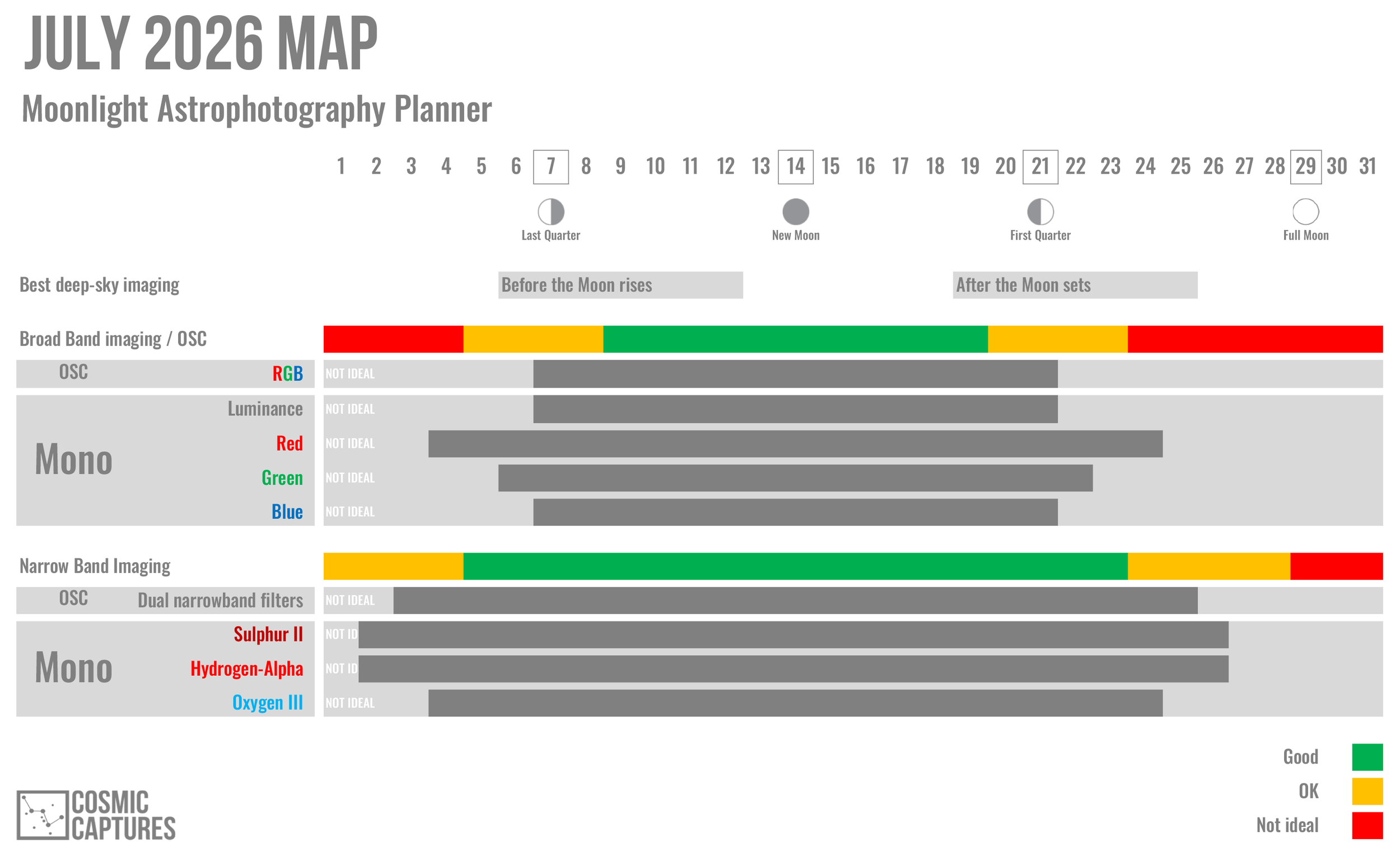
The main Moon Phases in July 2026
Planning your imaging sessions? The Moon plays a massive role in what we can capture.
Here’s what’s happening this month:

Last Quarter
July 7
The month opens with a waning Moon. Deep-sky imaging is best in the first half of the night, before the Moon rises in the small hours. The Sagittarius and Cygnus targets are well-placed in the post-dusk window on these nights. In the predawn east, the Last Quarter Moon sits close to Saturn — a nice wide-field or nightscape pairing.

New Moon
July 14
The darkest skies of the month, and the window for the faint stuff — LBN 331, NGC 6820, the Corona Australis cloud, and the low-surface-brightness arms of the galaxies. The Milky Way core climbs to its highest workable altitude in the hours around midnight. If you only get one clear night this month, make it this one.

First Quarter
July 21
The Moon shifts into the first half of the night. Deep-sky imaging is best after midnight once it has set. It's also a good evening for lunar surface detail — strong shadows along the terminator throw the crater rims into sharp relief.

Full Moon
July 29
The month closes with the full Buck Moon, named for the new antlers that grow on deer bucks around this time. Deep-sky imaging takes the night off — a good night to shoot the Moon itself, or to plan August.
The Moonlight Astrophotography Planner (MAP)
Each month, the MAP — or Moonlight Astrophotography Planner — helps you choose the best nights for capturing galaxies, nebulae, and nightscapes. Whether you’re shooting broadband or narrowband, MAP gives you clear guidance based on the Moon phase, so you can match your imaging plans to the sky conditions.
You can download this month’s MAP as a free PDF using the button below. It’s updated monthly to help you make the most of your imaging time, no matter your style or setup.
Earth at Aphelion — July 3
On July 3, Earth reaches aphelion — the farthest point in its orbit from the Sun, around 152 million kilometres away. It's a quiet milestone with a counterintuitive twist: the Northern Hemisphere is in the middle of summer at the exact moment the planet is furthest from the Sun. Seasons are driven by the tilt of Earth's axis, not its distance — a useful reminder of just how little that orbital distance actually varies across the year.
© timeanddate.com
Nightscape Opportunities
In the higher latitudes of the northern hemisphere, astronomical darkness is slowly returning after the solstice, and the galactic core is now well-placed in the south during the second half of the night. For anyone who can reach genuine darkness, this is one of the best months of the year for wide-field Milky Way work — the core is high enough to clear most of the horizon murk while still sitting low enough to anchor a landscape.
In the southern hemisphere, this is peak Milky Way season. The core passes overhead through the night, the bulge is at its most spectacular against truly dark skies, and the conditions southern observers wait all year for are happening now.
Image by Cosmic Captures
Noctilucent Clouds – The Glow of the Summer
If you live at higher latitudes, there’s a good chance to photograph noctilucent clouds in July — glowing silver-blue just above the twilight glow.
These rare clouds form high in the atmosphere and are only visible this time of year. They’re fading now, but with a bit of luck, you might still catch one dancing on the edge of night.
I made a video entirely about these clouds — I’ll link it below if you’re curious.
Capturing Twilight's Hidden Glow: Noctilucent Clouds
Image by Cosmic Captures
Meteors in July
July is a quiet month for meteors. The main event is the Southern Delta Aquariids, a modest shower that builds toward the end of the month — but its peak at the end of July runs straight into a near-full Moon this year, so only the brightest will cut through. The overlapping Alpha Capricornids are sparse but occasionally throw a slow, bright fireball worth catching.
The Perseids begin to stir in the last weeks of July, but they're a story for next month.
Image by Sky Guide APP - Sky 31.07.2026 @ 3:00 am from 30 degrees south