Cosmic Highlights
A monthly night sky guide to what’s worth capturing right now.
Each month, I curate a small selection of targets and stories to help you focus your time under the stars.
DECEMBER 2025
A Shared Sky — Orion Special
In December, the sky offers something rare — a canvas almost everyone on Earth can see.
High above winter nights in the north, and rising out of warm summer evenings in the south, the constellation Orion becomes a meeting place between hemispheres. Its glowing clouds of gas and dust, shaped by newborn stars, are among the most recognisable and photographed sights in the night sky.
This month’s Cosmic Highlights stays entirely within this legendary patch of sky — not just because it’s beautiful, but because it’s shared. And today, more people than ever can experience it for themselves. Whether you’re using a smart telescope, a camera on a tripod, or a setup you’ve slowly built over the years, Orion offers something to everyone: bright landmarks, subtle shapes, and a sense of wonder that grows the longer you look.
We’ll explore the well-known showpieces and the quieter structures around them, all connected by the same glowing cloud that spans the heart of the constellation. The goal is simple: to help you understand what you’re seeing and feel confident exploring it in your own way, at your own pace.
Whether you’re standing in a snowy landscape or under southern summer skies, Orion is yours.
And this month, it takes centre stage.
The December Night Sky at a Glance
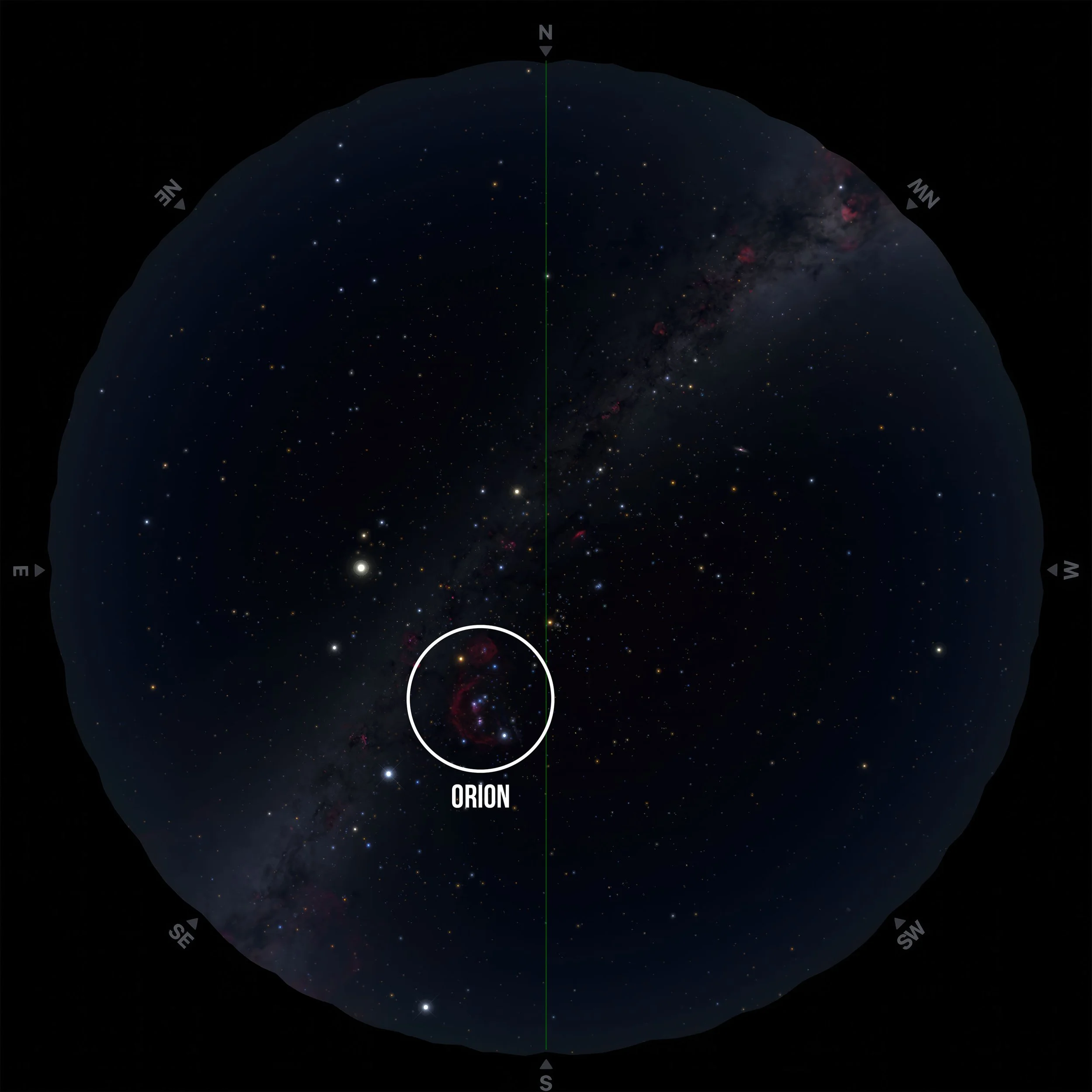
Northern Hemisphere Sky – Midnight at New Moon (at +30° latitude)
Image from the app Sky Guide
Southern Hemisphere Sky – Midnight at New Moon (at -30° latitude)
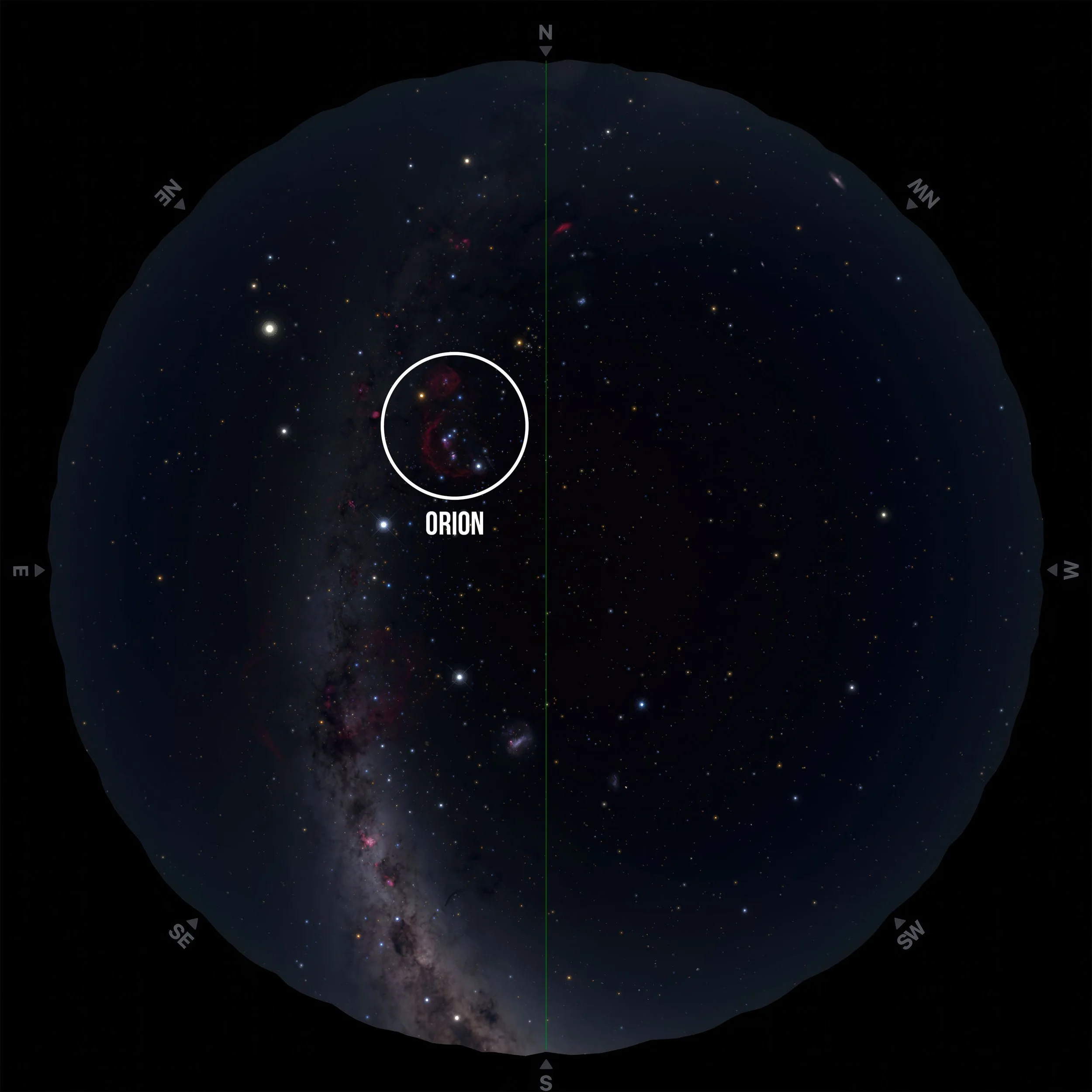
Image from the app Sky Guide
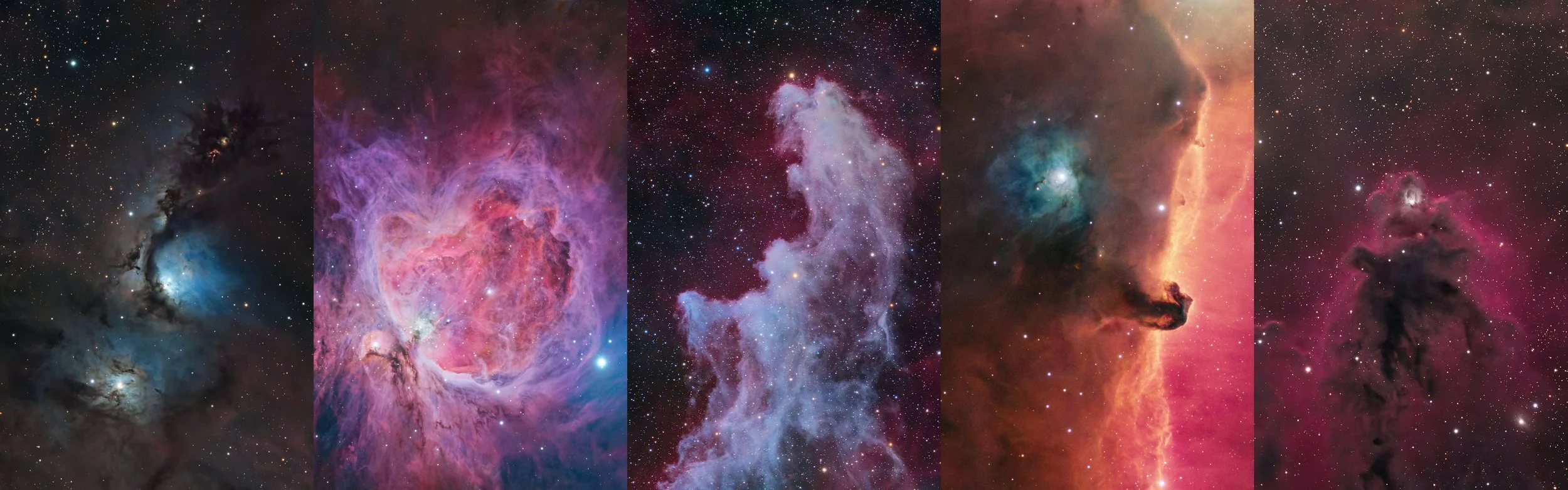
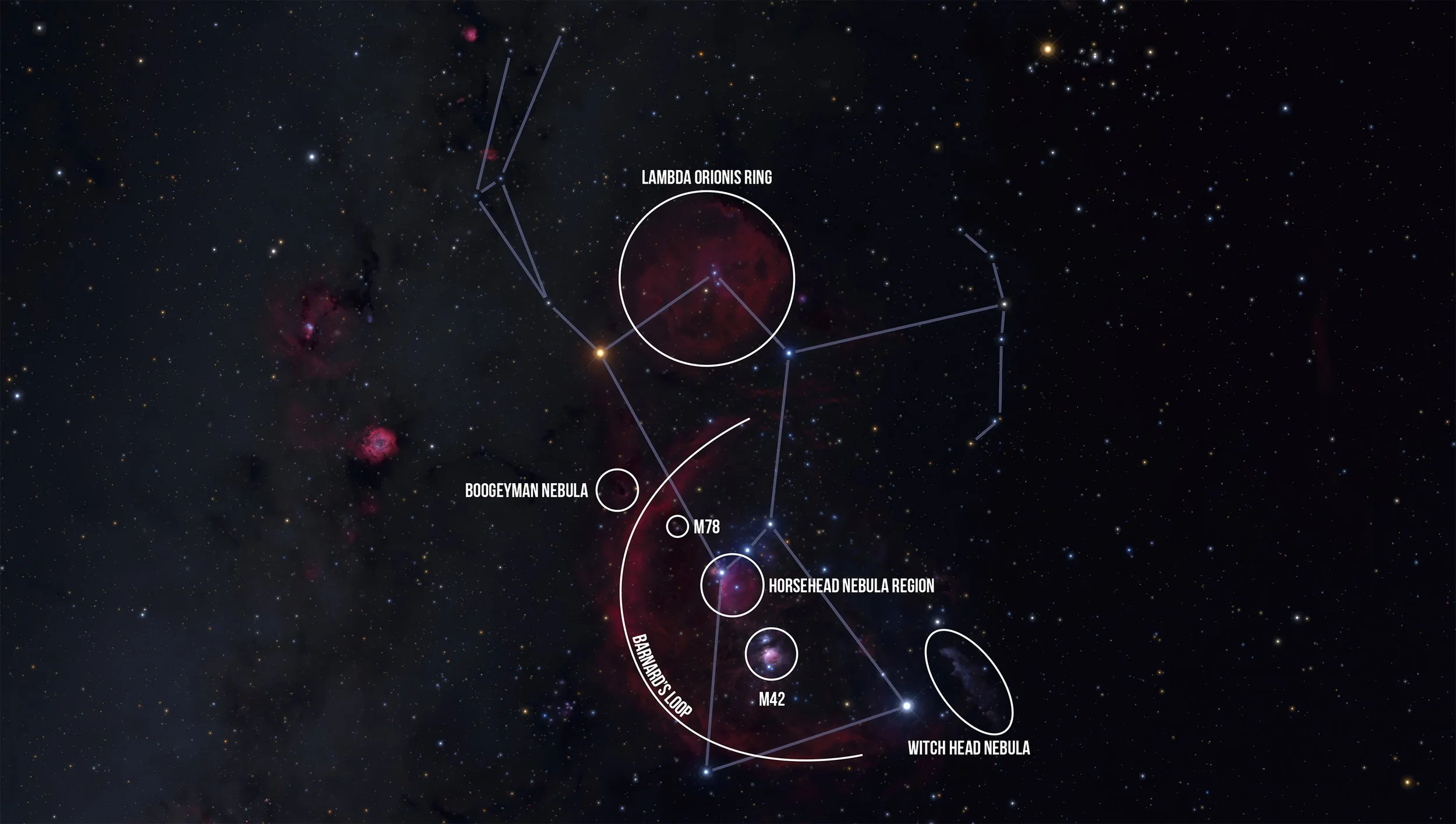
Orion reaches its peak this month, showcasing the brightest part of its nebular complex. M42 anchors the region with its blazing core, while the Horsehead sits just south along the same belt line. The soft blue reflection nebula M78 lies farther north, with the faint Boogeyman Nebula positioned on the opposite side of Barnard’s Loop.
Widefield frames capture the full sweep of this H II bubble — a colourful blend of emission, reflection, and dark dust.
If you’re using a smart telescope, this central part of Orion is perfect — M42, the Horsehead region, and M78 are bright, reliable, and wonderfully satisfying targets for ST users.
To the west, the ghostly Witch Head Nebula drifts near Rigel. Farther up the constellation, the enormous Lambda Orionis Ring (Sh2-264) surrounds Meissa (λ Ori) in a soft halo of ionised gas.
These wide, faint outskirts stretch beyond the field of view of most smart telescopes, but they’re still beautiful to explore through wider images, maps, or star charts that show the bigger story around the bright, smart-telescope-friendly targets in the core of Orion.
At midnight on the new Moon, these targets stand close to the meridian—their highest point in the sky. That makes them visible all night long and ideally positioned for imaging. The charts below give a general view of where to find them in the northern and southern skies.
Deep-Sky Targets in December
Orion dominates December’s sky, and every structure in this month’s list belongs to its sprawling nebular complex.
The Cosmic Astrophotography Planner (CAP) is your monthly companion for deep-sky imaging. Inside, you’ll find detailed information for each featured target — including ideal framing, recommended filters, smart-telescope suitability, exposure guidelines, and key scientific notes. It’s designed to help you plan faster, shoot with confidence, and make the most of every clear night.
Below is a simple overview of the targets featured in the December Cosmic Highlights video — designed to help you plan your imaging sessions and explore this legendary region at your own pace.
M42 – The Orion Nebula
Constellation: Orion | Distance: ~1,350 light-years | Apparent Size: ~1.0° × 1.0° | Apparent Magnitude: ~4.0
The Orion Nebula (M42) is one of the most welcoming sights in the night sky. Bright, easy to find, and beautiful at almost any scale, it’s often the first deep-sky object people ever photograph — the one that quietly hooks them and makes them fall in love with astrophotography. Whether you’re using a camera on a tripod, a telescope you’ve just started learning, or a smart telescope capturing one of its very first targets, M42 delivers a view worth remembering.
Just below Orion’s Belt lies a true stellar nursery — a place where new stars are actively forming. At the center sits the tiny Trapezium Cluster, a handful of young, energetic stars whose light shapes the glowing gas around them. Soft wings of color extend far beyond the bright core, creating a scene that feels both dramatic and peaceful. M42 is lively, detailed, and surprisingly forgiving — you don’t need long sessions or perfect technique to bring its character out.
Smart telescopes tend to do especially well here: the bright center appears quickly, and the surrounding structure slowly grows richer as the telescope stacks more images.
Best for: Wide to medium fields of view. 200–600 mm includes M42 and the Running Man Nebula together, while longer focal lengths reveal finer details near the core. Narrowband filters help boost contrast — and smart telescopes handle this target wonderfully with their short exposures and automatic processing.

Image by Cosmic Captures
Horsehead Region – IC 434 & Barnard 33
Constellation: Orion | Distance: ~1,375 light-years | Apparent Size: ~0.5° × 0.5° | Apparent Magnitude: Varies by component
The Horsehead Region is one of the most diverse and fascinating patches of sky you can fit into a single frame. Here, glowing gas, dark dust, and soft reflection light all meet in one dramatic field of view. Rising from the bright red glow of IC 434, the Horsehead Nebula (Barnard 33) stands out instantly — an iconic shape first identified in 1888 by Williamina Fleming, one of the pioneering women who helped lay the foundations of modern astrophysics.
That red backdrop comes from H-alpha emission, the deep red light produced when hydrogen gas is energized by nearby stars. Against it, the Horsehead’s dust forms a crisp silhouette, while the nearby Flame Nebula shows warm folds of ionized gas — gas lit up and glowing from the energy of very young, hot stars.
This region is also a fantastic target for smart telescopes. IC 434 is bright enough to show structure quickly, the Flame Nebula appears even under moderate light pollution, and the Horsehead’s shape becomes clearer as the telescope stacks more images. It’s one of the most satisfying ST targets in Orion.
Best for: Medium focal lengths (300–800 mm) capture the Horsehead, Flame Nebula, and IC 434 together. Longer focal lengths highlight the dust and texture along the emission ridge. Broadband, H-alpha, and duoband imaging all work well — and smart telescopes frame the whole scene beautifully thanks to their live stacking and short exposures.
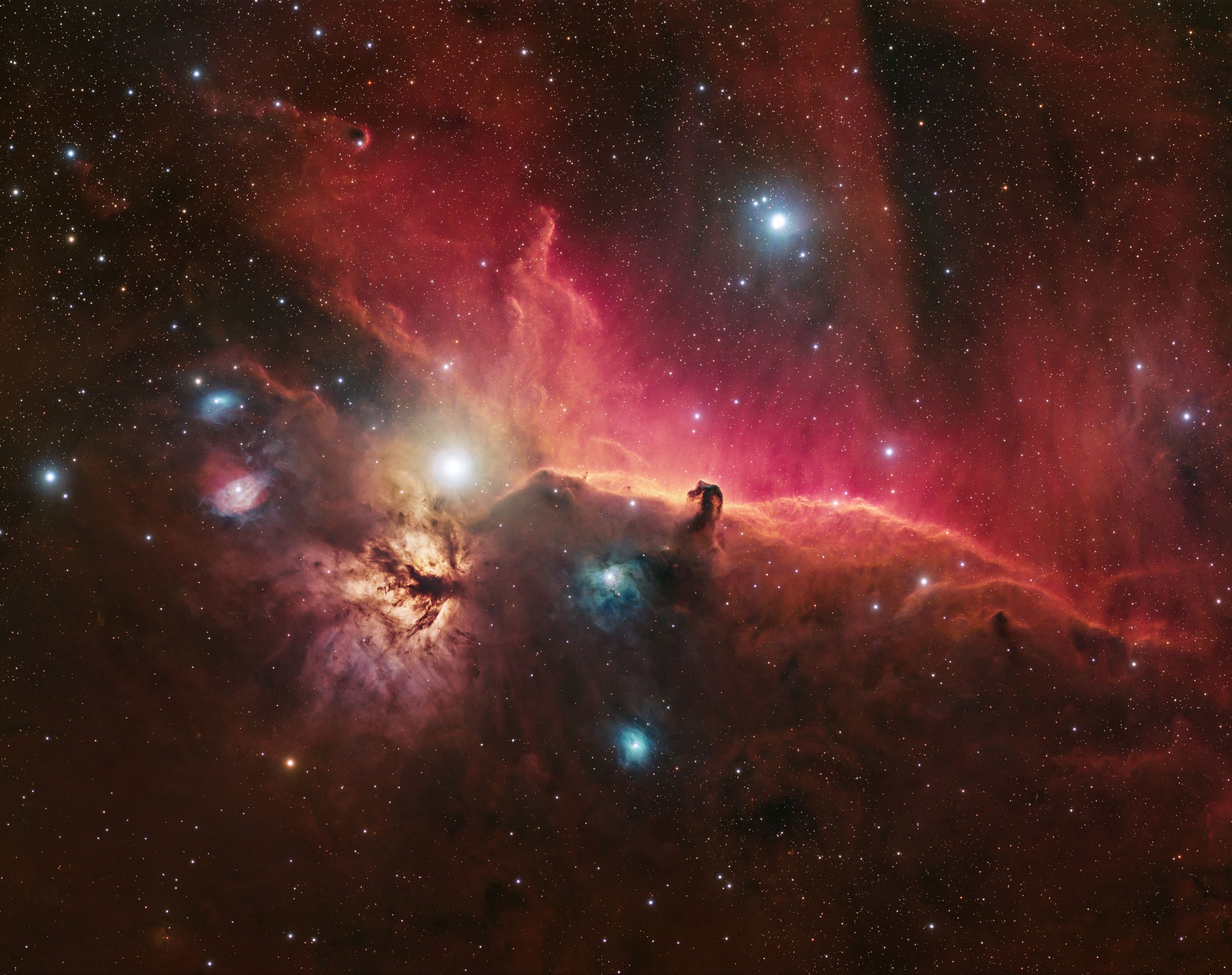
Image by Cosmic Captures
M78 – Casper the Friendly Ghost Nebula
Constellation: Orion | Distance: ~1,350 light-years | Apparent Size: ~8′ × 6′ | Apparent Magnitude: ~8.0
M78 is one of the quieter gems in Orion — a gentle blue reflection nebula that shines by scattering the light of the young stars hidden inside. Its soft glow and rounded shape give it a calm, almost storybook appearance, which is why many imagers know it by the nickname “Casper the Friendly Ghost Nebula.” The exact origin of the name isn’t documented, but it fits the nebula’s peaceful mood.
As a reflection nebula, M78 doesn’t emit its own light; instead, dust in the region reflects starlight, creating its smooth blue color. Dark lanes weave through the glow, adding texture and depth once you gather a bit more exposure time. It’s a lovely introduction to the subtler side of Orion — not as bright as the big showpieces, but full of quiet detail.
Smart telescopes handle M78 well, especially under darker skies. The main glow appears quickly, and the shape becomes more defined as the telescope stacks more images. With a bit of patience, you can capture its soft gradients and the surrounding dust.
Best for: Medium focal lengths (300–600 mm). Broadband imaging preserves the natural blue tones, while longer sessions bring out the surrounding dark lanes. Smart telescopes can produce satisfying results here, especially when allowed to run for extended stacking sessions.

Image by Cosmic Captures
Boogeyman Nebula – LDN 1622
Constellation: Orion | Distance: ~1,300 light-years | Apparent Size: ~25′ × 15′ | Apparent Magnitude: Very faint
The Boogeyman Nebula is one of the more mysterious corners of the Orion complex — a dark, ghostly shape that stands in quiet contrast to the softer glow of nearby M78. If M78 is the “friendly ghost,” this is its spooky opposite: a twisting silhouette of dust that seems to lean into the surrounding starlight, giving it an unmistakably eerie presence in long exposures.
This nebula is made of dark dust blocking the light behind it, much like a shadow cast into space. Because it doesn’t emit light on its own, it relies on soft reflection from nearby stars and the faint glow of surrounding gas to outline its shape. This is what makes it both fascinating and challenging — a reward for those who enjoy capturing subtle textures.
The Boogeyman is not an ideal smart-telescope target, simply because it’s too faint and too low in contrast for most ST sensors. But it’s still a meaningful part of the Orion story, especially when viewed in wider images that show how it balances the brighter structures around it.
Best for: Medium to longer focal lengths under dark skies, with longer exposures to reveal the soft dust. Broadband imaging works best for preserving the natural tones.

Image by Cosmic Captures
Barnard’s Loop – The Orion Arc
Constellation: Orion | Distance: ~1,350 light-years | Apparent Size: ~10° across | Apparent Magnitude: Very faint
Barnard’s Loop is one of the largest and most beautiful structures in the entire Orion complex — a giant, gently glowing arc of hydrogen gas that sweeps across the constellation like a cosmic brushstroke. It’s so big that you can’t see it all at once through a telescope. But with a DSLR or mirrorless camera and a simple wide-angle lens, the full shape appears like magic in long exposures. This is one of the most satisfying “first discoveries” for photographers exploring the night sky beyond stars alone.
The loop shines through H-alpha emission, the deep red light created when hydrogen gas is energized by young, massive stars in the Orion region. It’s essentially the outline of a huge bubble of gas that has been shaped by stellar winds and ancient supernova activity — a reminder that Orion is more than a constellation of bright stars; it’s the shell of a vast, active star-forming environment.
Barnard’s Loop is not suited to smart telescopes, simply because it spans several degrees of sky — far wider than an ST can frame. But for anyone shooting with a camera and lens, especially at 24 mm, 35 mm, or 50 mm, it’s one of the most rewarding winter targets you can capture.
Best for: Wide-angle DSLR and mirrorless setups (24–50 mm) under darker skies. H-alpha–sensitive cameras or clip-in filters help reveal the arc more strongly. Smart telescopes can enjoy the brighter nebulae inside the loop, but the full structure itself is a widefield-only subject.

Image by Cosmic Captures
Witch Head Nebula – IC 2118
Constellation: Eridanus (near Orion) | Distance: ~900 light-years | Apparent Size: ~3° × 1° | Apparent Magnitude: Faint
The Witch Head Nebula is one of the most memorable shapes in the night sky — a long, ghostly profile carved out of starlight reflected off drifting dust. It sits just west of Rigel, the bright blue star in Orion, whose light gives the nebula its soft bluish glow. In widefield images, the shape becomes almost unmistakable: a pale face emerging from the darkness, as if illuminated by a distant lantern.
As a reflection nebula, the Witch Head doesn’t shine on its own. Instead, dust in the region scatters Rigel’s starlight, creating the smooth, icy-blue color that makes the nebula so striking in long exposures. Its size is enormous — several degrees across — which makes it perfect for wide-angle imaging and a rewarding challenge for anyone who enjoys capturing delicate, faint structures.
This is a challenging target for smart telescopes, simply because it’s too large and too faint for most ST sensors. That said, under very dark skies and long sessions, who knows what might be possible?
Best for: Widefield imaging with 200-400mm focal lenght and larger APS-C sized sensors, or DSLR or mirrorless setups (135 mm +) under dark skies. Reflection nebulae benefit from long exposures and good sky transparency. Smart telescopes can attempt a brightest section of the nebula in excellent conditions, but the full shape is best captured with wider lenses.

Image by Cosmic Captures
Sh2-264 – Lambda Orionis Nebula
Constellation: Orion | Distance: ~900 light-years | Apparent Size: ~6° | Apparent Magnitude: Faint
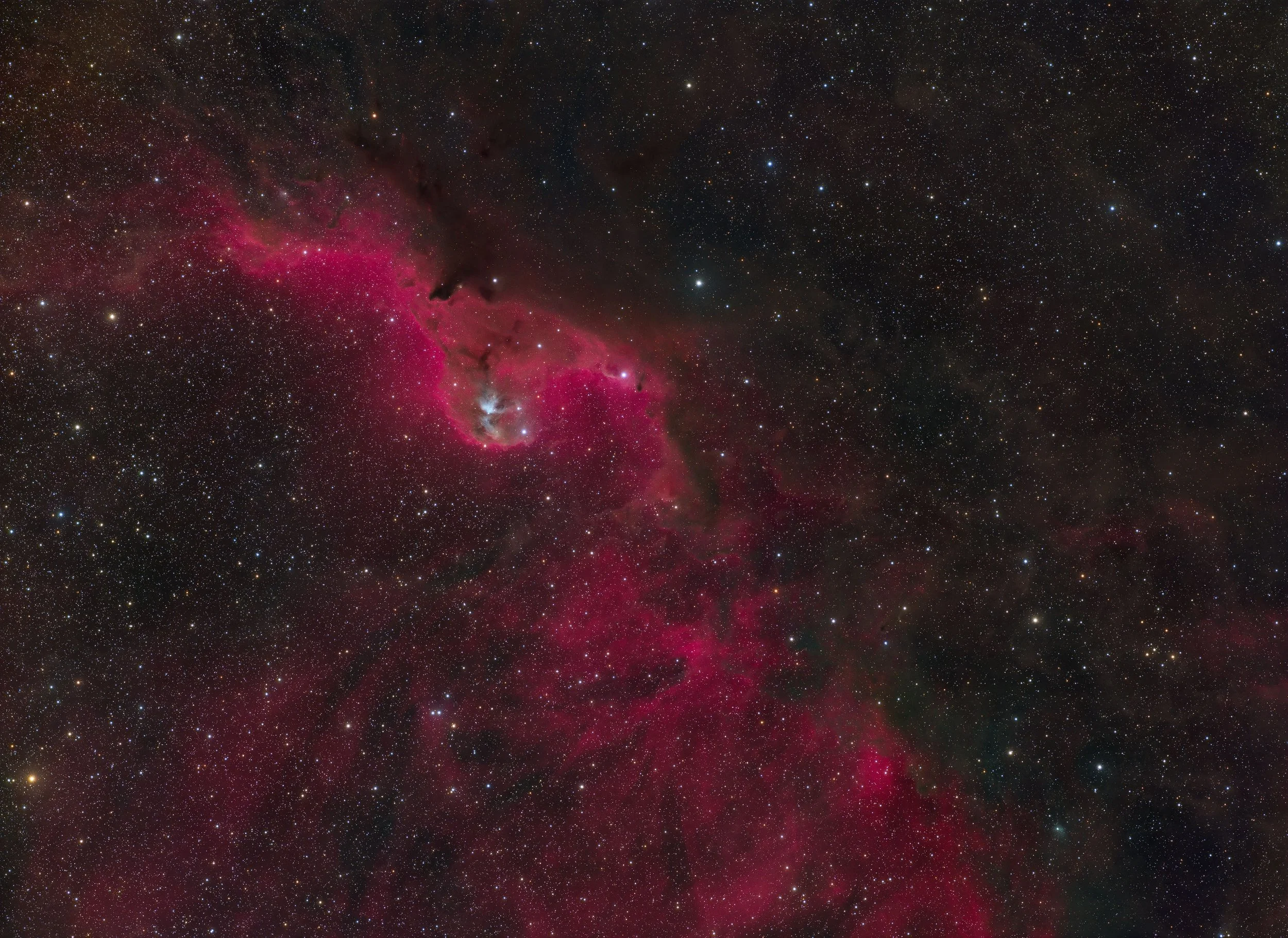
The Lambda Orionis Nebula (Sh2-264) is a huge, gentle cloud of glowing gas that surrounds Meissa, the star at Orion’s head. In widefield images, the shape looks like a soft, drifting outline — a giant, faint figure swimming through space. It’s one of those structures you rarely notice until you capture a long-exposure image, and then suddenly you can’t unsee it.
This nebula shines through ionized hydrogen, gas that glows faintly red when energized by the bright, young stars inside it. It forms part of the much larger Orion–Eridanus region, a complex bubble of gas shaped by stellar winds and ancient supernovae. The Lambda Orionis Nebula is one of the clearest signs that Orion isn’t just a set of bright stars — it’s the center of a vast, active environment stretching across the sky.
Because the Lambda Orionis Nebula is extremely wide and very faint, it’s best captured with DSLR or mirrorless cameras and wider lenses, or as part of a larger mosaic project. Even modified cameras need longer exposures to bring out its soft red glow.
For smart telescope users, this isn’t an ideal target — it’s simply too large to frame and too dim to reveal clearly. But a small portion of its structure can sometimes show up in long sessions under dark skies, especially in H-alpha–sensitive setups. For most imagers, though, the Lambda Orionis Ring is a true widefield subject.
Best for: DSLR and mirrorless widefield imaging (35–135 mm), or mosaics with short focal-length refractors. Modified or H-alpha–sensitive cameras help bring out the faint glow.
Telescope.live image data edited by Cosmic Captures
The main Moon Phases in November 2025
Planning your imaging sessions? The Moon plays a massive role in what we can capture.
Here’s what’s happening this month:

Full Moon
December 5
The Moon reaches full phase on November 5, known as the Cold Moon. It’s the last full moon of the year, and this year, it’s also a supermoon. Appearing slightly larger and brighter than usual, it occurs just a day after the Moon’s closest approach to Earth.

Last Quarter
December 11
Deep-sky imaging is best in the first half of the night before the Moon rises in the early morning hours.

New Moon
December 20
The darkest skies of the month arrive with the New Moon, ideal for deep-sky imaging.

First Quarter
December 27
Deep-sky imaging is best after midnight.
Also great for capturing lunar surface details with strong shadows along the terminator.
November 2025 MAP
(Moonlight Astrophotography Planner)
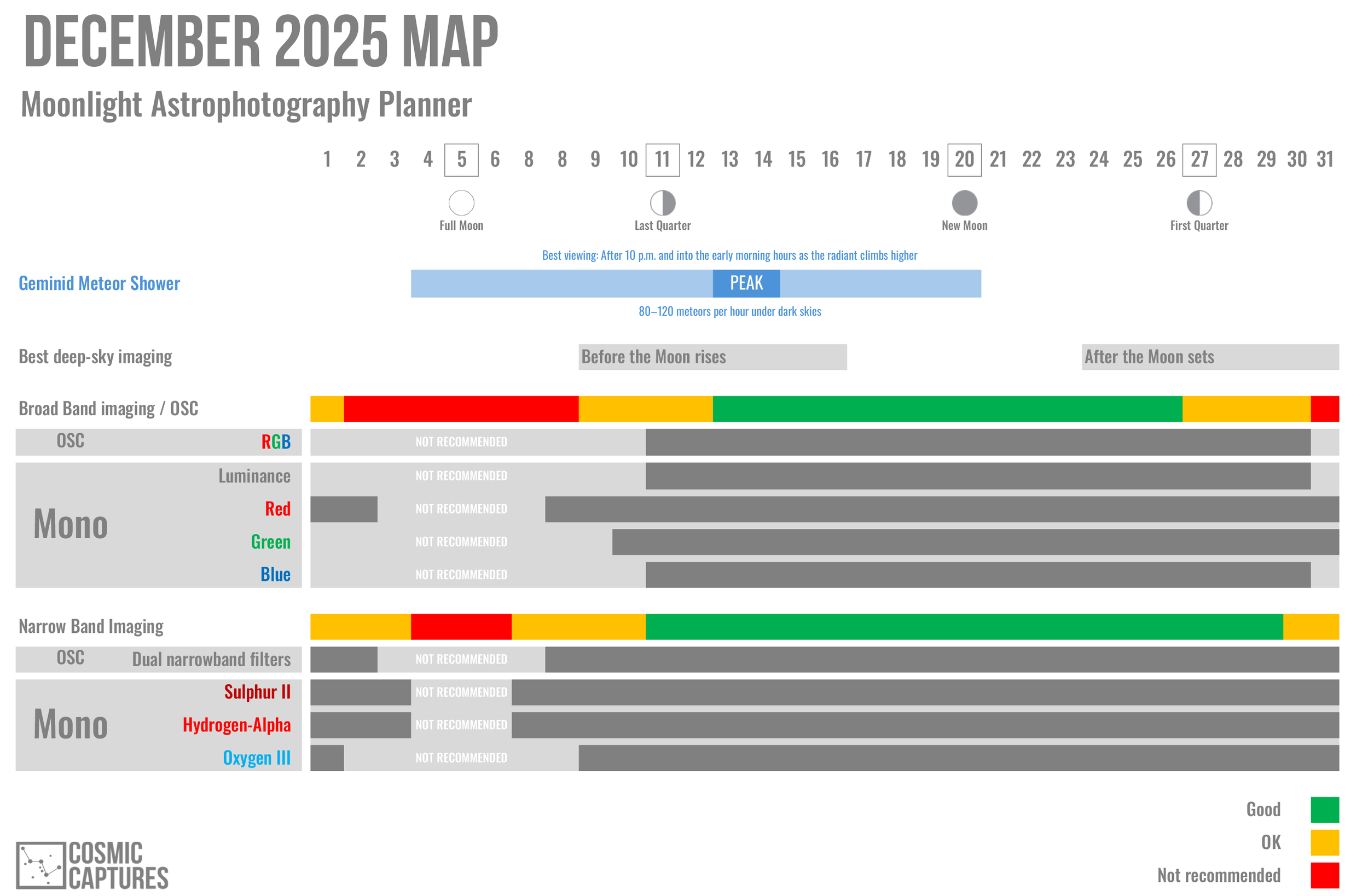
Each month, the MAP — or Moonlight Astrophotography Planner — helps you choose the best nights for capturing galaxies, nebulae, and nightscapes. Whether you’re shooting broadband or narrowband, MAP gives you clear guidance based on the Moon phase, so you can match your imaging plans to the sky conditions.
You can download this month’s MAP as a free PDF using the button below. It’s updated monthly to help you make the most of your imaging time, no matter your style or setup.
Geminid Meteor Shower — Peak December 13–14
The Geminids are the highlight of December — and one of the most reliable, impressive meteor showers of the entire year. They peak on the night of December 13–14, with strong activity continuing for several nights. Under dark skies, observers can expect 80–120 meteors per hour, and even more during particularly active years.
Unlike most meteor showers, the Geminids don’t come from a comet. They originate from 3200 Phaethon, a rocky object sometimes called a “rock comet,” which sheds dust as the Sun heats its surface. When Earth crosses this stream each December, those tiny particles hit our atmosphere and create bright, colorful meteors — often slower, steadier, and more dramatic than many other showers.
This year, the Moon is a waning crescent (about 34% illuminated) and rises after midnight, so the first half of the night is beautifully dark — ideal conditions for catching the fainter Geminids before moonlight begins to soften the sky.
Best viewing: After 10 p.m. and into the early morning hours as the radiant in Gemini climbs higher. Look anywhere in the sky — Geminids appear in all directions. Find a dark location, give your eyes time to adjust, and enjoy one of the most reliable meteor showers of the year.

Image by Cosmic Captures
December Solstice — December 21
The December Solstice marks the turning point of the year. In the Northern Hemisphere, it brings the longest night and the official start of winter. In the Southern Hemisphere, it’s the longest day and the beginning of summer.
From this point on, the Sun’s path slowly shifts again — nights begin to shorten in the north and lengthen in the south. It’s a quiet astronomical moment, but a meaningful one: a reminder that even at the darkest time of year, the light is already returning.

Image by NASA scientific visualisation studio
Nightscape Opportunities
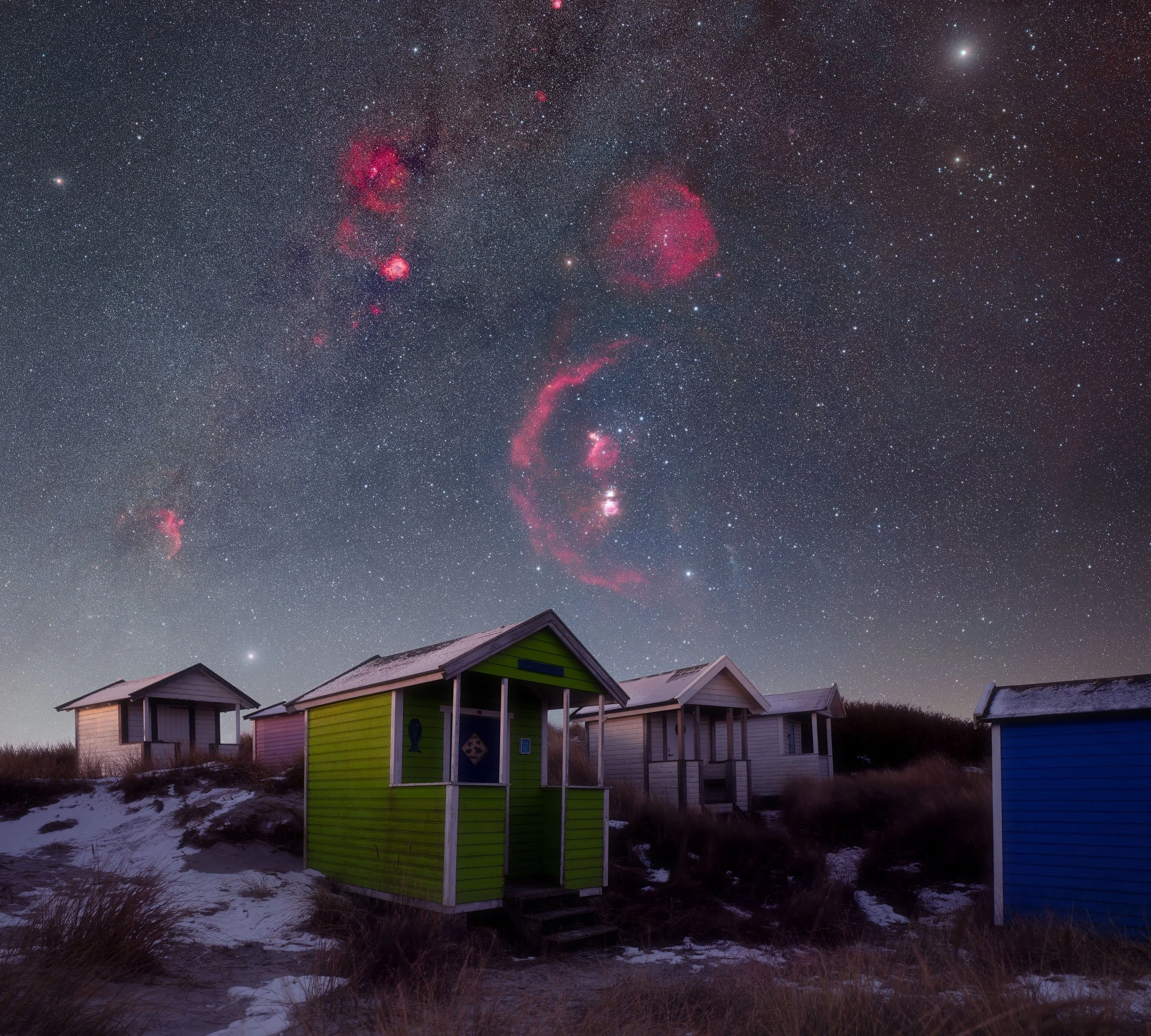
In the Northern Hemisphere, December brings the long, dark nights that nightscape photographers wait for all year. The winter constellations rise in full brilliance. Orion takes center stage — its bright stars and glowing nebulae climbing higher each night. Wide-angle images reveal the full sweep of the region, from Orion’s Belt and the soft arc of Barnard’s Loop to the blue shine of the Pleiades nearby. And mid-month, the Geminid meteor shower adds streaks of light across the sky, with 2025 offering excellent early-night views before the Moon rises.
In the Southern Hemisphere, Orion rises even higher, giving photographers a clear view of its faint outer structures — including the Witch Head Nebula and the wide halos of glowing gas around Meissa. The summer sky also brings rich widefield opportunities, with Gemini, Taurus, and Orion’s sweeping nebulae glowing above warm southern landscapes.
With long nights in the north and warm evenings in the south, December is an ideal month for nightscapes. Use the Moonlight Astrophotography Planner to time sessions around the dark hours and make the most of Orion season and the Geminids’ peak.