
Cosmic Highlights
A monthly night sky guide to what’s worth capturing right now.
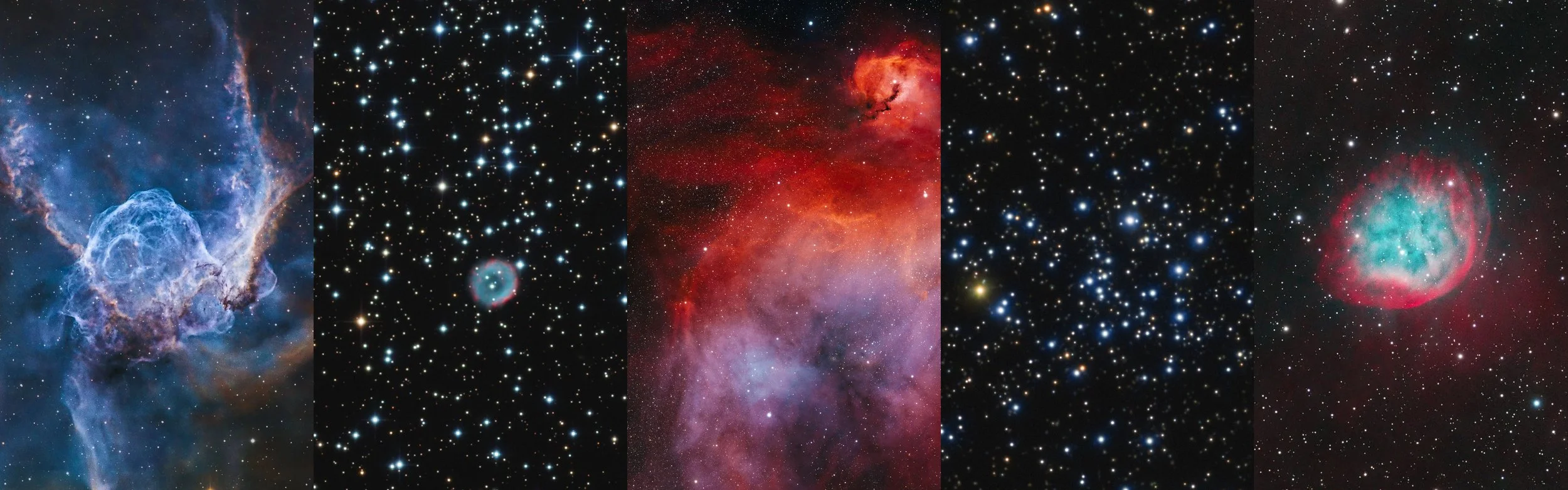
January 2026
January — Season of Star Clusters
January brings excellent evening views of many of the sky’s brightest constellations. During this part of Earth’s orbit, our nighttime side faces regions of the Milky Way that contain many nearby open star clusters, placing them well in the evening sky. Many of this month’s best-placed targets are these bright, nearby clusters, making it an ideal time for relaxed observing and quick, rewarding imaging sessions.
The Night Sky at a Glance
Northern Hemisphere Sky – Midnight at New Moon (at +40° latitude)
Image from the app Stellarium
Southern Hemisphere Sky – Midnight at New Moon (at -30° latitude)
Image from the app Stellarium
January is a month of rich and familiar skies in both hemispheres. Many of the brightest constellations now sit well placed in the evening, filling the sky with star clusters, nebulae, and bright winter stars.
In the northern hemisphere, Orion dominates the southern sky through much of the evening, joined by Taurus, Auriga, and Gemini overhead. Around them lie many bright open clusters and nebulae, while Cancer begins to climb higher later at night, bringing even more cluster-rich regions into view.
In the southern hemisphere, Orion stands high in the north with Canis Major and Puppis nearby, placing many bright clusters and nebulae in excellent view. The Milky Way stretches prominently across the sky, offering rich star fields while constellations like Carina and Vela provide additional cluster-filled regions to explore.
It’s a sky packed with bright and rewarding deep-sky targets — perfect for both relaxed observing and long imaging sessions.
The Best-Placed Objects This Month
These objects are at their highest point in the sky around midnight. That means better visibility, longer imaging windows, and a great chance to explore some of the best deep-sky objects in the night sky.


The Cosmic Astrophotography Planner (CAP)
The Cosmic Astrophotography Planner (CAP) is a curated monthly guide to help you make the most of the night sky — with a focused selection of targets, practical framing guidance, and clear expectations for what’s realistic to capture this month.
Each CAP is built from my long-term planning system and reflects how I’m prioritising targets based on season and real-world conditions.
The free monthly overview gives you a simple snapshot of what’s available and worth focusing on right now.
For deeper planning and access to the full system behind CAP, supporters get access to the complete Cosmic Captures ARC — my living Astrophotography Reference Catalogue, with full data, powerful sorting and filtering, customisation, and ongoing updates.
M41
Object type: Open cluster
Constellation: Canis Major
Apparent dimensions: ~38′ diameter
Filtering: Not recommended
Recommended integration time: ≤ 1 hour
Peak month: January
Altitude at peak: Northern hemisphere: Low · Southern hemisphere: High
M41 is a bright, easy-to-capture open cluster located just south of Sirius, the brightest star in the night sky. In images, it reveals a loose scattering of dozens of stars, with subtle colour variation between cooler orange giants and hotter blue-white stars. Because the cluster is both bright and well spread out, it produces satisfying results even in short sessions and remains a great choice under light-polluted or moonlit skies. Its wide, airy structure makes it feel less dense than some famous clusters, giving it a calm, spacious appearance in wide-field images.
M41, captured using a ZWO SeeStar S50 smart telescope by Cosmic Captures

M41 works beautifully with smart telescopes. Its large apparent size and bright member stars mean structure and colour begin to appear quickly, even with short integration times. Because it’s an open cluster, results stay pleasing even under moonlight or light pollution, making it a reliable and rewarding target for quick sessions or casual observing nights.
M44 – Beehive Cluster
Object type: Open cluster
Constellation: Cancer
Apparent dimensions: 95′ diameter
Filtering: Not recommended
Recommended integration time: ≤ 1 hour
Peak month: January
Altitude at peak: Northern hemisphere: High · Southern hemisphere: Medium
M44, better known as the Beehive Cluster, is one of the closest and most visually impressive open clusters in the night sky. Even to the naked eye under dark skies, it appears as a soft, misty patch, while telescopes and cameras reveal hundreds of stars packed into a wide, shimmering swarm. Its large apparent size makes it ideal for wide-field imaging, and subtle star colours begin to emerge quickly, making it rewarding even during short sessions or under less-than-perfect sky conditions.
M44 – Beehive Cluster, captured using a VESPERA II smart telescope by Cosmic Captures
M44 is an excellent target for a smart telescope, thanks to its brightness and large size. Star colours and structure appear quickly, making it perfect for short sessions, outreach, or relaxed observing nights when you want satisfying results without long integration times.
M46
Object type: Open cluster
Constellation: Puppis
Apparent dimensions: 23′ diameter
Filtering: Not recommended
Recommended integration time: ≤ 1 hour
Peak month: January
Altitude at peak: Northern hemisphere: Low · Southern hemisphere: High
M46 is a rich and compact open cluster containing dozens of faint stars packed into a beautifully textured field. What makes this target especially interesting is the tiny planetary nebula (NGC 2438) visible in the same field of view, appearing as a small, soft circular glow among the cluster stars. Although the nebula is actually much closer to us and only coincidentally aligned with the cluster, the contrast between the dense star field and this delicate bubble of gas makes M46 a uniquely rewarding imaging target.
M46, processed by Cosmic Captures from Telescope.Live image data
M46, captured using a ZWO SeeStar S50 smart telescope by Cosmic Captures
M46 works well with smart telescopes, with the star cluster appearing quickly even in short sessions. With a bit more integration time, the small planetary nebula in the field also starts to emerge, adding a fun detail to discover as the image improves.
M47
Object type: Open cluster
Constellation: Puppis
Apparent dimensions: 30′ diameter
Filtering: Not recommended
Recommended integration time: ≤ 1 hour
Peak month: January
Altitude at peak: Northern hemisphere: Low · Southern hemisphere: High
M47 is a bright, loosely concentrated open cluster whose stars are widely scattered, giving it a spacious, almost three-dimensional appearance. Several brighter member stars stand out clearly, making the cluster visually striking even in short exposures or small telescopes. Because of its brightness and open structure, it’s an easy and rewarding target that works well even under less-than-perfect sky conditions.
M47, captured using a ZWO SeeStar S50 smart telescope by Cosmic Captures
M47 is an excellent target for a smart telescope, producing satisfying results quickly thanks to its bright stars and open structure. Even short sessions reveal a pleasing star field, making it a great choice for relaxed observing nights or quick imaging sessions.
M48
Object type: Open cluster
Constellation: Hydra
Apparent dimensions: 44′ diameter
Filtering: Not recommended
Recommended integration time: ≤ 1 hour
Peak month: January
Altitude at peak: Northern hemisphere: Medium · Southern hemisphere: High
M48 is a large and relatively loose open cluster with dozens of stars scattered across a wide area of sky. Its irregular shape and varied star brightness give it a natural, almost random appearance, making it feel less structured than some of the more compact clusters. Because of its size and brightness, it works well for wide-field imaging and quickly produces pleasing results even during shorter imaging sessions.
M48, captured using a ZWO SeeStar S50 smart telescope by Cosmic Captures
M48 works very well with smart telescopes thanks to its large size and bright member stars. Structure and star colours begin to appear quickly, making it a satisfying target for short sessions or casual observing under a wide range of sky conditions.
M50 – Heart-shaped Cluster
Object type: Open cluster
Constellation: Monoceros
Apparent dimensions: 16′ diameter
Filtering: Not recommended
Recommended integration time: ≤ 1 hour
Peak month: January
Altitude at peak: Northern hemisphere: Medium · Southern hemisphere: High
M50 is a compact and bright open cluster containing a dense grouping of stars that stand out clearly against the surrounding Milky Way background. Some observers describe a subtle heart-like shape in its core, while images reveal a pleasing mix of star brightness that gives the cluster depth and texture. Its relatively small size and brightness make it an easy and rewarding target, even during short imaging sessions.
M50 – Heart-shaped Cluster, captured using a ZWO SeeStar S50 smart telescope by Cosmic Captures
M50 performs very well with smart telescopes, with its dense star concentration becoming visible quickly. Even short integrations reveal a rich, attractive cluster, making it a great target for quick observing sessions or nights with limited clear sky.
M67 – Golden Eye Cluster
Object type: Open cluster
Constellation: Cancer
Apparent dimensions: 30′ diameter
Filtering: Not recommended
Recommended integration time: ≤ 1 hour
Peak month: January
Altitude at peak: Northern hemisphere: High · Southern hemisphere: Medium
M67 is one of the oldest known open clusters, making it a fascinating contrast to many younger clusters scattered along the Milky Way. Its stars are packed into a dense, rounded grouping with many faint members creating a soft, granular glow in images. Because the cluster is so old, many of its brighter stars have evolved into warmer orange tones, giving the cluster a subtle color character when enough data is collected.
M67 – Golden Eye Cluster, captured using a ZWO SeeStar S50 smart telescope by Cosmic Captures
M67 works nicely with smart telescopes, though it benefits from a bit more integration time than brighter clusters to reveal its many fainter stars. As the image builds, the cluster’s dense and textured appearance becomes increasingly satisfying to explore.
M93 – Critter Cluster
Object type: Open cluster
Constellation: Puppis
Apparent dimensions: 22′ diameter
Filtering: Not recommended
Recommended integration time: ≤ 1 hour
Peak month: January
Altitude at peak: Northern hemisphere: Low · Southern hemisphere: High
M93 is a bright and compact open cluster with a distinctive triangular or fan-shaped arrangement of stars that makes it stand out from more evenly scattered clusters. Several brighter stars anchor the structure, while many fainter members fill in the surrounding field, giving the cluster a pleasing sense of depth. Its brightness and well-defined shape make it a rewarding and easy target even during short imaging sessions.
M93 – Critter Cluster, captured using a ZWO SeeStar S50 smart telescope by Cosmic Captures
M93 performs very well with smart telescopes, with its compact star pattern appearing quickly as images stack. Even short sessions reveal a well-defined cluster, making it an enjoyable target when observing time or sky conditions are limited.
NGC 2359 – Thor’s Helmet Nebula
Object type: Emission nebula
Constellation: Canis Major
Apparent dimensions: 6′ × 4′
Filtering: Dual-band or narrowband recommended (broadband works well under dark skies)
Recommended integration time: 3–6 hours
Peak month: January
Altitude at peak: Northern hemisphere: Low · Southern hemisphere: High
NGC 2359, commonly known as Thor’s Helmet, is an emission nebula shaped by the powerful stellar winds of a massive, hot star near its centre. These winds have carved out a glowing bubble of gas with sweeping wing-like extensions, creating the distinctive helmet-like appearance seen in images. Rich in fine structure and contrast, it rewards longer integration times, revealing delicate filaments and layered gas structures. Under dark skies, broadband imaging can also produce beautiful natural-colour results, while narrowband filters help bring out structure under light-polluted conditions.
NGC 2359 - Thor’s Helmet, processed by Cosmic Captures from Telescope.Live image data
NGC 2359 - Thor’s Helmet, captured using a ZWO SeeStar S50 smart telescope by Cosmic Captures
Thor’s Helmet is a more challenging smart telescope target, but possible with longer integrations. With enough time, the central bubble and brighter structures begin to emerge, making it a satisfying project for patient observers looking to push their setup a bit further.
IC 2177 – Seagull Nebula
Object type: Emission nebula
Constellation: Monoceros
Apparent dimensions: 150′ × 60′
Filtering: Dual-band or narrowband recommended (broadband works well under dark skies)
Recommended integration time: 3–6 hours
Peak month: January
Altitude at peak: Northern hemisphere: Medium · Southern hemisphere: Medium
IC 2177, known as the Seagull Nebula, is a vast emission nebula whose glowing gas forms a shape resembling a bird in flight, with wide wings stretching across several degrees of sky. The region is rich in hydrogen gas and young stars, creating large sweeping clouds and subtle dark dust lanes throughout the field. Because of its enormous size, it is best captured with wide-field setups, where longer integration times reveal increasingly complex textures and structures across the nebula.
IC 2177, captured with a Sky-Watcher Esprit 100 with ASI2600MM Pro camera and LRGBHSO filters. Image by Cosmic Captures.
The Seagull Nebula can be challenging for smart telescopes because of its very large size, meaning only part of the nebula usually fits within the field of view. However, with longer integrations and a dual-band filter, attractive sections of the nebula can still be captured, making it an enjoyable wide-field project or mosaic target.
Abell 31
Object type: Planetary nebula
Constellation: Cancer
Apparent dimensions: 16.2′ diameter
Filtering: Dual-band or narrowband recommended
Recommended integration time: 15+ hours
Peak month: January
Altitude at peak: Northern hemisphere: Medium · Southern hemisphere: Medium
Abell 31 is a large but extremely faint planetary nebula, representing the final stages of a dying star that has shed its outer layers into space. Unlike smaller, brighter planetary nebulae, its gas shell has expanded so much that its light is spread thinly across the sky, making it a challenging target to capture. With enough integration time, a delicate circular glow emerges, often showing subtle filamentary structure and faint interaction with surrounding interstellar material.
Abell 31, captured with a Sky-Watcher Esprit 100 with ASI2600MM Pro camera and LRGBHO filters. Image by Cosmic Captures.
Abell 31 is a difficult target for smart telescopes due to its very low surface brightness, typically requiring many hours of integration and good sky conditions. With patience and filtering, its faint circular shell can slowly appear, making it a rewarding challenge for experienced users.
The main Moon Phases in January 2026
Planning your imaging sessions? The Moon plays a massive role in what we can capture.
Here’s what’s happening this month:

Full Moon
January 3
The Moon reaches full phase on February 1, known as the Snow Moon.

Last Quarter
January 10
Deep-sky imaging is best in the first half of the night before the Moon rises in the early morning hours.

New Moon
January 18
The darkest skies of the month arrive with the New Moon, ideal for deep-sky imaging.

First Quarter
January 26
Deep-sky imaging is best after midnight.
Also great for capturing lunar surface details with strong shadows along the terminator.
Nightscape Opportunities
In the Northern Hemisphere, Orion and the surrounding winter constellations dominate the evening sky, placing some of the most recognisable Milky Way regions in great position after dark. This makes January a wonderful time to capture wide winter star fields, with bright constellations and colourful nebula regions adding structure above seasonal landscapes.
In the Southern Hemisphere, the Milky Way climbs high across the sky, bringing rich star fields and bright nebula regions into prime position for nightscape imaging. Orion and Canis Major rise prominently, while the southern Milky Way offers dense and colourful regions that work beautifully in both wide panoramas and vertical compositions.
January is a month of bright constellations and rich star fields — perfect for combining familiar night sky landmarks with winter or summer landscapes, depending on where you are observing from.