
Cosmic Highlights
A monthly night sky guide to what’s worth capturing right now.
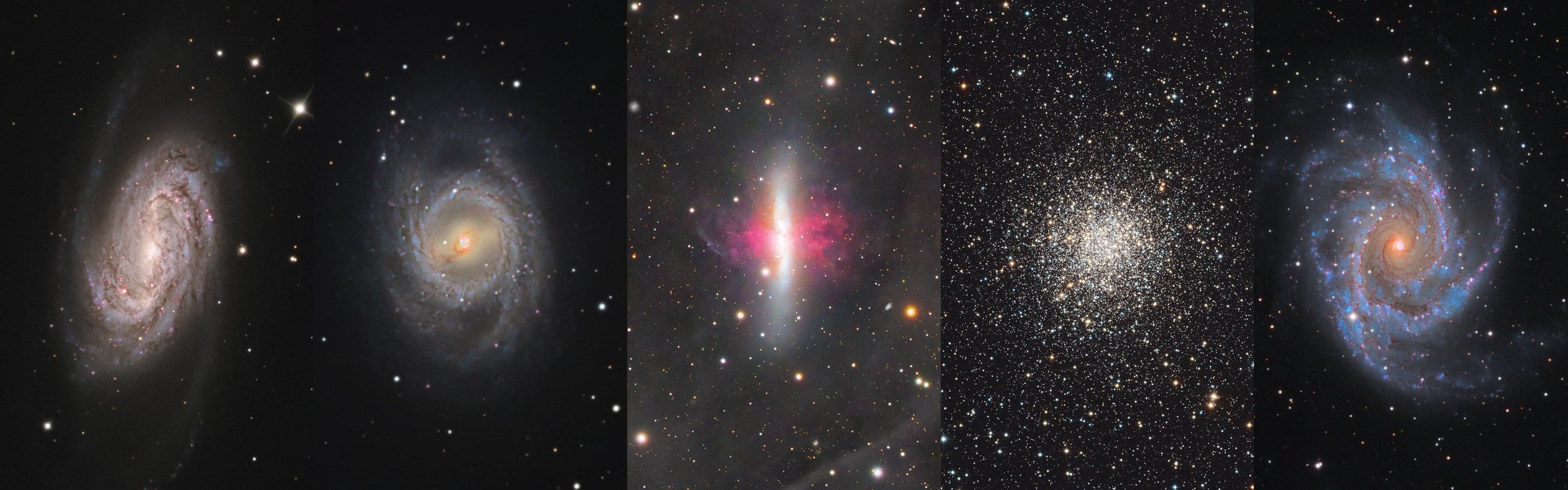
MARCH 2026
March — The Season of Galaxies
March marks the true beginning of galaxy season.
The bright winter nebulae continue to drift west, and the sky opens toward deeper space.
Where Orion once dominated, vast fields of distant galaxies now rise into view, especially in Leo, Virgo, and Coma Berenices.
These faint islands of light may look subtle at first, but with patience, they reveal an entirely different scale of the universe — millions of light-years instead of thousands.
March is a month for exploring these distant realms and beginning the long stretch of spring nights dedicated to galaxies.
The Night Sky at a Glance
Northern Hemisphere Sky – Midnight at New Moon (at +40° latitude)
Image from the app Stellarium
Southern Hemisphere Sky – Midnight at New Moon (at -30° latitude)
Image from the app Stellarium
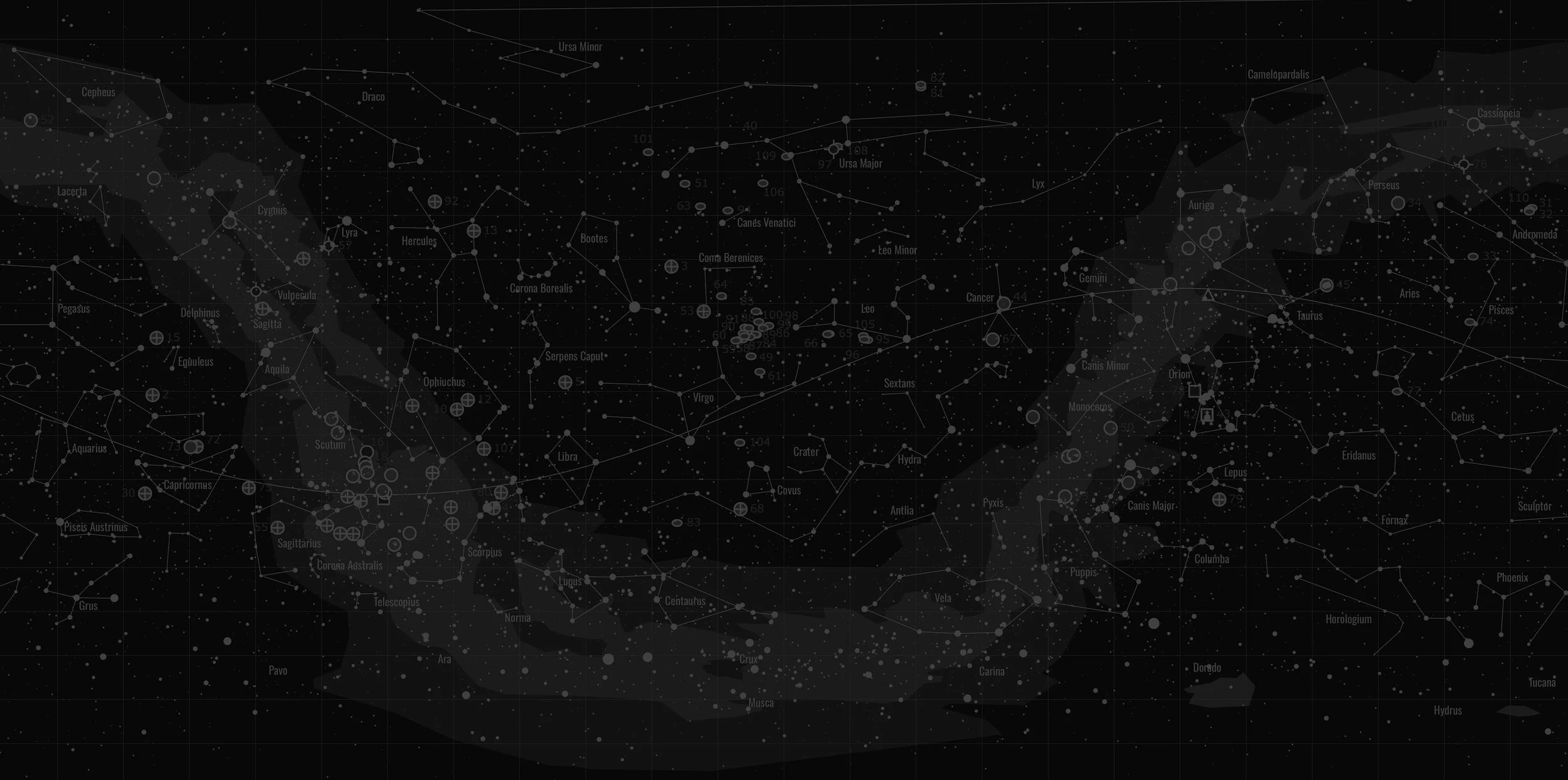
March is a month when the night sky opens toward deeper space. The bright winter constellations continue to drift west, while distant galaxies take their place higher in the sky.
In the northern hemisphere, Orion and Taurus sink toward the western horizon as the evening progresses. Overhead, Leo, Coma Berenices, and Virgo dominate the sky — clear signs that galaxy season has begun.
In the southern hemisphere, the Milky Way still stretches across the sky, with Carina and Crux offering rich star fields and nebulae. At the same time, galaxy-rich regions around Hydra and Virgo rise higher in the east.
It’s a sky that shifts from nearby nebulae to vast fields of distant galaxies, marking the true arrival of spring observing.
The Best-Placed Objects This Month
These objects are at their highest point in the sky around midnight. That means better visibility, longer imaging windows, and a great chance to explore some of the best deep-sky objects in the night sky.




The Cosmic Astrophotography Planner (CAP)
The Cosmic Astrophotography Planner (CAP) is a curated monthly guide to help you make the most of the night sky — with a focused selection of targets, practical framing guidance, and clear expectations for what’s realistic to capture this month.
Each CAP is built from my long-term planning system and reflects how I’m prioritising targets based on season and real-world conditions.
The free monthly overview gives you a simple snapshot of what’s available and worth focusing on right now.
For deeper planning and access to the full system behind CAP, supporters get access to the complete Cosmic Captures ARC — my living Astrophotography Reference Catalogue, with full data, powerful sorting and filtering, customisation, and ongoing updates.
M40 – Winnecke 4
Object type: Asterism (Optical pair of stars)
Constellation: Ursa Major
Apparent dimensions: Separation 0.8′
Filtering: Not recommended
Recommended integration time: <1 hour
Peak month: March
Altitude at peak: Northern hemisphere: High
Southern hemisphere: Horizon
M40, also known as Winnecke 4, is a pair of unrelated stars in Ursa Major that appear close together in the sky. Unlike most Messier objects, it is not a nebula or galaxy but a simple alignment of stars.
M40 was included in the Messier catalogue after Charles Messier attempted to verify an earlier report of a nebula at this location. Finding no nebula, he instead recorded the pair of stars, making M40 one of the more unusual entries in the Messier list.
As a bright stellar target, M40 does not require long integration times or special filters. It is best captured with short exposures that clearly show the separation between the two stars.
M40, captured using a DwarfLabs Dwarf Mini smart telescope by Cosmic Captures

M40 appears as a widely separated pair of bright stars in a smart telescope. It is mainly of interest for those aiming to complete the full Messier catalogue.
M49
Object type: Elliptical galaxy
Constellation: Virgo
Apparent dimensions: 10′ × 8′
Filtering: Not recommended
Recommended integration time: 1–3 hours +
Peak month: March
Altitude at peak: Northern hemisphere: Medium
Southern hemisphere: Medium
M49 is one of the brightest galaxies in the Virgo Cluster and appears as a large, softly glowing elliptical halo with a bright central core. Unlike spiral galaxies, it shows a smooth and uniform light distribution without obvious structure, making it a good example of a classic elliptical galaxy.
As a broadband target, M49 benefits most from dark skies and steady tracking rather than filters. Longer integration primarily helps reveal the faint outer halo and the many distant background galaxies scattered across the field.
M49, captured using a ZWO SeeStar S50 smart telescope by Cosmic Captures
M49 shows up as a bright but mostly featureless glow in a smart telescope. It may not be the most visually rewarding target on its own, but it makes a meaningful addition if you’re aiming to capture the Messier catalogue or exploring the rich galaxy fields of Virgo.
M61 – Swelling Spiral Galaxy
Object type: Spiral galaxy
Constellation: Virgo
Apparent dimensions: 6′ × 6′
Filtering: Not recommended
Recommended integration time: 1–3 hours +
Peak month: March
Altitude at peak: Northern hemisphere: Medium
Southern hemisphere: Medium
M61 is a face-on spiral galaxy in the Virgo Cluster with a bright central region surrounded by a softly structured spiral disk. Its nearly circular appearance makes it a classic example of a spiral galaxy seen from above, with faint arms that gradually become more visible as integration time increases.
As a broadband target, M61 benefits most from dark skies and steady tracking rather than filters. Longer exposures reveal subtle variations in brightness across the disk and the surrounding field of distant Virgo Cluster galaxies.
M61 – Swelling Spiral Galaxy, processed by Cosmic Captures from Telescope.Live image data
M61 – Swelling Spiral Galaxy, captured using a ZWO SeeStar S50 smart telescope by Cosmic Captures
M61 reveals its spiral structure surprisingly quickly in a smart telescope, with a bright core and clearly uneven arms. While it remains relatively small in the frame, longer integration adds definition and makes it a small but satisfying spiral galaxy to capture.
M65
Object type: Spiral galaxy
Constellation: Leo
Apparent dimensions: 9′ × 3′
Filtering: Not recommended
Recommended integration time: 1–3 hours +
Peak month: March
Altitude at peak: Northern hemisphere: High
Southern hemisphere: Medium
M65 is a slender spiral galaxy in Leo, seen at a moderate angle that gives it an elongated appearance with a bright central region and a smooth outer disk. It is part of the well-known Leo Triplet together with M66 and NGC 3628, making this region one of the most popular galaxy fields of the spring sky.
As a broadband target, M65 benefits most from dark skies and longer integration time rather than filters. Extended exposures help bring out the galaxy’s full extent and reveal faint background galaxies scattered across the field.
M65, processed by Cosmic Captures from Telescope.Live image data
M65, captured using a Vaonis VESPERA II smart telescope by Cosmic Captures
M65 shows a bright elongated core with a clearly visible dark dust band in a smart telescope. Its distinctive edge-on shape and strong contrast make it a satisfying galaxy to capture, with longer integration bringing out more detail in the disk.
M66
Object type: Spiral galaxy
Constellation: Leo
Apparent dimensions: 9′ × 4′
Filtering: Not recommended
Recommended integration time: 1–3 hours +
Peak month: March
Altitude at peak: Northern hemisphere: High
Southern hemisphere: Medium
M66 is a bright spiral galaxy in Leo with a compact core and a distorted spiral structure caused by gravitational interactions within the Leo Triplet. Its uneven arms and patchy brightness give it a more dynamic appearance than many similarly sized galaxies.
As a broadband target, M66 benefits most from dark skies and longer integration time rather than filters. Extended exposures reveal increasingly complex structure across the spiral arms and improve contrast in the outer regions of the galaxy.
M66, processed by Cosmic Captures from Telescope.Live image data
M66, captured using a Vaonis VESPERA II smart telescope by Cosmic Captures
M66 is small but it quickly reveals a bright core and clear spiral structure in a smart telescope. Its uneven arms and patchy brightness make it an engaging galaxy to capture, with longer integration bringing out more detail across the disk.
NGC 3628 – Hamburger Galaxy
Object type: Spiral galaxy
Constellation: Leo
Apparent dimensions: 13′ × 3.4′
Filtering: Not recommended
Recommended integration time: 1–3 hours +
Peak month: March
Altitude at peak: Northern hemisphere: High
Southern hemisphere: Medium
NGC 3628 is a striking edge-on spiral galaxy in Leo, best known for its prominent dark dust lane that divides the bright central disk. Its long, narrow shape gives it the appearance of a thin streak of light across the star field, making it one of the most distinctive galaxies of the Leo Triplet.
As a broadband target, NGC 3628 benefits most from dark skies and longer integration time rather than filters. Extended exposures help reveal the full extent of the thin disk and improve contrast in the central dust lane.
NGC 3628, M66, and M65 , captured with a Sky-Watcher Esprit 100 at f/4.12 with ASI2600MM Pro camera and LRGB filters. Image by Cosmic Captures.
NGC 3628 – Hamburger Galaxy, captured using a Vaonis VESPERA II smart telescope by Cosmic Captures
NGC 3628 appears as a long, narrow streak with a clearly visible central dust lane in a smart telescope. Its distinctive edge-on shape makes it easy to recognize, and longer integration improves contrast in the dust lane and extends the faint outer disk.
M68
Object type: Globular cluster
Constellation: Hydra
Apparent dimensions: 11′
Filtering: Not recommended
Recommended integration time: 1–3 hours +
Peak month: March
Altitude at peak: Northern hemisphere: Low
Southern hemisphere: High
M68 is a compact globular cluster in Hydra, appearing as a dense ball of ancient stars with a bright central concentration. Its relatively small size and low altitude for northern observers make it a more subtle globular cluster compared to the brighter Messier clusters.
As a broadband target, M68 benefits most from steady tracking and longer integration time rather than filters. Extended exposures help resolve more individual stars around the outer regions while maintaining the bright, concentrated core.
M68, processed by Cosmic Captures from Telescope.Live image data
M68, captured using a ZWO SeeStar S50 smart telescope by Cosmic Captures
Individual stars begin to resolve quickly in a smart telescope, giving M68 a distinct granular appearance. However, it is one of the smaller and dimmer globular clusters in the Messier catalogue, making it a slightly more subtle and challenging target.
M84
Object type: Elliptical galaxy
Constellation: Virgo
Apparent dimensions: 6′ × 5′
Filtering: Not recommended
Recommended integration time: 1–3 hours +
Peak month: March
Altitude at peak: Northern hemisphere: Medium
Southern hemisphere: Medium
M84 is a bright elliptical galaxy in the Virgo Cluster, appearing as a compact oval glow with a strong central concentration. It is one of the prominent members of the Markarian’s Chain region, where numerous galaxies can often be captured within the same field of view.
As a broadband target, M84 benefits most from dark skies and longer integration time rather than filters. Extended exposures help improve contrast in the outer halo and reveal the many faint background galaxies scattered across this rich region of the Virgo Cluster.
M84 (lower center) shown together with the nearby galaxy M86 and surrounding Virgo Cluster galaxies. Captured with a Sky-Watcher Esprit 100 at f/4.12 and an ASI2600MM Pro camera using LRGB filters.
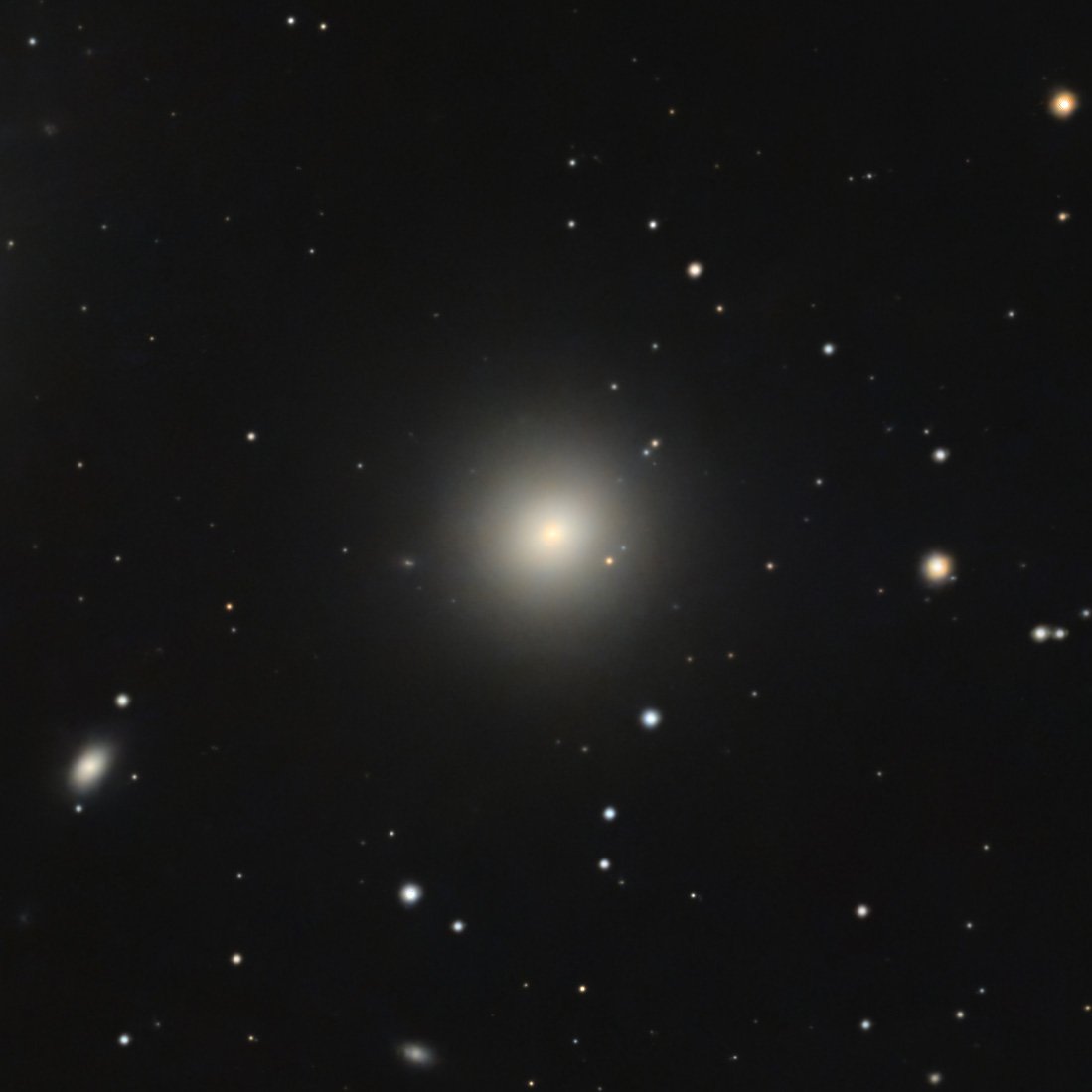
M84, captured using a ZWO SeeStar S50 smart telescope by Cosmic Captures
M84 appears as a small, bright oval glow with a concentrated core in a smart telescope. While it shows little internal structure, it is a satisfying target when captured as part of the dense Virgo Cluster galaxy fields.
M85
Object type: Lenticular galaxy
Constellation: Coma Berenices
Apparent dimensions: 7′ × 5′
Filtering: Not recommended
Recommended integration time: 1–3 hours +
Peak month: March
Altitude at peak: Northern hemisphere: High
Southern hemisphere: Medium
M85 is a bright lenticular galaxy in Coma Berenices, appearing as a smooth oval glow with a bright central region and a gently fading outer halo. Its uniform appearance reflects its intermediate nature between elliptical and spiral galaxies, lacking both obvious spiral structure and strong dust lanes.
As a broadband target, M85 benefits most from dark skies and longer integration time rather than filters. Extended exposures help improve contrast in the faint outer halo and reveal the many distant background galaxies scattered across this region of the Virgo Cluster.
M85, captured using a ZWO SeeStar S50 smart telescope by Cosmic Captures
M85 appears as a bright, smooth oval glow with a concentrated core in a smart telescope. While it shows little internal structure, it is an easy galaxy to capture and stands out clearly in the field.
M86
Object type: Elliptical galaxy
Constellation: Virgo
Apparent dimensions: 9′ × 6′
Filtering: Not recommended
Recommended integration time: 1–3 hours +
Peak month: March
Altitude at peak: Northern hemisphere: High
Southern hemisphere: Medium
M86 is a large elliptical galaxy in the Virgo Cluster, appearing as a broad oval glow with a bright central region and an extended outer halo. It lies in one of the richest galaxy fields of the spring sky, surrounded by numerous smaller Virgo Cluster galaxies that often appear in the same field of view.
As a broadband target, M86 benefits most from dark skies and longer integration time rather than filters. Extended exposures help reveal the galaxy’s full extent and improve contrast in the faint outer halo while bringing out distant background galaxies across the field.
M86 (centre) is shown together with the nearby galaxy M84 and the surrounding Virgo Cluster galaxies. Captured with a Sky-Watcher Esprit 100 at f/4.12 and an ASI2600MM Pro camera using LRGB filters.
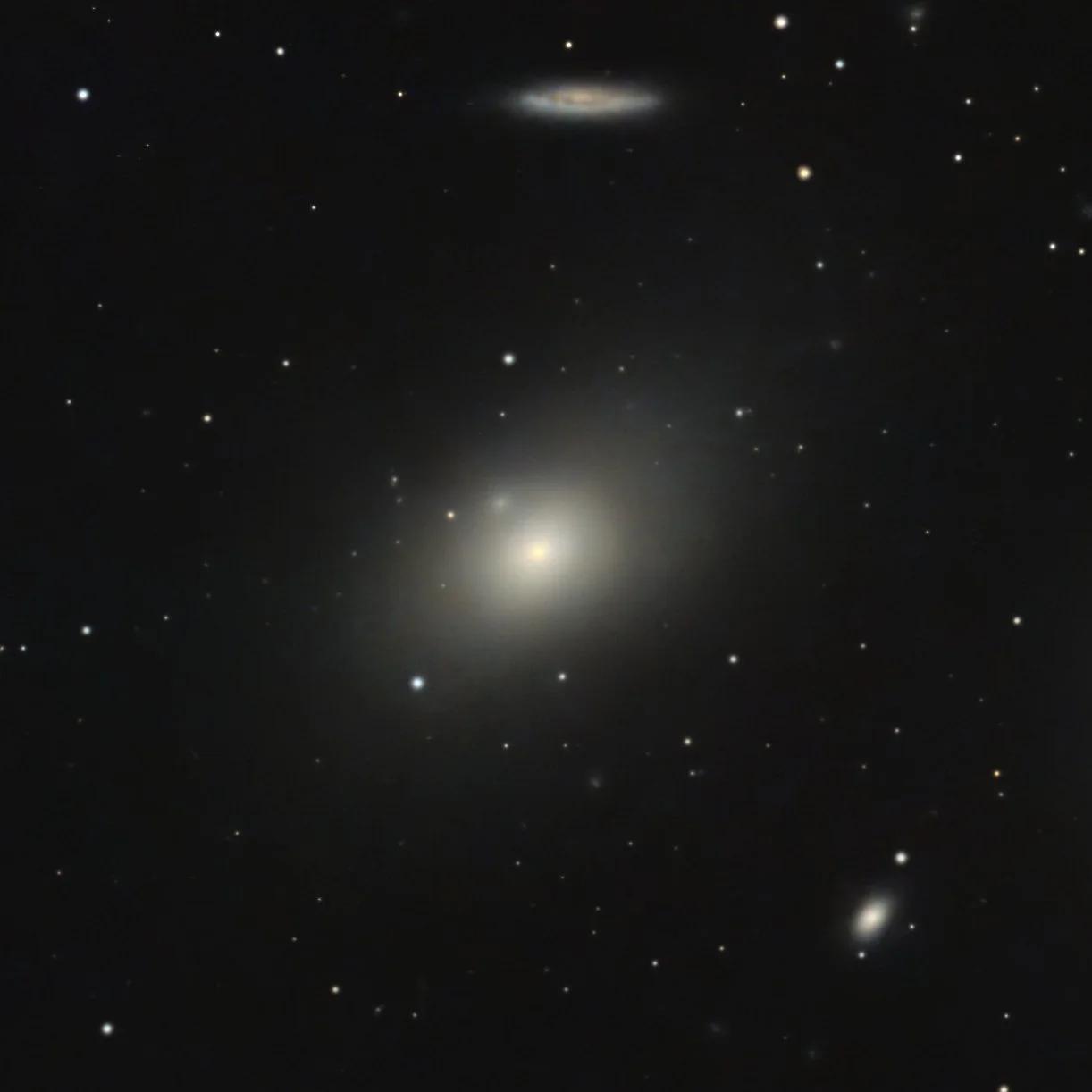
M84, captured using a ZWO SeeStar S50 smart telescope by Cosmic Captures
M86 appears as a large, smooth oval glow with a bright center in a smart telescope. While it shows little internal structure, its size and brightness make it easy to capture, especially in the dense galaxy fields of the Virgo Cluster.
M87 – Virgo A
Object type: Elliptical galaxy
Constellation: Virgo
Apparent dimensions: 7′ × 7′
Filtering: Not recommended
Recommended integration time: 1–3 hours +
Peak month: March
Altitude at peak: Northern hemisphere: High
Southern hemisphere: Medium
M87 is a massive elliptical galaxy at the center of the Virgo Cluster, appearing as a bright, nearly round glow with a strong central concentration. At its core lies a supermassive black hole — the first ever to be directly imaged — which powers a jet of energetic particles extending far beyond the galaxy.
As a broadband target, M87 benefits most from dark skies and longer integration time rather than filters. Extended exposures improve contrast in the outer halo and reveal the many faint background galaxies scattered across this rich cluster environment.
M87 - Virgo A, captured with a Sky-Watcher Esprit 100 at f/4.12 and an ASI2600MM Pro camera using LRGB filters
M87, captured using a ZWO SeeStar S50 smart telescope by Cosmic Captures
M87 appears as a bright, round glow with a concentrated core in a smart telescope. While it shows little visible structure, its brightness makes it an easy galaxy to capture and a recognizable member of the Virgo Cluster.
M88
Object type: Spiral galaxy
Constellation: Coma Berenices
Apparent dimensions: 7′ × 4′
Filtering: Not recommended
Recommended integration time: 1–3 hours +
Peak month: March
Altitude at peak: Northern hemisphere: High
Southern hemisphere: Medium
M88 is a bright spiral galaxy in the Virgo Cluster, showing an elongated disk with a bright central region and subtle spiral structure. Seen at a slight angle, the galaxy appears as a smooth oval glow that gradually reveals more texture with longer integration time.
As a broadband target, M88 responds well to longer integration under dark skies. Additional exposure time helps define the elongated spiral disk and brings out subtle brightness variations across the galaxy.
M88, processed by Cosmic Captures from Telescope.Live image data
M88, captured using a ZWO SeeStar S50 smart telescope by Cosmic Captures
M88 shows a bright elongated core surrounded by a softly structured disk in a smart telescope. With longer integration, hints of spiral structure begin to emerge, making it a rewarding galaxy to capture within the Virgo Cluster.
M89
Object type: Elliptical galaxy
Constellation: Virgo
Apparent dimensions: 5′ × 5′
Filtering: Not recommended
Recommended integration time: 1–3 hours +
Peak month: March
Altitude at peak: Northern hemisphere: High
Southern hemisphere: Medium
M89 is a small elliptical galaxy in the Virgo Cluster, appearing as a nearly round glow with a softly concentrated centre. Its smooth and uniform light distribution is typical for elliptical galaxies, with little visible structure even in longer integrations.
As a broadband target, M89 responds mainly to longer integration under dark skies. Additional exposure time improves contrast and gradually extends the faint outer halo.
M89, captured using a ZWO SeeStar S50 smart telescope by Cosmic Captures
M89 appears as a small, round glow with a softly brightened center in a smart telescope. It remains a fairly subtle target, but can be worth capturing as part of a journey through the Messier catalogue or while exploring the dense galaxy fields of Virgo.
M90
Object type: Spiral galaxy
Constellation: Virgo
Apparent dimensions: 9′ × 4′
Filtering: Not recommended
Recommended integration time: 1–3 hours +
Peak month: March
Altitude at peak: Northern hemisphere: High
Southern hemisphere: Medium
M90 is a spiral galaxy in the Virgo Cluster, appearing as an elongated oval glow with a bright central region and a softly fading outer disk. Seen at a moderate angle, the galaxy shows a smooth light distribution with only subtle hints of internal structure.
As a broadband target, M90 responds best to longer integration under dark skies. Additional exposure time helps define the galaxy’s elongated shape and gradually extends the faint outer regions.
M90, captured using a ZWO SeeStar S50 smart telescope by Cosmic Captures
M90 appears as a small, elongated glow with a brighter central region in a smart telescope. It shows only limited structure and remains a fairly subtle target, but can still be a worthwhile addition when working through the Messier catalogue.
M91
Object type: Barred spiral galaxy
Constellation: Coma Berenices
Apparent dimensions: 5′ × 4′
Filtering: Not recommended
Recommended integration time: 1–3 hours +
Peak month: March
Altitude at peak: Northern hemisphere: High
Southern hemisphere: Medium
M91 is a compact barred spiral galaxy in Coma Berenices and one of the more distant members of the Messier catalogue. It appears as a small oval glow with a bright central region and a faint surrounding disk, with only subtle structure visible even in longer integrations.
As a broadband target, M91 benefits from longer integration under dark skies. Additional exposure time helps improve contrast and gradually reveals the faint outer disk.
M91, processed by Cosmic Captures from Telescope.Live image data
M91, captured using a ZWO SeeStar S50 smart telescope by Cosmic Captures
M91 appears as a small, faint oval glow with a softly brightened center in a smart telescope. It remains a fairly subtle target, but can be worth capturing as part of a journey through the Messier catalogue.
M96
Object type: Spiral galaxy
Constellation: Leo
Apparent dimensions: 8′ × 5′
Filtering: Not recommended
Recommended integration time: 1–3 hours +
Peak month: March
Altitude at peak: Northern hemisphere: High
Southern hemisphere: Medium
M96 is a spiral galaxy in Leo, appearing as a softly glowing oval disk with a bright central region and gently fading outer structure. Seen at a moderate angle, the galaxy shows a smooth light distribution with only subtle hints of spiral structure.
As a broadband target, M96 responds well to longer integration under dark skies. Additional exposure time helps define the galaxy’s shape and improves contrast across the faint outer disk.
M96, captured using a ZWO SeeStar S50 smart telescope by Cosmic Captures
M96 appears as a small-sized oval glow with a bright core in a smart telescope. It shows only a limited structure, but it stands out clearly in the field and improves gradually with longer integration.
M97 – Owl Nebula
Object type: Planetary nebula
Constellation: Ursa Major
Apparent dimensions: 3.4′
Filtering: Dual narrowband recommended
Recommended integration time: 1–3 hours +
Peak month: March
Altitude at peak: Northern hemisphere: High
Southern hemisphere: Very low
M97 is a planetary nebula in Ursa Major appearing as a small, round disk of softly glowing gas. Its name comes from the pair of darker regions that form the suggestion of an owl’s eyes in detailed images, though these features require higher resolution and longer integration to become clearly visible.
As an emission object, M97 benefits from dual narrowband filters, which improve contrast and help define the nebula’s round shape against the background sky. Longer integration gradually strengthens the outer halo and improves overall definition.
M97, processed by Cosmic Captures from Telescope.Live image data
M97, captured using a ZWO SeeStar S50 smart telescope by Cosmic Captures
M97 appears surprisingly quickly in a smart telescope as a small, round disk that stands out clearly from the surrounding stars. While it remains compact and shows limited detail, it is an easy and satisfying planetary nebula to capture.
M98
Object type: Spiral galaxy
Constellation: Coma Berenices
Apparent dimensions: 10′ × 3′
Filtering: Not recommended
Recommended integration time: 1–3 hours +
Peak month: March
Altitude at peak: Northern hemisphere: High
Southern hemisphere: Medium
M98 is an edge-on spiral galaxy in Coma Berenices, appearing as a long, narrow streak of light with a slightly brighter central region. Its thin profile and tapered ends give it a distinctive elongated shape, though internal structure remains fairly subtle.
As a broadband target, M98 responds well to longer integration under dark skies. Additional exposure time helps improve contrast across the disk and gradually extends the faint outer regions.
M98, processed by Cosmic Captures from Telescope.Live image data
M98, captured using a ZWO SeeStar S50 smart telescope by Cosmic Captures
M98 appears as a thin, elongated glow with a brighter center in a smart telescope. While it remains a fairly subtle galaxy, its distinctive edge-on shape makes it recognizable and a worthwhile addition when exploring the Messier galaxies of the Virgo Cluster.
M99 – St. Catherine's Wheel
Object type: Spiral galaxy
Constellation: Coma Berenices
Apparent dimensions: 5′ × 5′
Filtering: Not recommended
Recommended integration time: 1–3 hours +
Peak month: March
Altitude at peak: Northern hemisphere: High
Southern hemisphere: Medium
M99 is a face-on spiral galaxy in the Virgo Cluster with a bright central region and a well-defined spiral pattern. Its asymmetric arms give the galaxy a slightly uneven appearance, making it one of the more distinctive spiral galaxies in this region of the sky.
As a broadband target, M99 responds well to longer integration under dark skies. Additional exposure time improves contrast across the spiral disk and reveals more subtle structure in the outer regions.
M99, captured using a ZWO SeeStar S50 smart telescope by Cosmic Captures
M99 reveals a bright core and visible spiral structure in a smart telescope. Despite its compact size, the asymmetric arms make it a satisfying spiral galaxy to capture, with longer integration improving the detail across the disk.
M100 – Mirror Galaxy
Object type: Spiral galaxy
Constellation: Coma Berenices
Apparent dimensions: 7′ × 6′
Filtering: Not recommended
Recommended integration time: 1–3 hours +
Peak month: March
Altitude at peak: Northern hemisphere: High
Southern hemisphere: Medium
M100 is a face-on spiral galaxy in Coma Berenices with a bright central region surrounded by a softly structured spiral disk. Its nearly circular appearance and gentle spiral pattern make it a classic example of a spiral galaxy in the Virgo Cluster.
As a broadband target, M100 responds well to longer integration under dark skies. Additional exposure time improves contrast across the spiral disk and gradually reveals more subtle structure.
M100 - Mirror Galaxy, processed by Cosmic Captures from Telescope.Live image data
M100 - Mirror Galaxy, captured using a ZWO SeeStar S50 smart telescope by Cosmic Captures
M100 shows a bright central region surrounded by visible spiral structure in a smart telescope. Its moderate size and clear spiral pattern make it a satisfying galaxy to capture, with longer integration improving the definition of the arms.
M104 – Sombrero Galaxy
Object type: Spiral galaxy
Constellation: Virgo
Apparent dimensions: 9′ × 4′
Filtering: Not recommended
Recommended integration time: 1–3 hours +
Peak month: March
Altitude at peak: Northern hemisphere: Low
Southern hemisphere: High
M104 is a bright spiral galaxy in Virgo, seen at a steep angle with a large central bulge surrounded by a thin disk. A prominent dark dust lane cuts across the bright core, giving the galaxy its characteristic “Sombrero” appearance and making it one of the most recognisable galaxies in the Messier catalogue.
As a broadband target, M104 responds well to longer integration under dark skies. Additional exposure time improves contrast in the thin disk and helps define the prominent dust lane.
M104 – Sombrero Galaxy, processed by Cosmic Captures from Telescope.Live image data
M104 – Sombrero Galaxy, captured using a ZWO SeeStar S50 smart telescope by Cosmic Captures
M104 shows a bright central bulge with the distinctive dark dust lane becoming visible almost immediately in a smart telescope. The strong contrast between the bright core and the dust lane makes this one of the most recognizable and rewarding Messier galaxies to capture.
M105
Object type: Elliptical galaxy
Constellation: Leo
Apparent dimensions: 5′ × 5′
Filtering: Not recommended
Recommended integration time: 1–3 hours +
Peak month: March
Altitude at peak: Northern hemisphere: High
Southern hemisphere: Medium
M105 is an elliptical galaxy in Leo, appearing as a compact, nearly round glow with a bright central concentration and a smoothly fading outer halo. While the galaxy itself is fairly featureless, it lies in an attractive region of the sky together with the nearby galaxies NGC 3384 and NGC 3389, which often appear in the same field of view.
As a broadband target, M105 responds mainly to longer integration under dark skies. Additional exposure time improves contrast and gradually extends the faint outer halo.
M105 (to the right) is shown together with the nearby galaxies NGC 3384 and NGC 3389, processed by Cosmic Captures from Telescope.Live image data
M105 (to the right) with galaxies NGC 3384 and NGC 3389, captured using a ZWO SeeStar S50 smart telescope by Cosmic Captures
M105 appears as a small, round glow with a bright center in a smart telescope. The galaxy itself shows little structure, but the nearby galaxies NGC 3384 and NGC 3389 make this an interesting field to explore.
M106
Object type: Spiral Galaxy
Constellation: Canes Venatici
Apparent dimensions: 19′ × 7′
Filtering: Not recommended
Recommended integration time: 1–3 hours +
Peak month: March
Altitude at peak: Northern hemisphere: High
Southern hemisphere: Very low
M106 is a large spiral galaxy in Canes Venatici with a bright central region and an extended disk showing complex structure. Its considerable size and prominent spiral pattern make it one of the most impressive galaxies reaching peak altitude in March.
As a broadband target, M106 responds well to longer integration under dark skies. Additional exposure time reveals increasingly rich structure across the extended disk and improves contrast in the outer regions.
M106, processed by Cosmic Captures from Telescope.Live image data
M106, captured using a ZWO SeeStar S50 smart telescope by Cosmic Captures
M106 appears as a large galaxy with a bright core and clearly visible structure in a smart telescope. Its size and detail make it one of the most rewarding galaxy targets of the March sky, with longer integration bringing out increasingly rich spiral features.
M108
Object type: Spiral Galaxy
Constellation: Ursa Major
Apparent dimensions: 9′ × 2′
Filtering: Not recommended
Recommended integration time: 1–3 hours +
Peak month: March
Altitude at peak: Northern hemisphere: High
Southern hemisphere: Very low
M108 is an edge-on spiral galaxy in Ursa Major, appearing as a long, narrow streak of light with a slightly brighter central region. Its thin profile and irregular brightness give the galaxy a somewhat mottled appearance, making it more textured than many similarly sized galaxies.
As a broadband target, M108 responds well to longer integration under dark skies. Additional exposure time improves contrast along the disk and gradually reveals more subtle structure.
M108, processed by Cosmic Captures from Telescope.Live image data
M108, captured using a ZWO SeeStar S50 smart telescope by Cosmic Captures
M108 appears as a thin, elongated galaxy with a slightly uneven brightness in a smart telescope. Its distinctive edge-on shape makes it easy to recognize, and longer integration helps bring out the irregular structure along the disk.
M109 – Vacuum Cleaner Galaxy
Object type: Barred Spiral Galaxy
Constellation: Ursa Major
Apparent dimensions: 8′ × 5′
Filtering: Not recommended
Recommended integration time: 1–3 hours +
Peak month: March
Altitude at peak: Northern hemisphere: High
Southern hemisphere: Very low
M109 is a barred spiral galaxy in Ursa Major, appearing as a softly glowing oval disk with a bright central region. The galaxy’s bar and spiral structure are fairly subtle, giving it a smooth overall appearance compared to more strongly structured spiral galaxies.
As a broadband target, M109 responds well to longer integration under dark skies. Additional exposure time improves contrast across the disk and gradually reveals more subtle structure.
M109, processed by Cosmic Captures from Telescope.Live image data
M109, captured using a ZWO SeeStar S50 smart telescope by Cosmic Captures
M109 shows a bright central region with visible spiral structure in a smart telescope. The galaxy stands out clearly in the field, and longer integration reveals increasing detail in the spiral arms.
NGC 3521 – Bubble Galaxy
Object type: Spiral galaxy
Constellation: Leo
Apparent dimensions: 10′ × 4.8′
Filtering: Not recommended
Recommended integration time: 1–3 hours +
Peak month: March
Altitude at peak: Northern hemisphere: Medium
Southern hemisphere: High
NGC 3521 is a bright spiral galaxy in Leo with a broad, irregular disk and a luminous central region. Its uneven spiral structure and patchy dust features give it a textured appearance that becomes increasingly apparent with longer integration. The galaxy’s slightly tilted orientation helps reveal both the bright inner regions and the softer outer disk.
As a broadband target, NGC 3521 responds well to longer integration under dark skies. Additional exposure time improves contrast across the disk and gradually reveals more of the galaxy’s uneven structure.
NGC 3521, processed by Cosmic Captures from Telescope.Live image data
NGC 3521, captured using a ZWO SeeStar S50 smart telescope by Cosmic Captures
NGC 3521 appears as a bright elongated galaxy with a strong central region in a smart telescope. Its uneven structure becomes visible with longer integration, making it a rewarding galaxy to capture.
NGC 3576 – Statue of Liberty Nebula
Object type: Emission nebula
Constellation: Carina
Apparent dimensions: 20′ × 20′
Filtering: Dual narrowband recommended
Recommended integration time: 3 hours +
Peak month: March
Altitude at peak: Northern hemisphere: Not visible
Southern hemisphere: Medium
NGC 3576 is a bright emission nebula in Carina, forming a large cloud of glowing hydrogen with intricate structure and dark dust lanes. Its complex shapes and bright regions make it a striking nebula when imaged with sufficient integration time.
NGC 3576 can be captured in broadband, but dual narrowband filters, or SHO filters improve contrast and help reveal more of the nebula’s structure, especially under light-polluted skies.
NGC 3521, processed by Cosmic Captures from Telescope.Live image data
NGC 3576 is not visible from the Northern Hemisphere, but from southern locations it appears as a large emission nebula in a smart telescope. It can be captured in broadband, while dual narrowband filters reveal more structure and improve contrast and help a lot when imaging from a light-polluted location.
The main Moon Phases in March 2026
Planning your imaging sessions? The Moon plays a massive role in what we can capture.
Here’s what’s happening this month:

Full Moon & Total Lunar Eclipse –March 3
The Moon reaches full phase on March 3, known as the Worm Moon.
During this Full Moon, a total lunar eclipse will be visible across Asia, Australia, and North America, when the Moon passes completely into Earth’s shadow.
At maximum eclipse, the Moon will take on a deep red color, often called a Blood Moon, caused by sunlight filtering through Earth’s atmosphere and illuminating the lunar surface.
Check timeanddate.com for exact timings.

Last Quarter
March 11
Deep-sky imaging is best in the first half of the night before the Moon rises in the early morning hours.

New Moon
March 19
The darkest skies of the month arrive with the New Moon, ideal for deep-sky imaging.more details.

First Quarter
March 25
Deep-sky imaging is best after midnight.
Also great for capturing lunar surface details with strong shadows along the terminator.
The Moonlight Astrophotography Planner (MAP)
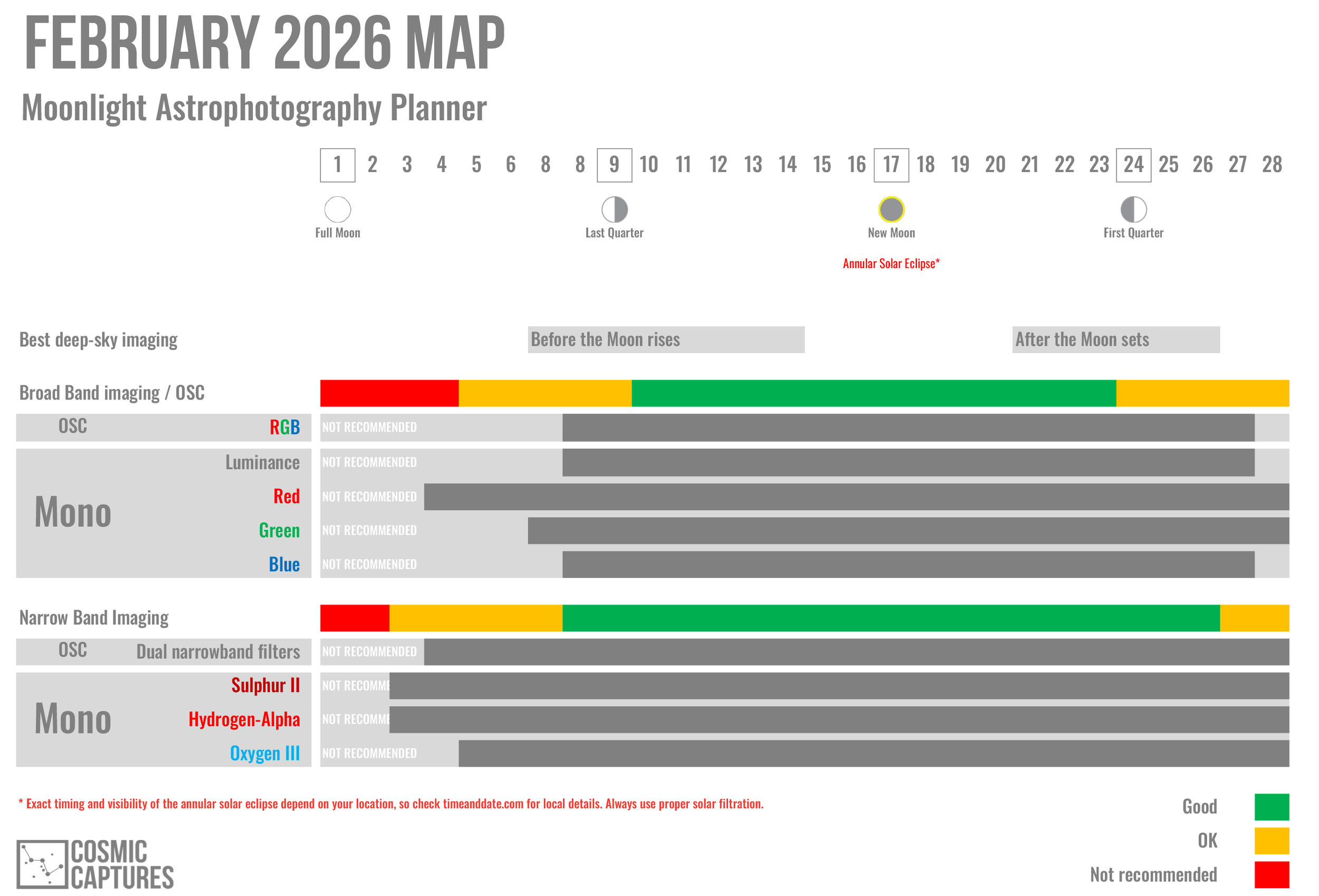
Each month, the MAP — or Moonlight Astrophotography Planner — helps you choose the best nights for capturing galaxies, nebulae, and nightscapes. Whether you’re shooting broadband or narrowband, MAP gives you clear guidance based on the Moon phase, so you can match your imaging plans to the sky conditions.
You can download this month’s MAP as a free PDF using the button below. It’s updated monthly to help you make the most of your imaging time, no matter your style or setup.
Total Lunar Eclipse – March 2-3
A special highlight this month is the total lunar eclipse on March 2–3. During totality the Moon turns deep red as it passes through Earth’s shadow, creating a striking and very photogenic scene.
Lunar eclipses unfold slowly over several hours, making them ideal for both close-up images and wide nightscape compositions. Telephoto lenses reveal surface detail and color variations, while wide-angle images can show the eclipsed Moon within the surrounding constellations.
This is one of the easiest major astronomical events to capture and well worth planning for if skies are clear.
Image by Cosmic Captures
March Equinox — March 20
The March Equinox marks the balance point of the year, when day and night are nearly equal across the world. In the Northern Hemisphere, it signals the official start of spring, while in the Southern Hemisphere, autumn begins.
Around the equinox, the Sun rises almost due east and sets almost due west for observers everywhere on Earth. The lengthening days in the north and the growing nights in the south mark a gradual shift in the rhythm of the seasons.
It’s a quiet astronomical milestone, but an important one — a moment of balance before the year continues its steady drift toward longer days or longer nights.
Nightscape Opportunities
In the Northern Hemisphere, the winter Milky Way is slowly sinking westward, and Orion’s season is coming to an end. Early in the night, the familiar winter constellations still dominate, but in the early morning hours the summer Milky Way begins to rise, bringing the first views of the galactic core.
March offers a rare transition period where it becomes possible to capture both the winter and summer Milky Way within the same month — or even during the same night, with the winter sky visible in the evening and the summer Milky Way before dawn.
In the Southern Hemisphere, the Milky Way core climbs higher each night and becomes increasingly prominent before dawn. The rich star fields of Scorpius and Sagittarius begin to take center stage, heralding the return of the brightest Milky Way season.
March is a month of transition — the last opportunities for winter nightscapes and the first real return of the Milky Way core.
Image by Cosmic Captures